Quick Summary:
A fertilizer pan granulator is a rotating disc machine that turns powder into uniform pellets through centrifugal force and a liquid binder. It delivers a granulation rate of up to 95%, adjustable pellet size, and works for both organic and compound fertilizers.
However, raw material moisture should be 25–30% and particle size under 50 mm; avoid iron and stones to prevent damage. This low-cost, space-saving option is ideal for small to medium-scale production lines.
Are you tired of dealing with powdered fertilizer that’s messy, hard to store, and creates dust pollution? Do you have piles of animal waste and no idea how to turn them into valuable products? Without proper granulation, you’re losing money on wasted materials, risking inconsistent nutrient delivery, and struggling with inefficient production.
A fertilizer pan granulator solves this. It’s a simple, low-cost machine that transforms powder into uniform, round pellets using a tilted rotating disc and a liquid binder.
In this guide, as a professional pan granulator manufacturer, I will explain what a fertilizer pan granulator is, how it works, why it offers a granulation rate up to 95%, and what to check before you buy. You’ll also learn about design features, raw material requirements, and how to control pellet size. If you’re producing organic or NPK fertilizer, this is the practical starting point.
What Is a Fertilizer Pan Granulator?
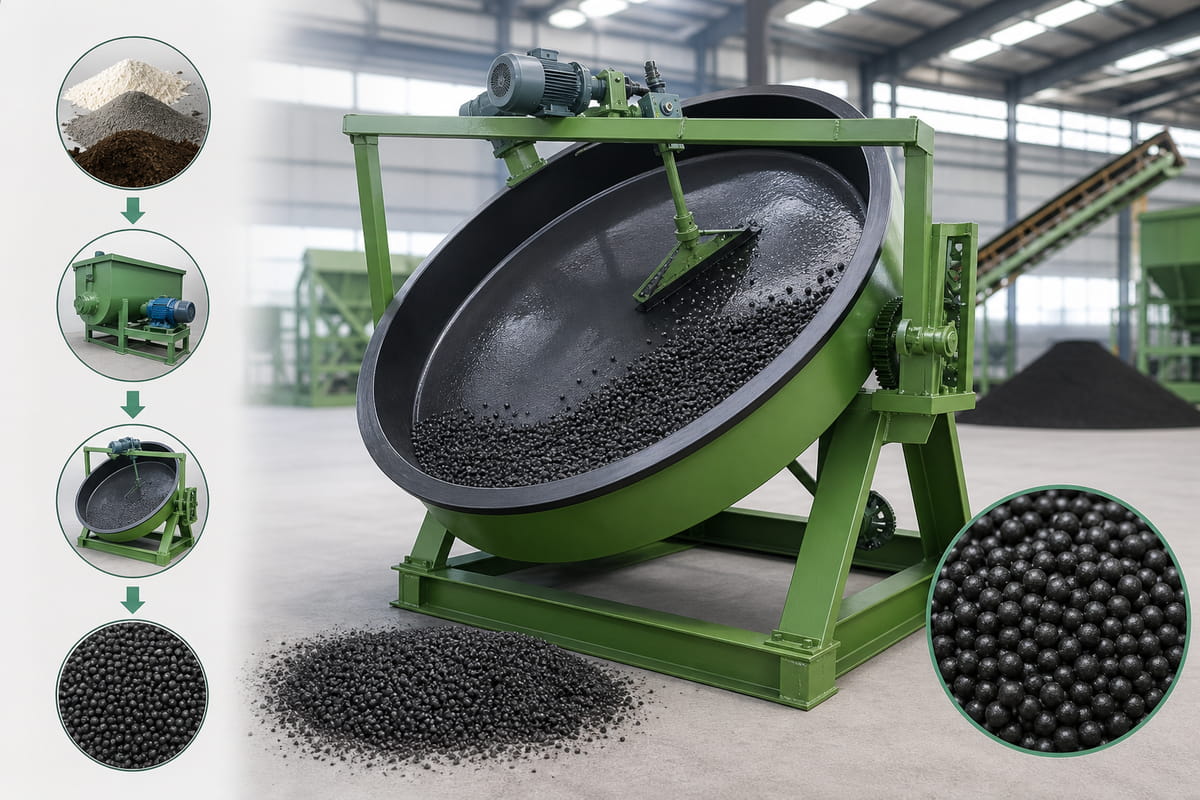
A fertilizer pan granulator (also called a disc granulator or pan pelletizer) uses a tilted, rotating pan to turn fine powder into granules.
Here’s the process in a nutshell:
- Powdered raw material goes into the pan.
- A liquid binder, usually water or steam, is sprayed onto the powder.
- The pan spins, creating centrifugal force.
- Particles tumble, stick together, and grow into round pellets.
- Granules typically come out between 2 and 5 mm in size.
It’s basically like rolling a snowball. Except instead of snow, you’re rolling fertilizer powder. And instead of a hill, you’re using a spinning steel disc.
Pro Tip: If you’re looking for a high granulation rate, the pan granulator usually wins. Quality models hit 93% to 95% granulation rates. That’s a big deal when you’re producing fertilizer at scale.
How Does a Fertilizer Pan Granulator Work?
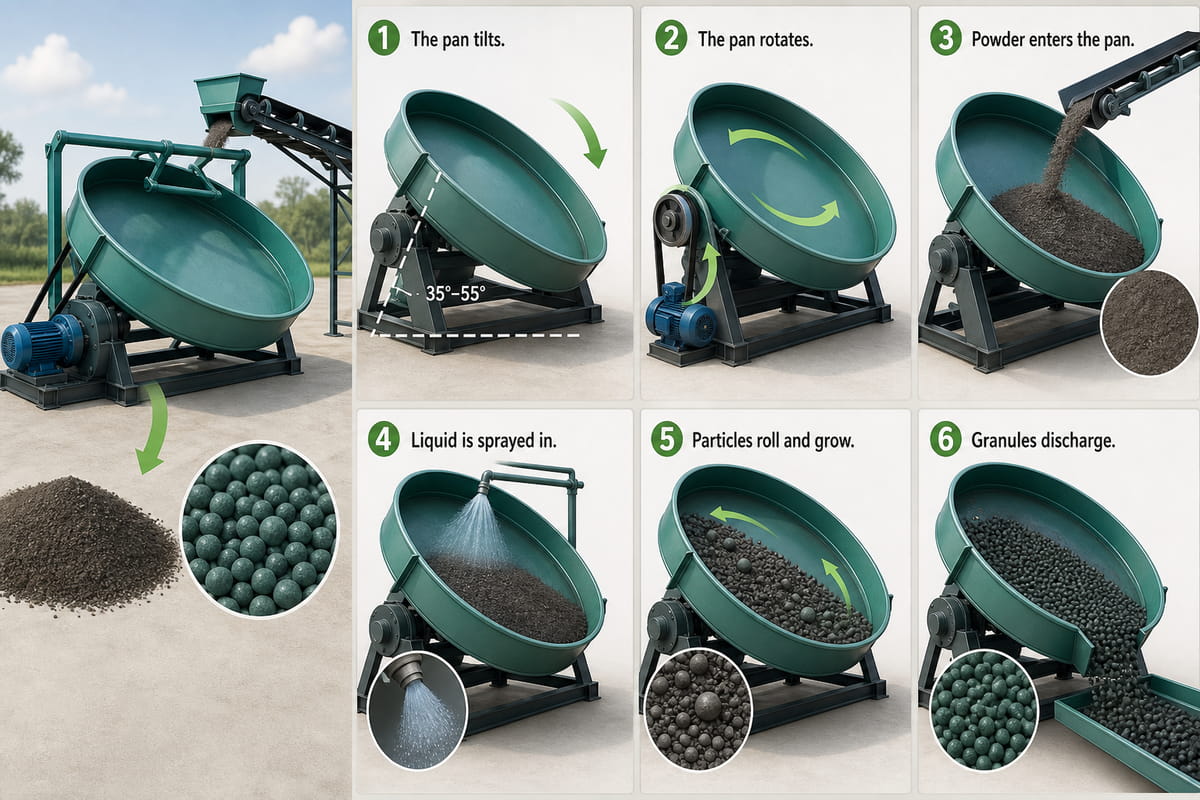
Let’s walk through the working principle step by step:
1. The pan tilts. Most disc granulators sit at an angle between 35 and 55 degrees. The tilt is what helps material move and tumble.
2. The pan rotates. A motor and reducer drive the rotation. Some models use a flexible belt drive, which helps the machine start smoothly.
3. Powder enters the pan. Raw materials are fed through the top inlet, usually with a conveyor. The machine works best with powders smaller than 50 mm.
4. Liquid is sprayed in. Water or another binder is added while the pan spins. This is wet granulation, and it’s a very effective way to form uniform granules.
5. Particles roll and grow. Centrifugal force pushes the material outward. Friction and gravity cause the fine particles to stick together in layers. Over time, they form smooth, round pellets.
6. Granules discharge. When pellets reach the right size, they flow out through discharge outlets. Smaller particles stay in the pan longer and keep growing.
A scraper cleans the pan wall during this process. Without it, material sticks to the disc and ruins the granulation effect.
One operator I spoke with described it like this: “You can literally see the granules grow.” That’s a huge advantage. You’re not operating blind.
Why Use a Pan Granulator? The 6 Benefits
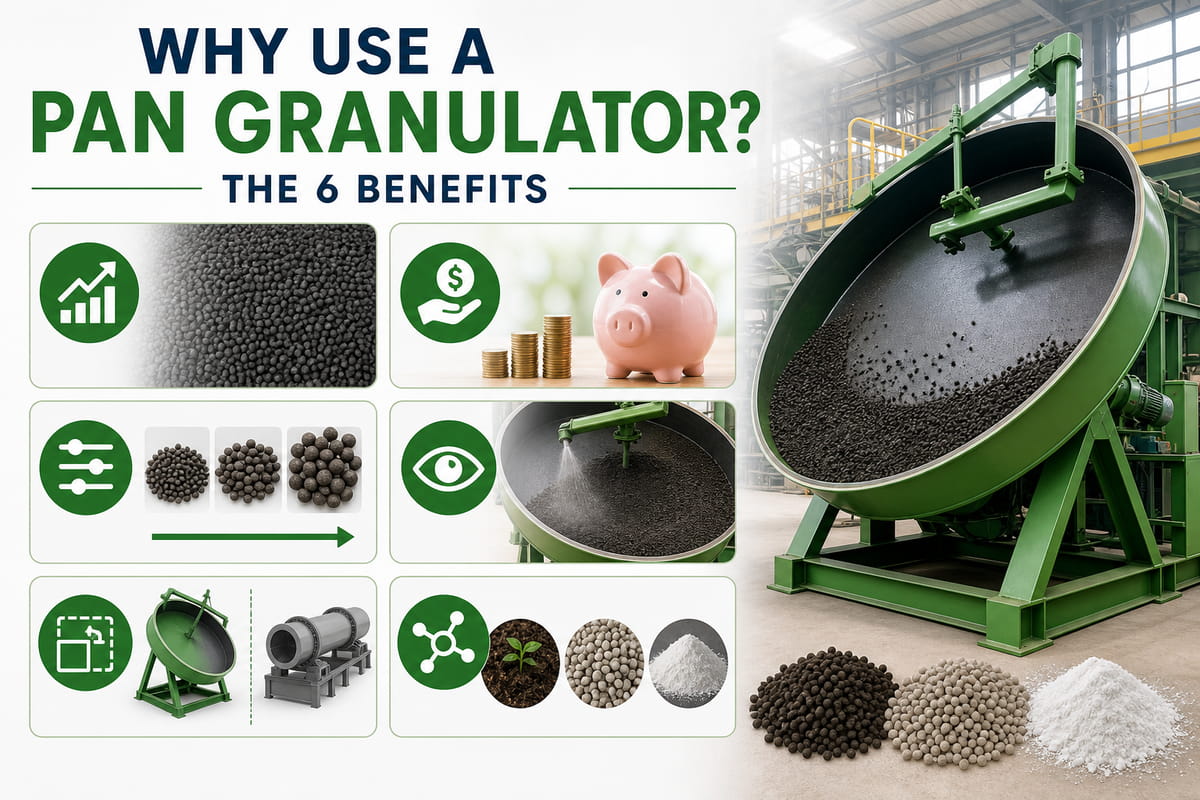
There are plenty of reasons to choose a pan granulator. Let me break them down.
High Granulation Rate
This is the big one. A pan granulator can reach a granulation rate of up to 95%. That’s about as high as it gets in the fertilizer equipment world. In fact, it’s often higher than rotary drum granulators, double roller extrusion granulators, and new organic fertilizer pellet mills.
Lower Cost
Pan granulators are generally less expensive than larger systems. If you’re setting up a new fertilizer production line or upgrading an existing plant, the pan granulator is a budget-friendly option.
Adjustable Pellet Size
You can control final pellet size. Change the pan angle. Adjust the rotation speed. Tweak the moisture content. Each of these affects the size and quality of your granules.
You Can See What’s Happening
With a rotary drum granulator, the process is hidden inside a big metal tube. With a pan granulator, the granulation process is right there in front of you. That makes it easier to make adjustments in real time.
Takes Up Less Space
A disc granulator has a smaller footprint than a rotary drum granulator. If floor space is tight, that’s a serious plus.
Versatile
You can use it for organic fertilizers, compound fertilizers, and even some industrial powders. That’s why it’s a staple in many fertilizer plants.
Pan Granulator vs. Other Granulators: A Quick Comparison
Let’s be honest: there are a few different ways to make fertilizer granules. Here’s how the pan granulator stacks up.
| Feature | Pan Granulator | Rotary Drum Granulator | Double Roller Extrusion |
|---|---|---|---|
| Granulation rate | Up to 95% | Moderate | Moderate |
| Best for | Organic and compound fertilizer | Large-scale compound fertilizer | Dry compound fertilizer |
| Space needed | Small | Large | Small |
| Process visibility | High | Low | Medium |
| Cost | Low to medium | Higher | Medium |
| Moisture requirement | Wet granulation | Wet granulation | Dry granulation |
The bottom line? If you want the highest granulation rate and more control over the process, the pan granulator is a strong choice.
What Can You Make With a Pan Granulator?
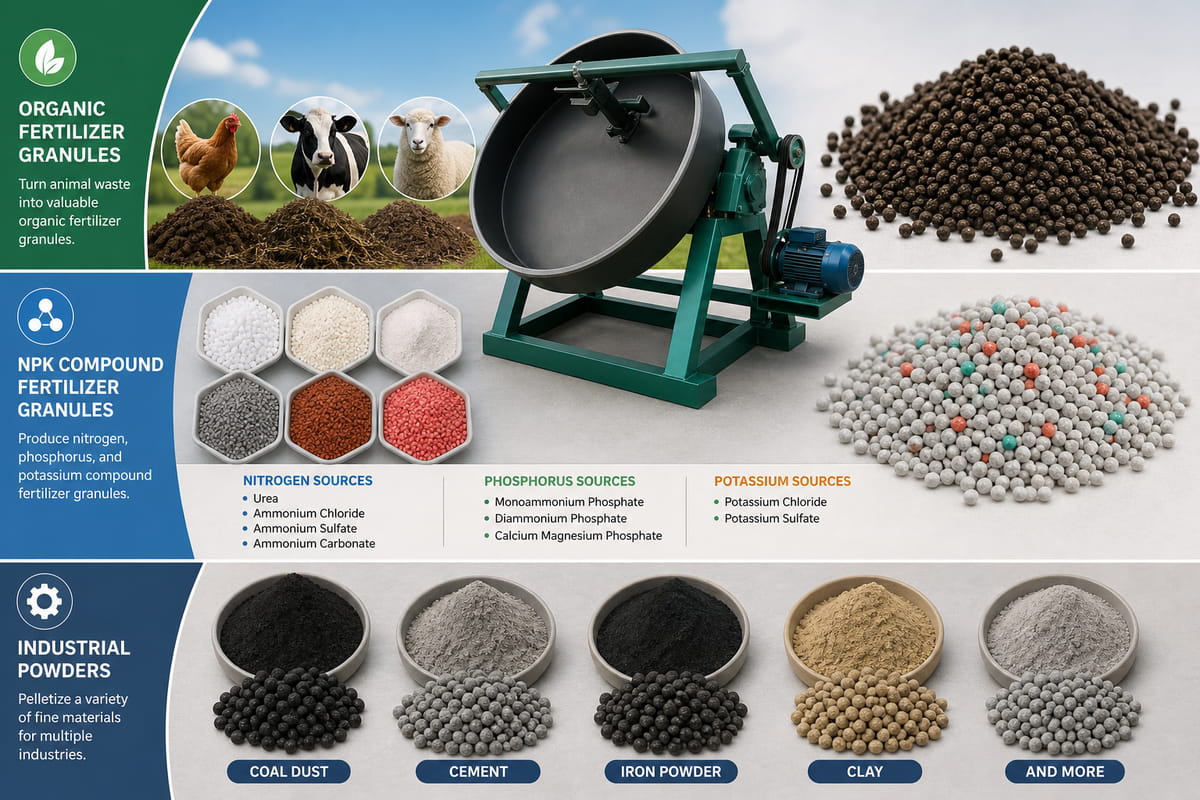
A pan granulator is multi-functional. You can produce a wide range of granular fertilizers with it.
Organic Fertilizer Granules
Got animal waste? No problem. A disc granulator can turn chicken manure, cow dung, sheep manure, and other organic materials into valuable organic fertilizer granules.
This is one of the most popular uses. In fact, many farmers use pan granulators to deal with animal waste while creating a profitable product at the same time.
NPK Compound Fertilizer Granules
You can also produce compound fertilizers. The machine handles nitrogen, phosphorus, and potassium sources well.
Common raw materials include:
- Nitrogen sources: urea, ammonium chloride, ammonium sulfate, ammonium carbonate
- Phosphorus sources: monoammonium phosphate, diammonium phosphate, calcium magnesium phosphate
- Potassium sources: potassium chloride, potassium sulfate
If you’re making NPK fertilizer, a pan granulator is a practical option.
Industrial Powders
The machine isn’t just for fertilizer. It can also pelletize coal dust, cement, iron powder, clay, and other fine materials. That makes it useful across several industries.
What Raw Materials Work Best?
This is important. The pan granulator will perform well if you feed it the right material.
Here are some guidelines I personally recommend:
- Particle size: Keep raw materials under 50 mm. Larger pieces can cause problems.
- Moisture content: Around 25% to 30% is ideal for most applications.
- Avoid contaminants: Iron and stones can damage the disc. Inspect materials before feeding.
In my experience, moisture is the most common issue. If the material is too dry, it won’t form granules. If it’s too wet, the granules end up too large. You need that sweet spot.
Design Highlights That Matter
Not all pan granulators are created equal. Here’s what to look for in a quality machine.
Adjustable Disc Angle
The angle of the disc should be adjustable. Most operators use shims or gaskets to change the tilt. The rule is simple: a steeper angle generally makes smaller granules.
Smart Scraper Design
A good scraper prevents material from sticking to the pan wall. Some machines use both power and powerless scrapers. That design keeps the disc clean and helps granules keep their shape.
Multiple Discharge Outlets
Quality machines often have three discharge ports. This allows for more continuous production and reduces labor intensity. More outlets mean less downtime.
Durable Construction
Look for a machine with a strong body frame. U-steel frames are a good sign. The bottom of the disc should also be reinforced with multiple steel plates, so it doesn’t deform under pressure.
Reliable Motor and Reducer
The motor and reducer are the heart of the machine. Flexible belt drives help with smooth starts. And high-frequency quenching on the gears can double the service life.
In 2026, you should expect durability. The right machine will run for years with proper maintenance.
How to Control Fertilizer Pellet Size of Pan Granulator
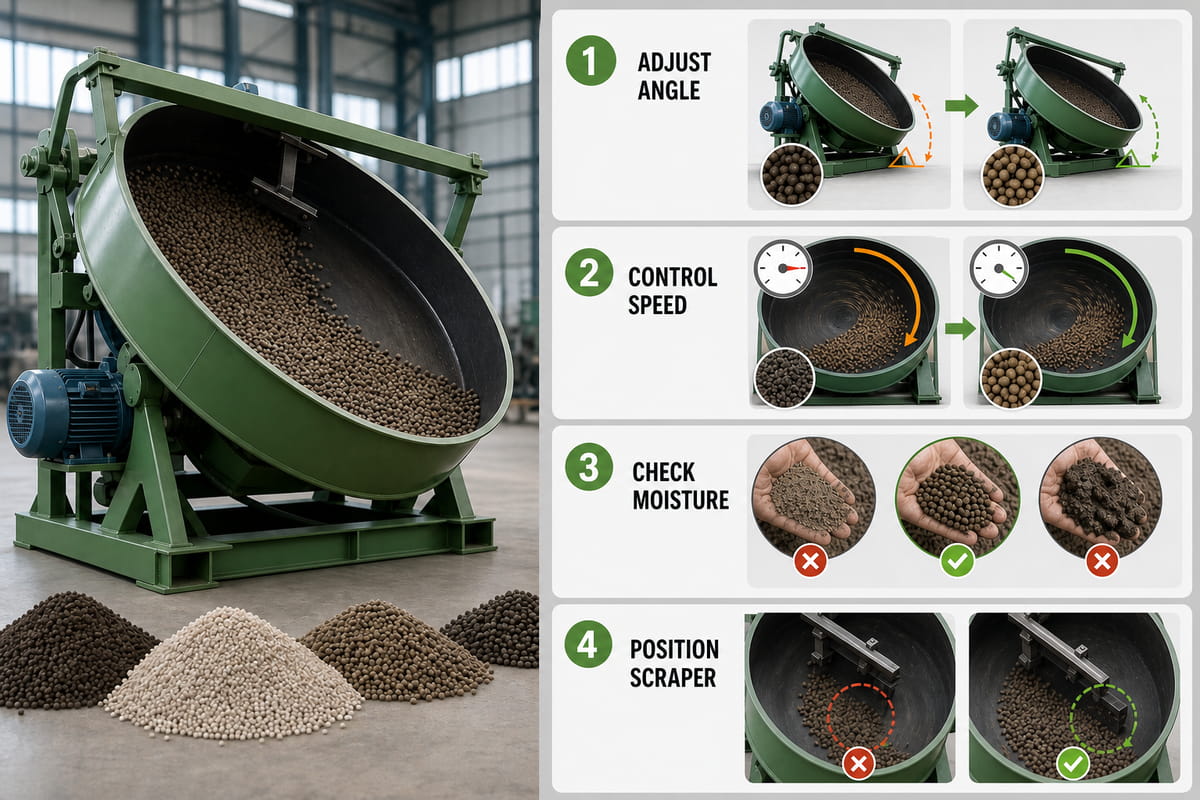
One of the biggest advantages of the pan granulator is control. Here’s how to dial in the exact pellet size you need.
1. Adjust the Disc Angle
A bigger angle creates smaller granules. If your pellets are too large, increase the tilt slightly. If they’re too small, reduce the angle.
2. Control the Rotation Speed
Faster speed affects how long material stays in the pan. Slower speed gives particles more time to grow. You’ll need to test to find the best setting.
3. Check Moisture Content
Dry material won’t granulate well. Overly wet material creates oversized, soft pellets. Monitor moisture closely during production.
4. Position the Scraper Correctly
The scraper position affects material flow. A properly placed scraper helps produce uniform granules and prevents clumping.
Pro Tip: Keep a notebook or digital log of your settings. When you find a combination that works, write it down. That way, you can replicate it.
Common Mistakes to Avoid
I’ve seen people make these mistakes more often than you’d think. Don’t be one of them.
Feeding the Machine the Wrong Material
Iron, stones, and large debris can seriously damage the disc. Always screen your raw materials before they enter the pan.
Ignoring Moisture Levels
Moisture is everything in wet granulation. If you don’t measure it, you’re guessing. And guessing leads to inconsistent pellet quality.
Setting the Angle Once and Forgetting It
The angle isn’t a “set it and forget it” thing. Different materials may need different angles. Be willing to adjust.
Not Cleaning the Pan
The scraper helps, but it’s not a replacement for maintenance. Regular cleaning keeps the machine running smoothly.
Buying the Wrong Size
Match the machine to your production goals. A small lab unit won’t support a large-scale plant. And a huge 3.6-meter disc is overkill for a small farm operation.
How to Choose the Right Pan Granulator: Buying Checklist
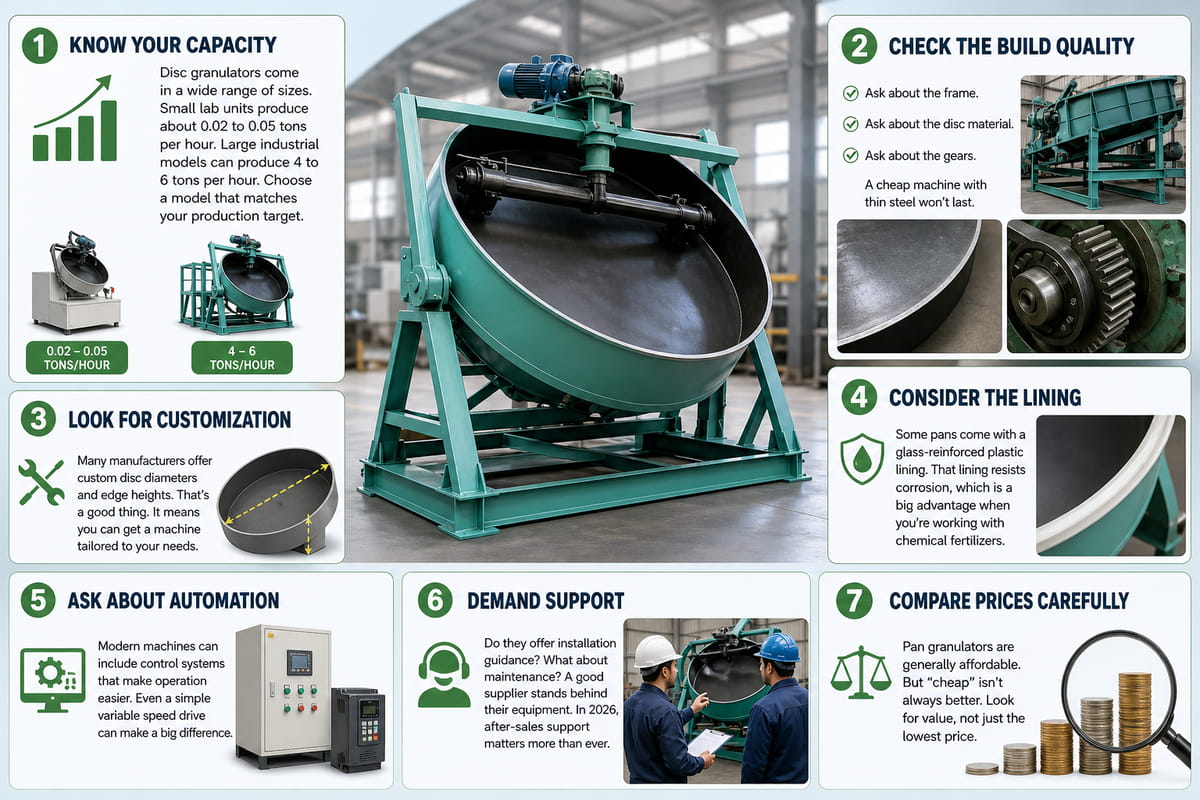
Here’s the deal: not every machine on the market is worth your money. Use this checklist when you’re comparing options.
1. Know Your Capacity
Disc granulators come in a wide range of sizes. Small lab units produce about 0.02 to 0.05 tons per hour. Large industrial models can produce 4 to 6 tons per hour. Choose a model that matches your production target.
2. Check the Build Quality
Ask about the frame. Ask about the disc material. Ask about the gears. A cheap machine with thin steel won’t last.
3. Look for Customization
Many manufacturers offer custom disc diameters and edge heights. That’s a good thing. It means you can get a machine tailored to your needs.
4. Consider the Lining
Some pans come with a glass-reinforced plastic lining. That lining resists corrosion, which is a big advantage when you’re working with chemical fertilizers.
5. Ask About Automation
Modern machines can include control systems that make operation easier. Even a simple variable speed drive can make a big difference.
6. Demand Support
Do they offer installation guidance? What about maintenance? A good supplier stands behind their equipment. In 2026, after-sales support matters more than ever.
7. Compare Prices Carefully
Pan granulators are generally affordable. But “cheap” isn’t always better. Look for value, not just the lowest price.
Is a Pan Granulator Right for You?
Let’s wrap this up with a simple decision framework.
You should seriously consider a pan granulator if:
- You want to produce organic fertilizer granules from animal manure.
- You’re making NPK compound fertilizer and need uniform pellets.
- You want a high granulation rate with lower equipment cost.
- You don’t have a ton of floor space.
- You want to see and control the granulation process.
You might want a different system if:
- You need extremely high capacity, like 10+ tons per hour.
- You prefer dry granulation without moisture.
- You already have a production line designed around a rotary drum granulator.
But for most small and medium fertilizer producers, the pan granulator is the perfect fit.
The Bottom Line
So now you have the full picture.
A fertilizer pan granulator is a simple, powerful, and cost-effective way to turn powder into premium fertilizer granules. It gives you high granulation rates, visible control, and the flexibility to work with organic and compound materials.
If you’re setting up a fertilizer production line in 2026, this machine deserves a serious look. It’s not the flashiest piece of equipment, but it gets the job done.