Quick Summary:
The NPK fertilizer production process has two main routes: compound granulation (each granule contains N, P, K) and bulk blending (separate nutrient granules are mixed). Compound granulation follows nine steps—crushing, batching, mixing, granulation, drying, cooling, screening, coating, and packaging—and is the safer path for consistent quality.
You should watch three key risk points: inconsistent raw material particle size, incorrect moisture after drying (too low causes dust, too high causes caking), and hot or uncoated granules at packaging. If you need commercial-grade NPK fertilizer, choose compound granulation with quality checks at every stage.
If you’re trying to understand the NPK fertilizer production process, you’ve likely found two extremes: chemistry-textbook jargon or vague manufacturer fluff that doesn’t explain what actually happens. That’s frustrating—and worse, it leads to expensive equipment decisions, inconsistent granules, and quality failures you can’t afford.
In this guide, as a professional NPK fertilizer production line manufacturer, I will help you to fixe that, giving you the straight sequence: raw material crushing and batching, mixing, granulation, drying, cooling, screening, coating, and packaging. You’ll also get practical guidance on equipment selection, cost ranges, common production problems, and the quality control checks that prevent costly mistakes.

Two Main Approaches to NPK Fertilizer Production
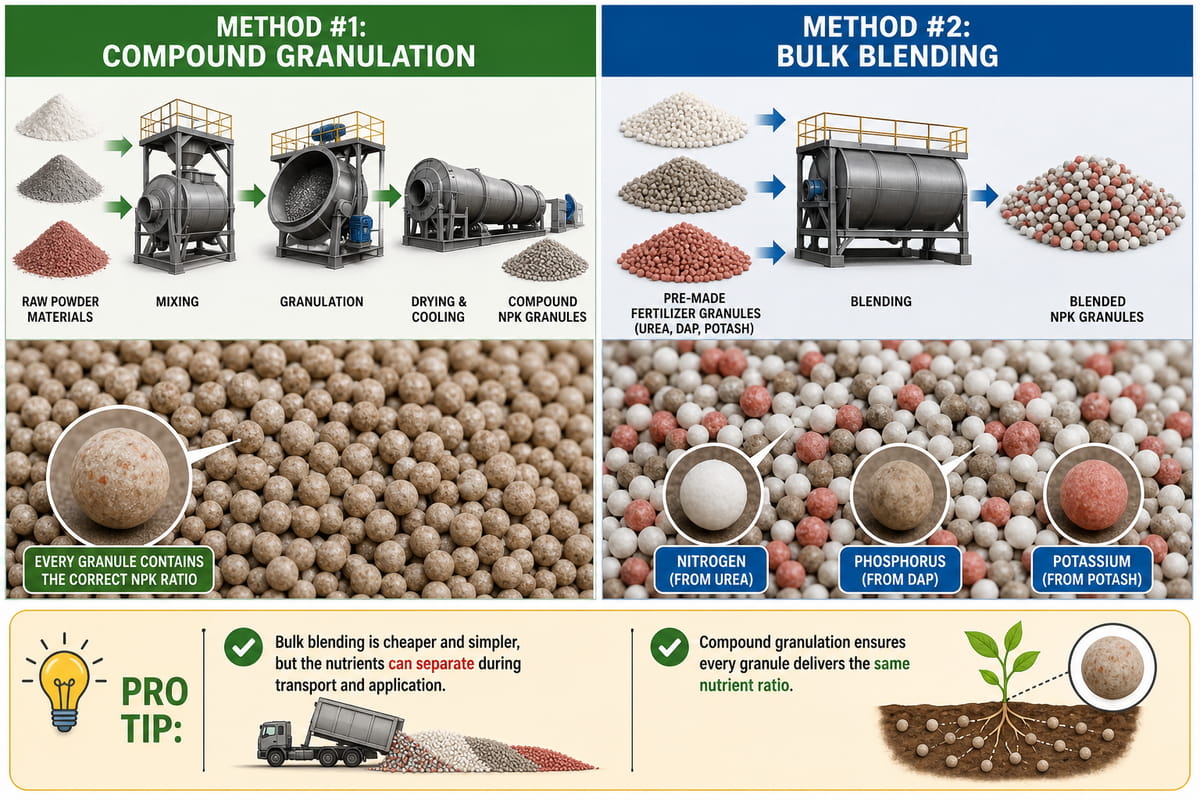
Here’s something most guides won’t tell you clearly: there are two fundamentally different ways to produce NPK fertilizer.
Method #1: Compound Granulation
This is the “real” NPK fertilizer production process where you take raw powder materials, combine them, and create uniform granules where each pellet contains the correct ratio of nutrients. This is what most commercial fertilizer plants use.
Method #2: Bulk Blending
This is the simpler approach where you take already-made granules of different fertilizers (like urea granules, DAP granules, and potash granules) and physically mix them together. Each granule contains only one nutrient, but the blend as a whole provides the NPK ratio.
Pro Tip: Bulk blending is cheaper and simpler, but the nutrients can separate during transport and application. Compound granulation ensures every granule delivers the same nutrient ratio.
Which one should you focus on?
If you’re looking to understand the full NPK fertilizer production process at an industrial scale, compound granulation is what you need to master. That’s what we’ll focus on for the rest of this guide.
Essential Raw Materials for NPK Fertilizer Production

Before you can run the NPK fertilizer production process, you need the right inputs. Let me break down the common sources for each nutrient.
Nitrogen Sources
- Urea: The most popular nitrogen source, containing about 46% nitrogen
- Ammonium nitrate: Another common option with high nitrogen content
- Ammonium sulfate: Provides nitrogen plus sulfur as a bonus nutrient
Phosphorus Sources
- Monoammonium phosphate (MAP): Contains about 11% nitrogen and 52% phosphorus
- Diammonium phosphate (DAP): Contains about 18% nitrogen and 46% phosphorus
- Phosphoric acid: Used in chemical granulation processes
Potassium Sources
- Potassium chloride (MOP): The most common potassium source, containing about 60% potassium
- Potassium sulfate (SOP): Used when chloride-sensitive crops are the target
The key here is that you need to select materials based on your target formulation, compatibility with other ingredients, and local availability.
But here’s the thing: raw material quality directly impacts everything downstream. Cheap materials with inconsistent particle sizes will cause problems during granulation.
The Complete NPK Fertilizer Production Process: Step by Step
Now for the good stuff. Here’s the actual NPK fertilizer production process broken down into clear, actionable steps.
Step 1: Raw Material Preparation and Crushing
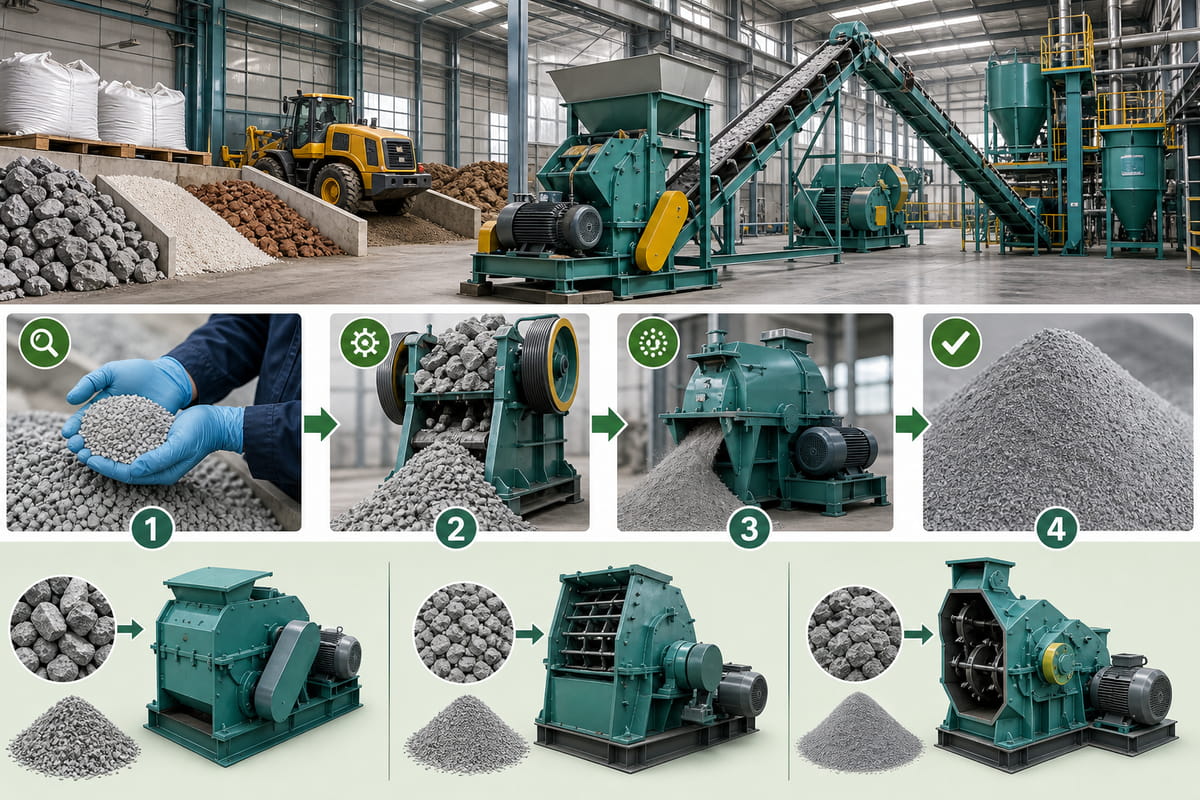
The first step in the NPK fertilizer production process is getting your raw materials into the right physical form.
Why does this matter?
Because granulation works best with fine, uniform powders. If you’re working with lumpy materials or inconsistent particle sizes, your granules will be inconsistent too.
Here’s what you need to do:
- Inspect incoming materials for moisture content and particle size
- Crush oversized materials using a chain crusher or cage crusher
- Achieve the target particle size (typically 50-100 mesh for good granulation)
The equipment you’ll use includes:
- Chain crushers for medium-hard materials
- Cage crushers for finer grinding
- Hammer mills for tougher materials
Pro Tip: Don’t skip the crushing step even if your materials seem “fine enough.” Inconsistent particle size is one of the most common causes of poor granulation results.
Step 2: Batching and Dosing
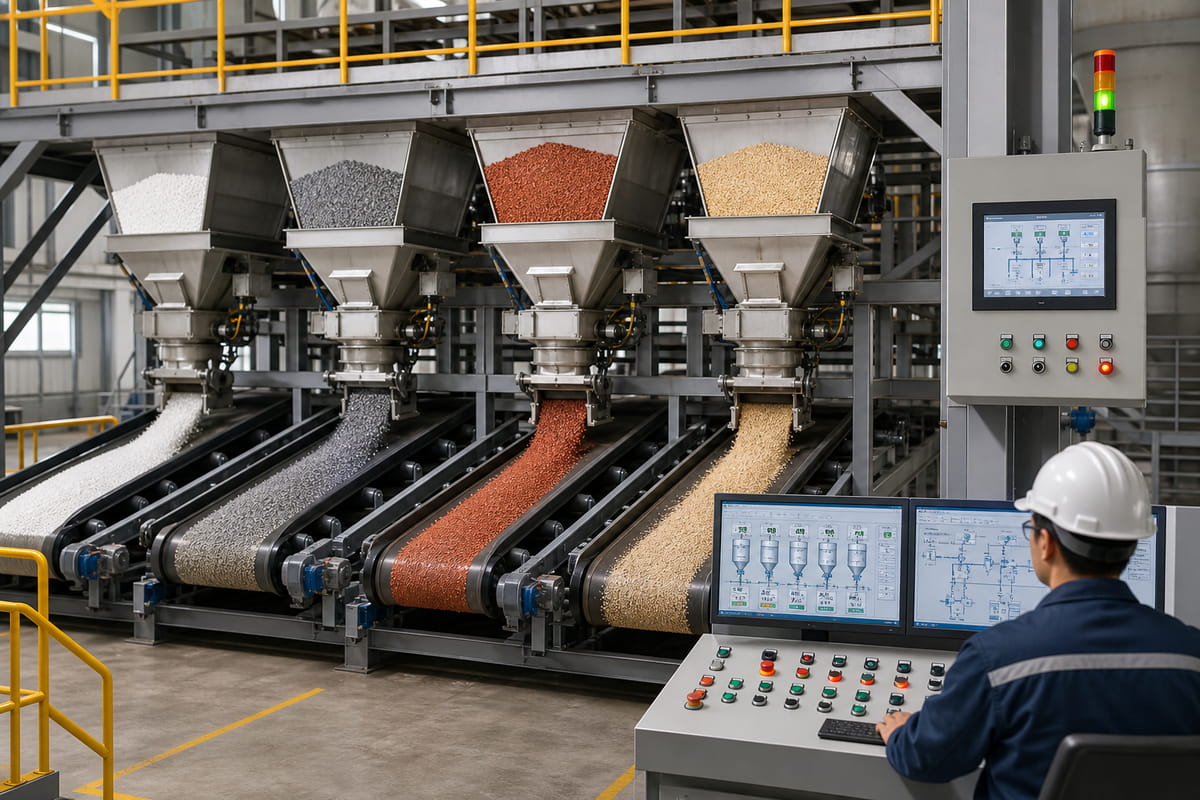
Once your materials are crushed and prepared, you need to combine them in the correct proportions.
This is where precision matters.
If you’re making a 15-15-15 fertilizer, you need exact amounts of your nitrogen, phosphorus, and potassium sources to hit those numbers. A 1% error might not sound like much, but at scale, it means thousands of tons of off-spec product.
Here’s how the batching process works:
- Automatic batching machines weigh each material precisely
- Electronic belt scales feed materials at controlled rates
- PLC control systems manage the entire dosing operation
The goal is to achieve consistent, repeatable batches that match your target formulation exactly.
Step 3: Mixing
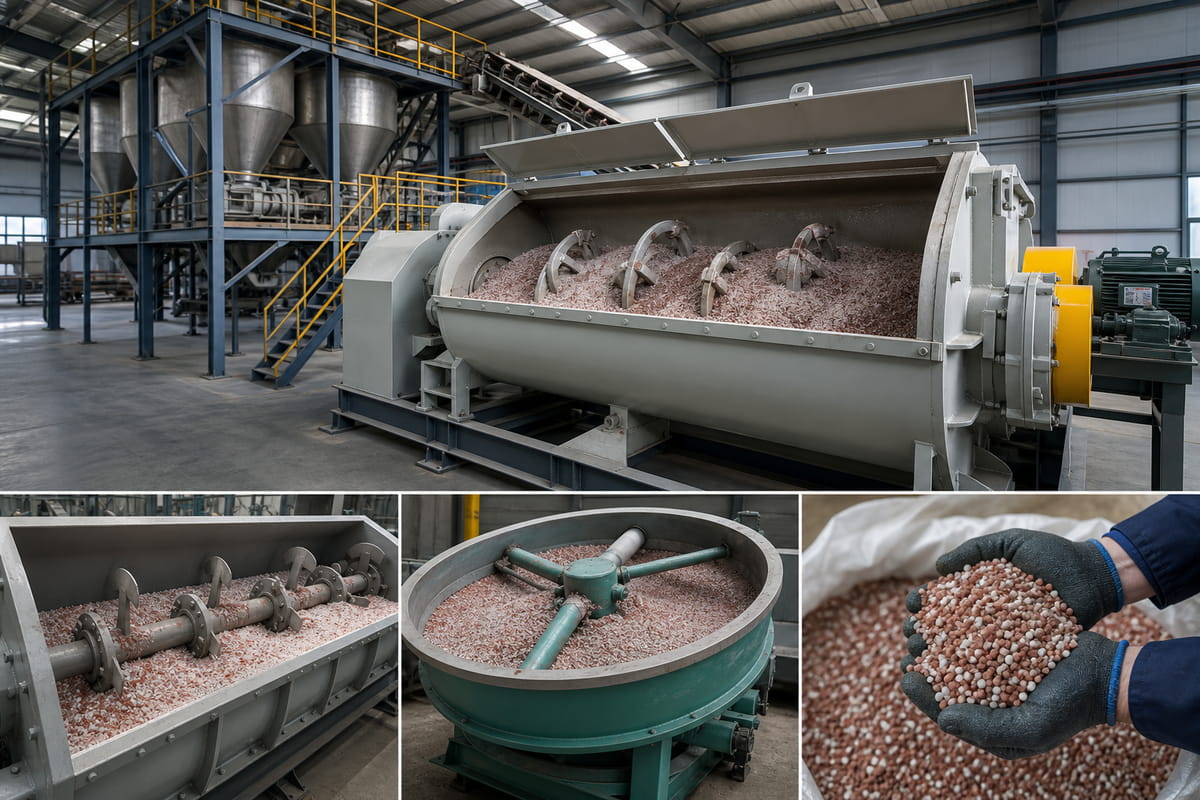
After batching, the materials need to be thoroughly mixed before granulation.
But here’s the thing: mixing isn’t just about randomly combining materials. It’s about achieving uniform distribution so that every granule you produce later will contain the correct nutrient ratio.
The equipment options include:
- Horizontal mixers for continuous mixing operations
- Double shaft mixers for more thorough blending
- Disc mixers for specialized applications
The mixing time depends on your material properties and equipment type. But generally, you want to mix until you can take samples from different areas of the mixer and get identical nutrient analysis results.
Step 4: Granulation
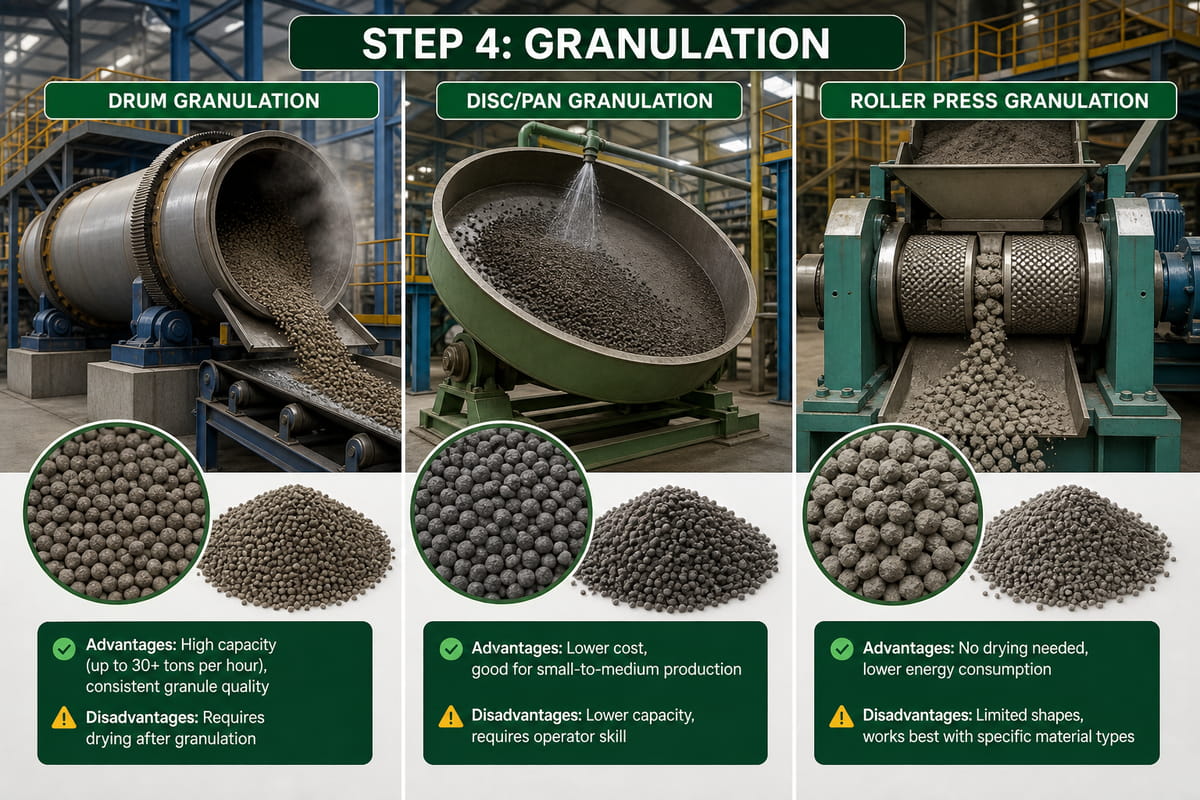
Here’s where the magic happens. Granulation is the core of the NPK fertilizer production process—it’s where powder becomes pellets.
There are three main granulation methods:
Drum Granulation
The most common approach for large-scale production. Materials enter a rotating drum where they tumble and agglomerate into granules. Steam or water is added to help binding.
Advantages: High capacity (up to 30+ tons per hour), consistent granule quality Disadvantages: Requires drying after granulation
Disc/Pan Granulation
A rotating disc uses centrifugal force to form granules. This is more economical for smaller operations.
Advantages: Lower cost, good for small-to-medium production Disadvantages: Lower capacity, requires operator skill
Roller Press Granulation
Dry granulation method where powder is compressed between rollers and then crushed into granules.
Advantages: No drying needed, lower energy consumption Disadvantages: Limited shapes, works best with specific material types
Pro Tip: If you’re just starting out and want to minimize complexity, roller press granulation can eliminate the drying and cooling steps entirely. But for high-volume production, drum granulation is the industry standard.
Step 5: Drying
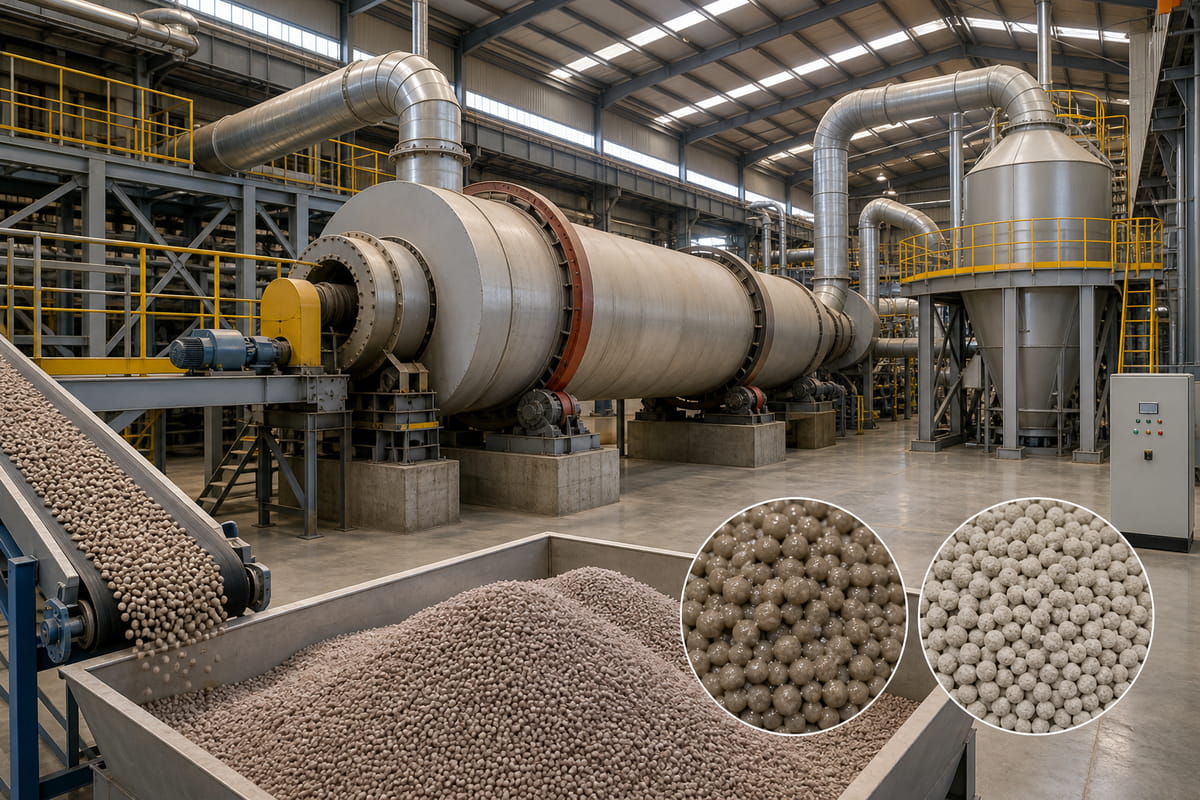
If you used wet granulation methods (drum or disc), your granules will contain excess moisture that needs to be removed.
Why does drying matter?
Because wet granules are:
- Soft and easily damaged
- Prone to caking during storage
- Unstable for packaging and transport
The drying process uses:
- Rotary drum dryers for large-scale operations
- Fluid bed dryers for gentler drying
- Hot air circulation to evaporate moisture
The target moisture content after drying is typically 2-5%. Go lower, and you risk dust problems. Go higher, and you’ll have caking issues.
Step 6: Cooling
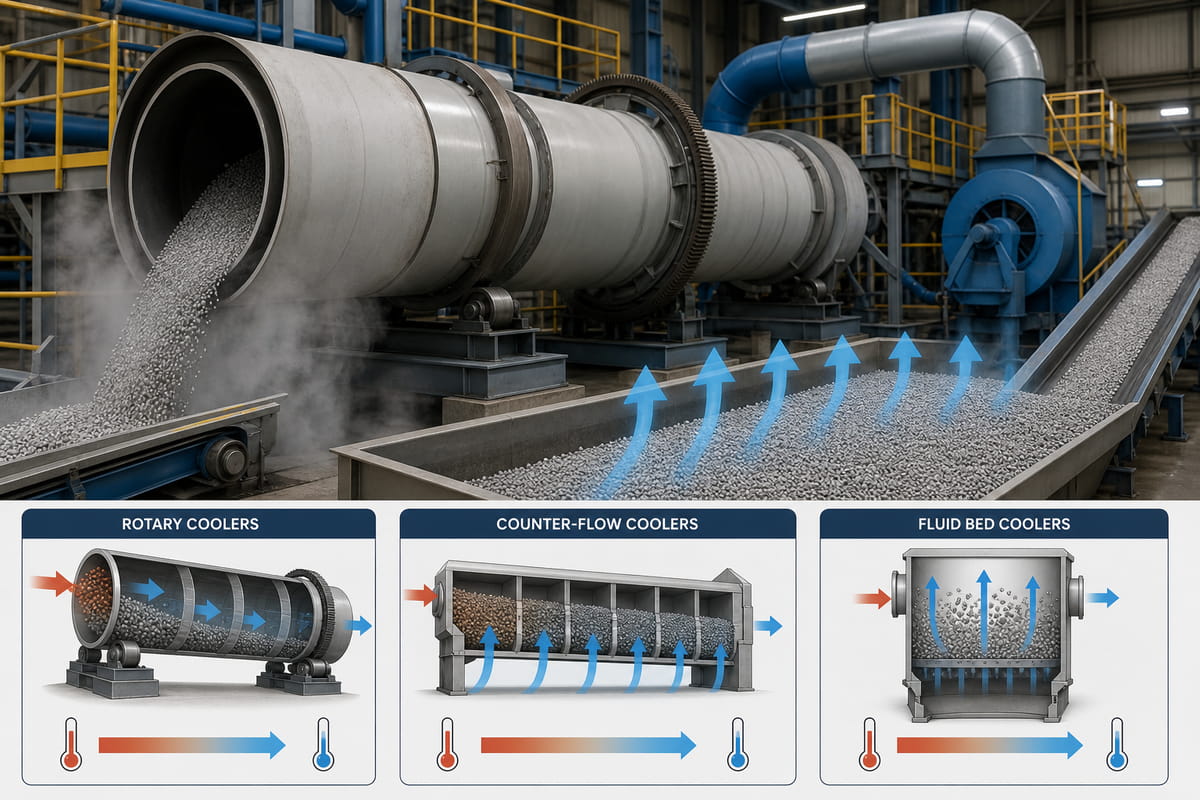
After drying, your granules are hot—sometimes 70-80°C or higher. If you package them at that temperature, several bad things happen:
- Granules stick together
- Anti-caking coatings don’t apply properly
- Packaging materials can be damaged
The cooling process uses:
- Rotary coolers with ambient air circulation
- Counter-flow coolers for better efficiency
- Fluid bed coolers for uniform cooling
The target is to bring granules down to near room temperature (25-35°C) before moving to the next step.
Step 7: Screening
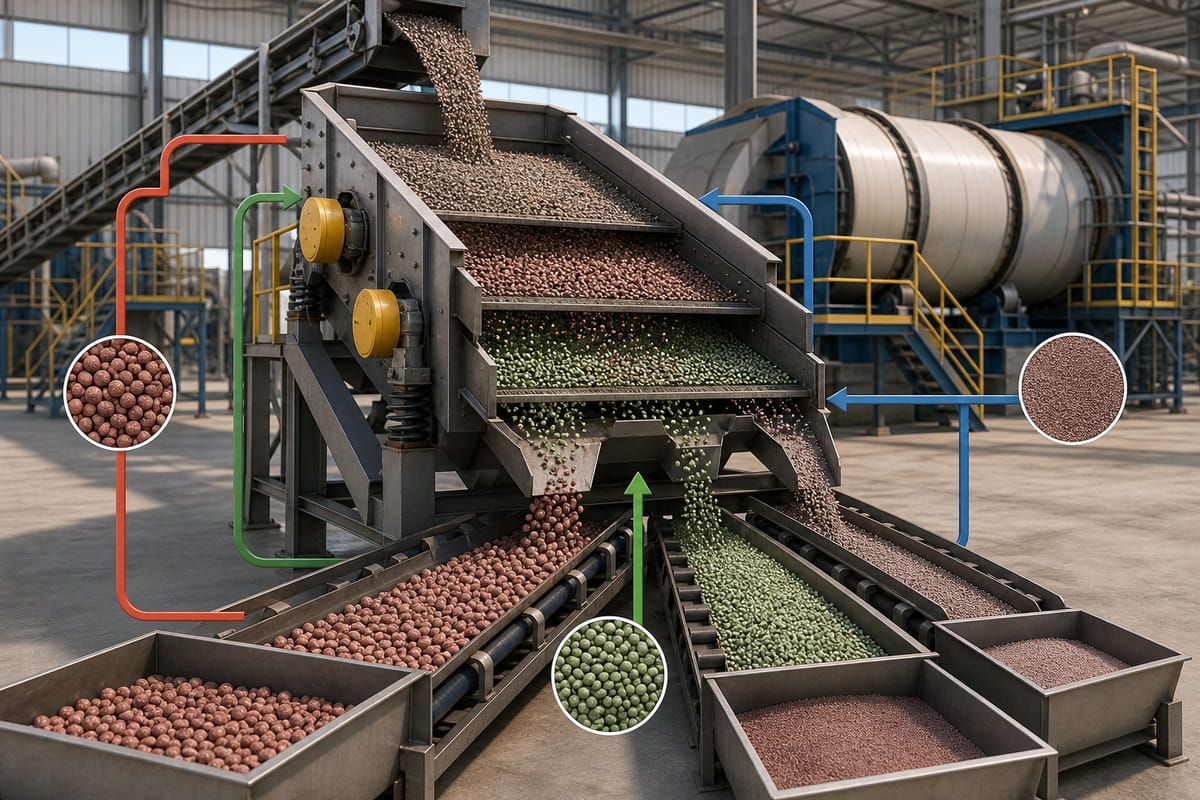
Here’s a truth that surprises many newcomers: not every granule that comes out of the granulator is the right size.
Some are too large. Some are too small. Only a portion will actually meet your target specifications.
That’s where screening comes in.
Using vibrating screens or rotary screens, you separate granules into:
- Oversized granules: Too large, need to be crushed and recycled
- Undersized granules: Too small, returned to the granulator
- On-spec granules: The right size, continue to coating
Pro Tip: The recycling loop is actually a feature, not a bug. Returning undersized material to the granulator provides seed particles that help new granules form more efficiently.
Step 8: Coating
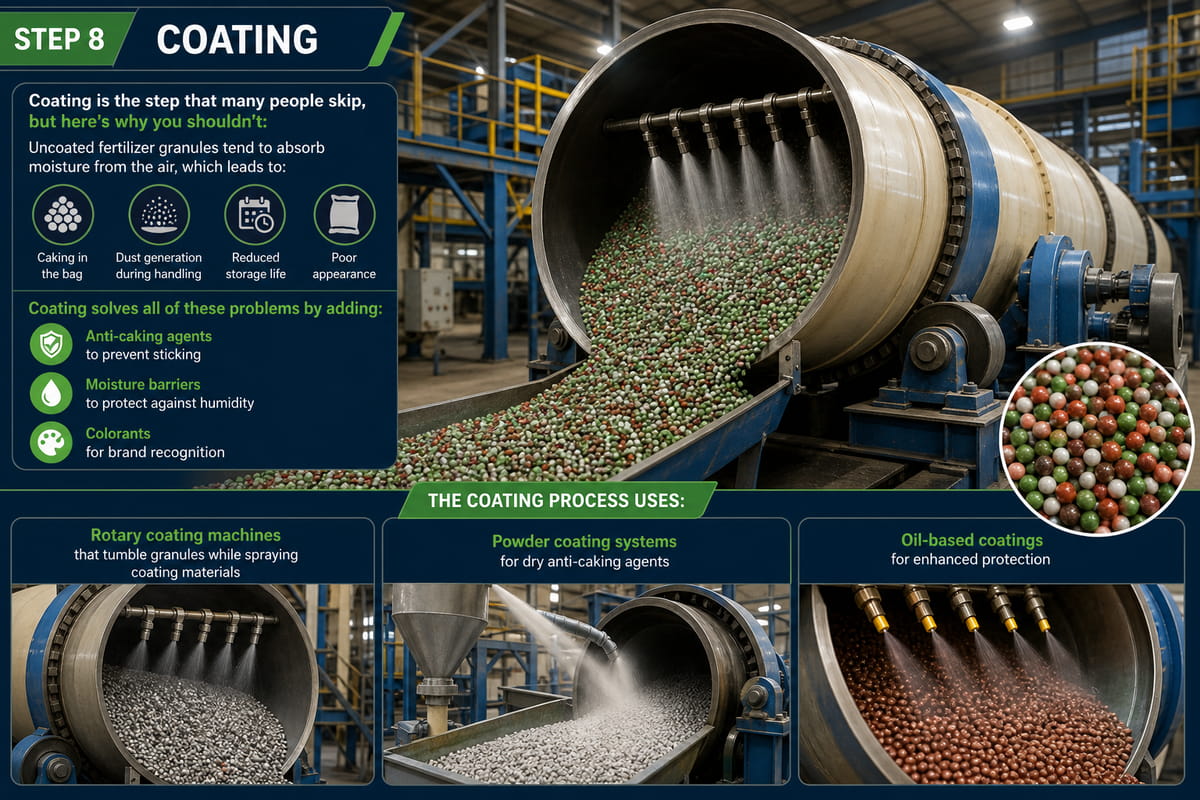
Coating is the step that many people skip, but here’s why you shouldn’t:
Uncoated fertilizer granules tend to absorb moisture from the air, which leads to:
- Caking in the bag
- Dust generation during handling
- Reduced storage life
- Poor appearance
Coating solves all of these problems by adding:
- Anti-caking agents to prevent sticking
- Moisture barriers to protect against humidity
- Colorants for brand recognition
The coating process uses:
- Rotary coating machines that tumble granules while spraying coating materials
- Powder coating systems for dry anti-caking agents
- Oil-based coatings for enhanced protection
Step 9: Packaging
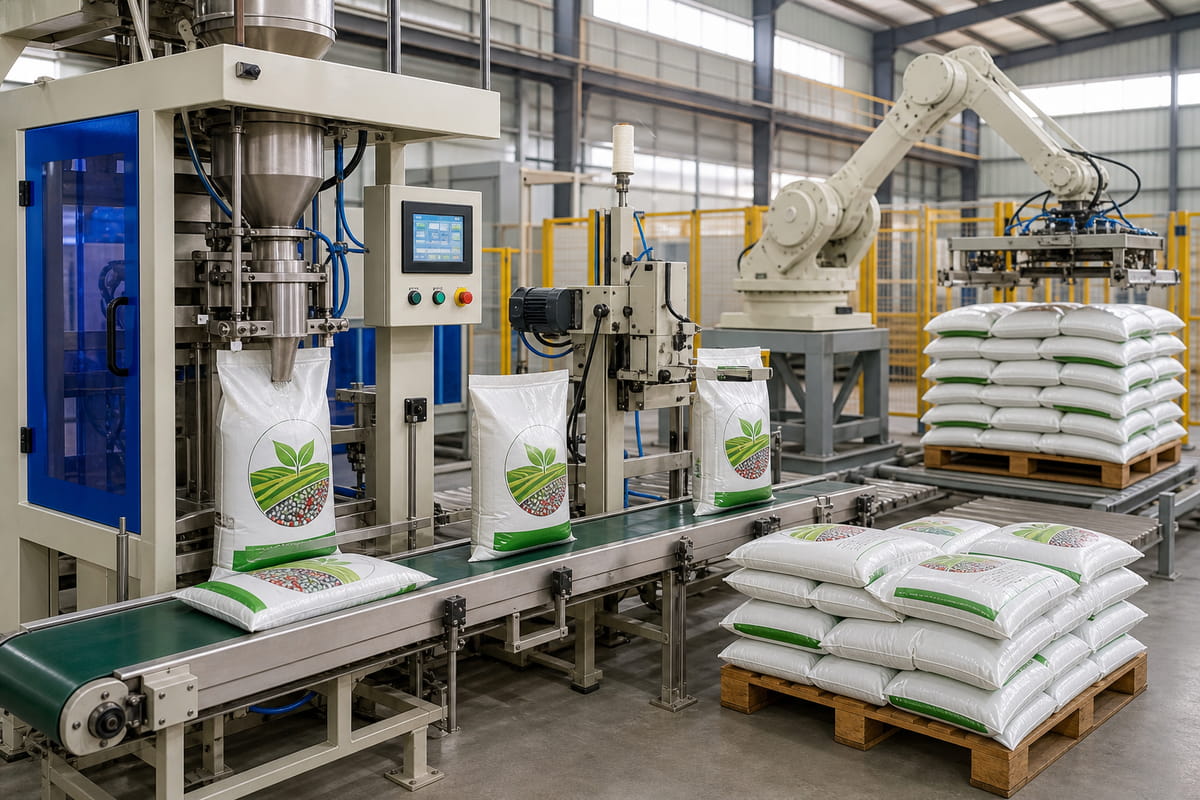
The final step in the NPK fertilizer production process is packaging the finished product.
But don’t think of this as just “putting stuff in bags.” Proper packaging involves:
- Accurate weighing for consistent bag weights
- Moisture-proof bags to protect product quality
- Sealed closures to prevent contamination
- Labeling for product identification
The equipment includes:
- Automatic packing machines for high-speed operation
- Semi-automatic systems for smaller operations
- Palletizers for efficient warehouse handling
Equipment Needed for NPK Fertilizer Production

If you’re setting up a complete NPK fertilizer production line, here’s the equipment you’ll need:
Core Equipment
- Crusher – For size reduction of raw materials
- Batching system – For accurate dosing
- Mixer – For blending materials
- Granulator – For converting powder to granules
- Dryer – For moisture removal (wet granulation only)
- Cooler – For temperature reduction
- Screener – For size classification
- Coating machine – For surface treatment
- Packaging machine – For final bagging
Supporting Equipment
- Conveyors – For material movement between stages
- Dust collectors – For environmental compliance
- Storage silos – For raw material and finished product storage
- Control systems – For automation and monitoring
The specific equipment you choose depends on:
- Your production capacity requirements
- Your raw material types
- Your budget constraints
- Your local environmental regulations
Cost Considerations for NPK Fertilizer Production
Let’s talk about money for a minute.
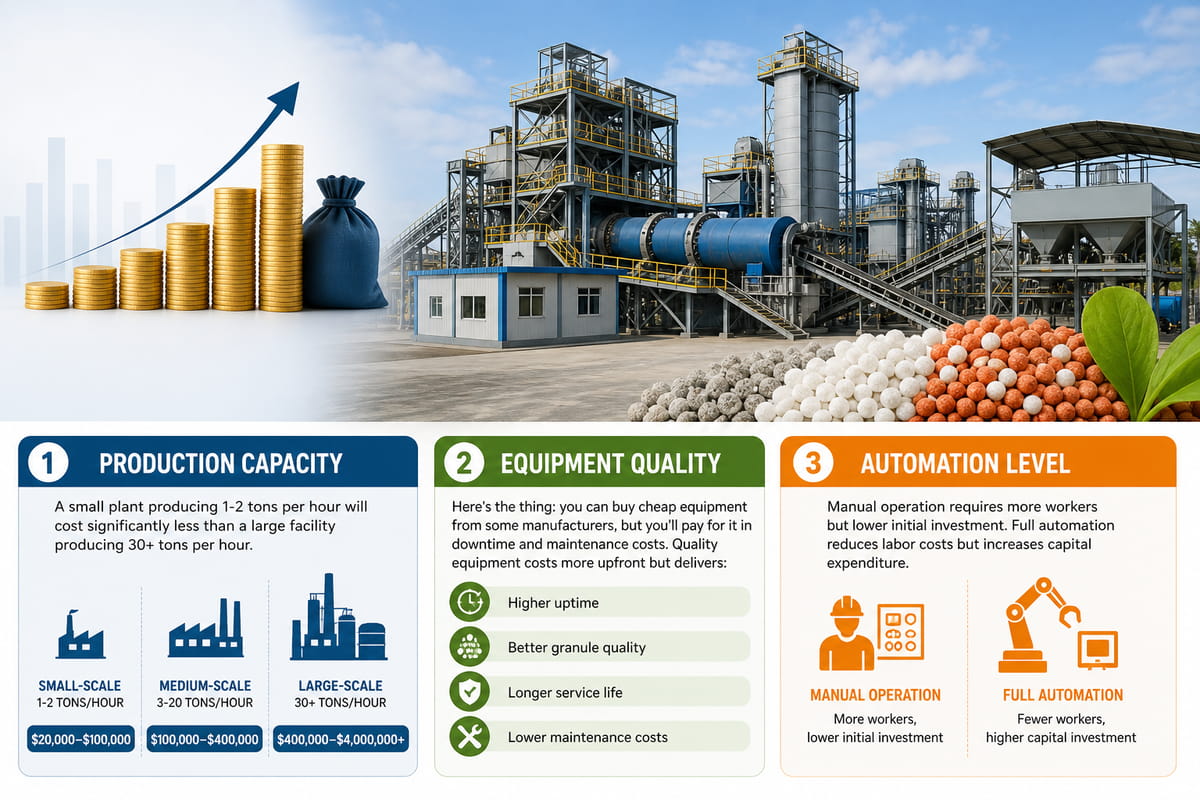
The cost of setting up an NPK fertilizer production plant varies widely based on:
1. Production Capacity
A small plant producing 1-2 tons per hour will cost significantly less than a large facility producing 30+ tons per hour.
Small-scale: $20,000-$100,000 Medium-scale: $100,000-$400,000 Large-scale: $400,000-$4,000,000+
2. Equipment Quality
Here’s the thing: you can buy cheap equipment from some manufacturers, but you’ll pay for it in downtime and maintenance costs. Quality equipment costs more upfront but delivers:
- Higher uptime
- Better granule quality
- Longer service life
- Lower maintenance costs
3. Automation Level
Manual operation requires more workers but lower initial investment. Full automation reduces labor costs but increases capital expenditure.
Pro Tip: For most operations, semi-automation is the sweet spot. You get the consistency of automated batching and weighing while maintaining flexibility for adjustments.
Quality Control in NPK Fertilizer Production
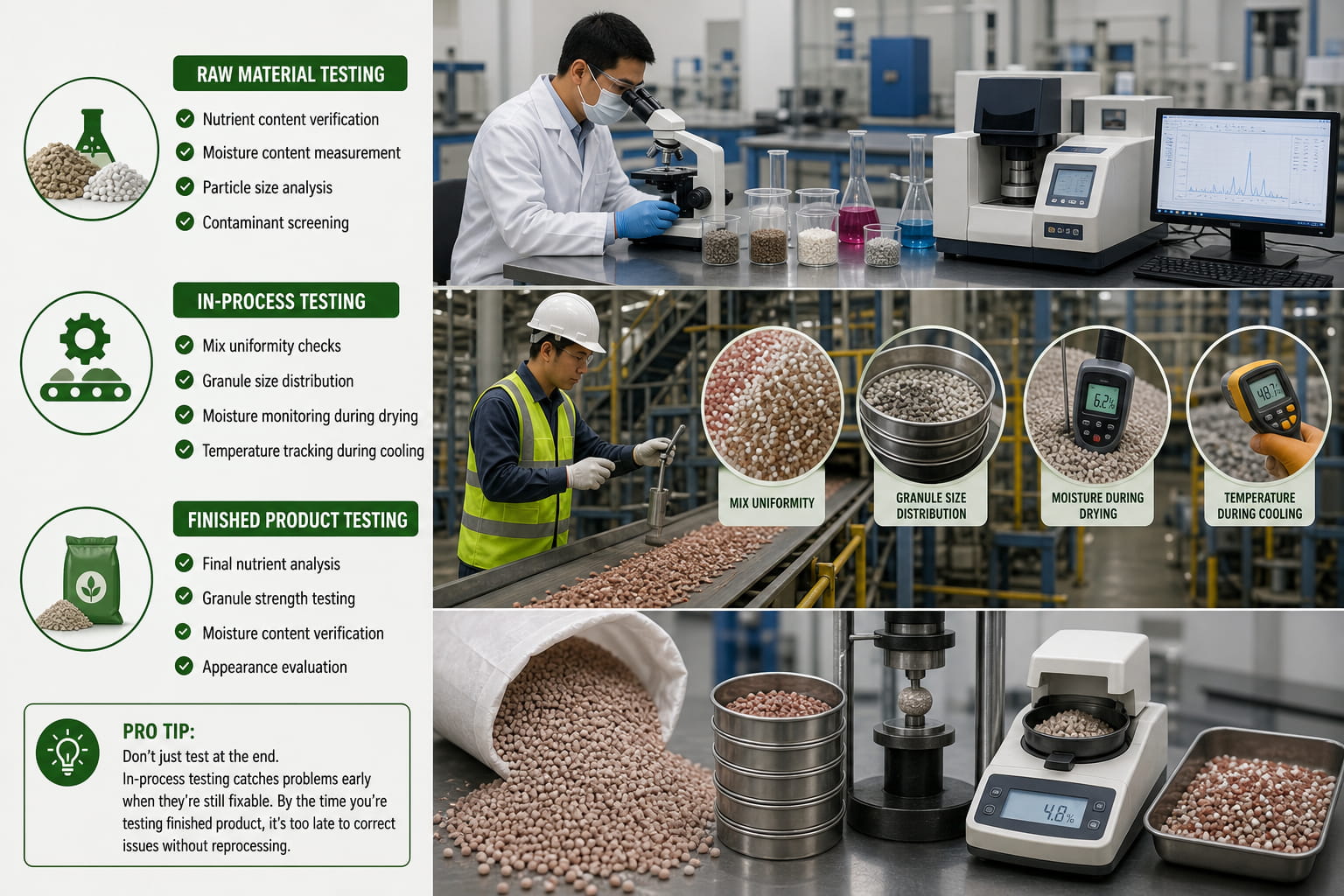
If you want to produce fertilizer that farmers trust and rebuy, quality control isn’t optional—it’s essential.
Here’s what you should be testing:
Raw Material Testing
- Nutrient content verification
- Moisture content measurement
- Particle size analysis
- Contaminant screening
In-Process Testing
- Mix uniformity checks
- Granule size distribution
- Moisture monitoring during drying
- Temperature tracking during cooling
Finished Product Testing
- Final nutrient analysis
- Granule strength testing
- Moisture content verification
- Appearance evaluation
Pro Tip: Don’t just test at the end. In-process testing catches problems early when they’re still fixable. By the time you’re testing finished product, it’s too late to correct issues without reprocessing.
Environmental Considerations
The NPK fertilizer production process generates some environmental challenges that you need to address:
Dust Control
Crushing, screening, and handling operations generate dust. You need:
- Dust collection systems on all equipment
- Proper ventilation in work areas
- Regular cleaning programs
Emissions Management
Drying operations can release volatile compounds. You need:
- Scrubbers for exhaust gases
- Proper stack heights
- Compliance with local regulations
Noise Control
Crushers, mills, and granulators are noisy. You need:
- Sound enclosures where possible
- Hearing protection for workers
- Buffer zones from residential areas
Choosing the Right NPK Fertilizer Production Process
Here’s my bottom-line advice for choosing your production approach:
Choose Compound Granulation If:
- You want to produce premium fertilizer with consistent quality
- You have access to powder raw materials
- Your target market values uniform granules
- You have the budget for a complete production line
Choose Bulk Blending If:
- You’re just getting started with limited capital
- You have access to granular raw materials
- You’re serving a local market with custom blends
- You want to start production quickly
Choose Roller Press Granulation If:
- You want to avoid the drying and cooling steps
- Your raw materials have suitable moisture content
- You’re targeting medium production volumes
- Energy costs are a major concern in your area
Key Takeaways
The NPK fertilizer production process is a sequence of nine steps: crushing, batching, mixing, granulation, drying, cooling, screening, coating, and packaging.
Two main production approaches exist: compound granulation (where each granule contains all three nutrients) and bulk blending (where different nutrient granules are mixed together).
Raw material quality matters: Your nitrogen, phosphorus, and potassium sources determine your final product quality. Choose carefully and test regularly.
Granulation is the heart of the process: Whether you use drum, disc, or roller press granulation, this is where your product takes shape.
Quality control is essential at every stage: From raw material testing to finished product analysis, consistent testing ensures consistent quality.
Equipment choices depend on your specific situation: Production capacity, raw materials, budget, and local regulations all influence your equipment decisions.
Environmental compliance is non-negotiable: Dust collection, emissions management, and proper waste handling are essential for sustainable operations.
The NPK fertilizer production process might seem complex at first, but once you break it down into clear steps, it becomes manageable. Start with understanding the flow, invest in quality equipment, and maintain rigorous quality control. That’s the formula for success in this industry.
Now you have a clear roadmap for understanding the NPK fertilizer production process. The next step is to apply this knowledge—whether that means optimizing an existing operation, planning a new facility, or simply making better purchasing decisions for your fertilizer needs.