Quick Summary:
An organic fertilizer production plant in 2026 can cost as little as $10,000 for a small powder line or $550,000+ for a large granular facility. On top of equipment, land and infrastructure can add $100,000 to over $1 million, and you’ll need working capital for raw materials and permits.
The smartest path is to start with a powder line, rent land, and expand only after validating demand. This article gives you the full cost breakdown, including hidden expenses and ROI expectations.
Trying to pin down an organic fertilizer production plant cost can feel impossible. You see figures from $10,000 to $550,000+ and have no idea which one applies to your project. Get it wrong and you’ll blow your budget on equipment while underestimating land, permits, and working capital.
In this guide, as a professional organic fertilizer production line manufacturer, I will break down the real 2026 costs for powder, granular, and liquid plants, including hidden expenses and land estimates. You’ll also learn the practical route: start small, rent land, and scale once you prove demand. No fluff, just the numbers that matter.
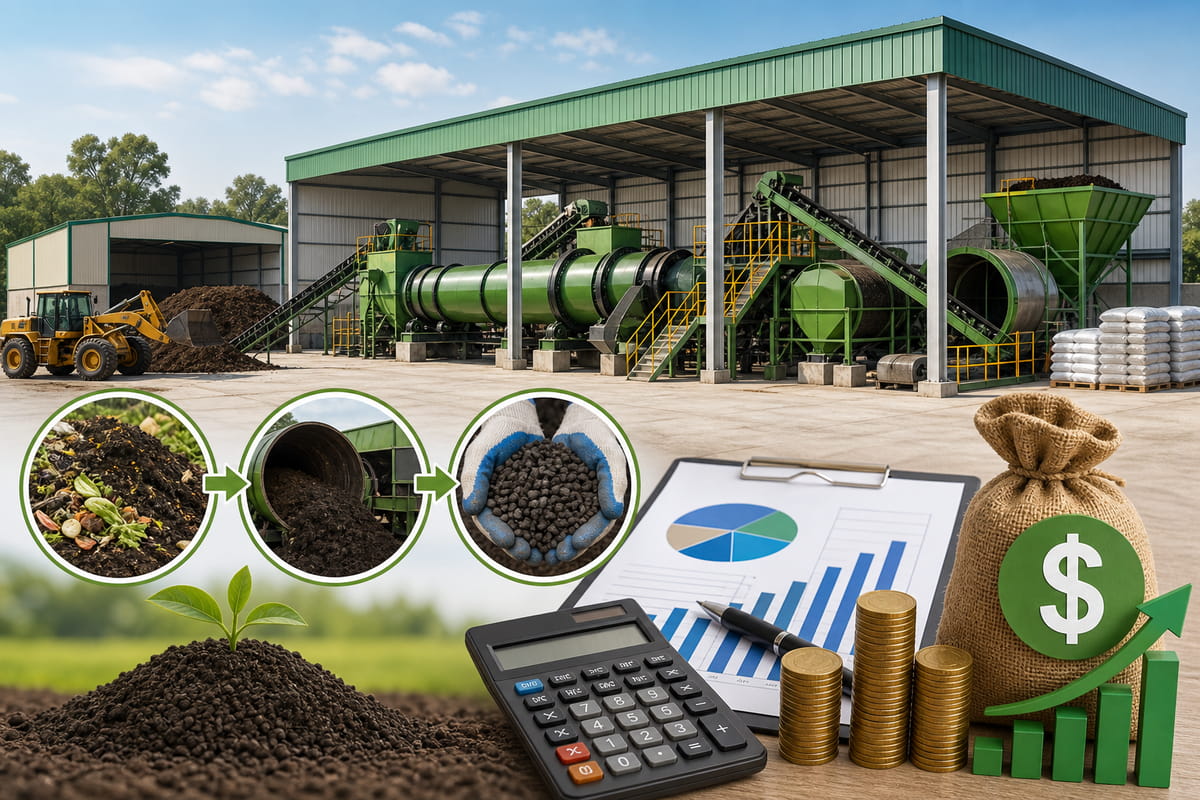
How Much Does an Organic Fertilizer Plant Cost in 2026?
In 2026, you can build a small powder organic fertilizer line for as little as $10,000. On the other end, a large granular production facility can easily hit $550,000+ for equipment alone.
Here’s a basic guide:
| Production Type | Equipment Cost Range | Capacity |
|---|---|---|
| Powder organic fertilizer line | $10,000 – $100,000 | 1–20 tons/hour |
| Granular organic fertilizer plant | $100,000 – $550,000 | 1–20 tons/hour |
| Liquid organic fertilizer facility | $21,000 – $50,000 | 1–5 tons/hour |
These numbers are for equipment, not the full turnkey project. Land, installation, utilities, permits, and raw materials will stack on top.
But don’t let that scare you. The range is wide because the business models are completely different. A simple powder line is almost a no-brainer to start. A granular line is a bigger commitment, but it comes with higher margins and a more marketable product.
My advice? Start with the smallest plant that proves your market. Then scale.
What Actually Goes Into Organic Fertilizer Production Plant Cost?

You can’t just buy a few machines and call it a factory. The full organic fertilizer manufacturing plant setup cost includes way more than the sticker price of equipment.
Here’s what you need to plan for:
1. Equipment and Machinery
The biggest line item. Equipment cost depends on how much you automate, what material you process, and whether you’re making powder or granules.
Core machines include:
- Compost turners – $30,000–$35,000 for a wheel-type unit
- Crushers – $1,300–$8,000 depending on type
- Mixers – $1,700–$8,000
- Granulators – $5,000–$40,000
- Dryers and coolers – necessary for most granular lines
- Screening drums – $1,800–$7,000
- Bagging/packaging systems – $4,200–$15,000
Don’t forget the in-between stuff: belt conveyors, feeders, control panels. It adds up fast.
2. Land and Facility Construction
In my experience, land is the part people underestimate the most. A powder line with 20 tons/hour capacity can sit on 5,000 square meters. A large granular plant might need 10,000 square meters or more.
Land lease prices run $5–$30 per square meter per year. Purchase prices are higher, usually $100–$500 per square meter. So yeah, location matters.
3. Working Capital
This is the quiet killer. You need money for:
- Raw materials (manure, crop residue, compost activators)
- Labor
- Utilities
- Environmental compliance permits
- Pre-launch payroll
- Packaging supplies
Budget at least several months of operating expenses before your first sale. I’ve seen profitable plants shut down because they ran out of cash before production stabilized.
4. Environmental and Permitting Costs
Organic fertilizer production sounds eco-friendly, but it still falls under environmental regulations. Odor control, waste handling, and runoff management are real costs. Depending on your local rules, permits alone can set you back thousands of dollars.
Organic Fertilizer Production Plant Cost Analysis
Equipment Cost Breakdown by Production Type

Let’s get specific. The equipment route you choose will shape everything.
Powder Organic Fertilizer Production Line: $10,000 – $100,000
If you want low risk and fast startup, start here. Powder lines skip drying, cooling, and granulating. That slashes equipment costs and complexity.
Here’s what a powder line looks like:
- Fermentation/composting equipment
- Crusher or shredder
- Mixer
- Screener
- Packaging system
For $10,000–$20,000, you can buy a groove-type compost turner, a semi-wet material crusher, a small mixer, and a basic screening machine. That’s enough for 1–3 tons/hour.
For $45,000–$60,000, you can run a 5–10 tons/hour powder operation. It’ll require more space and a more robust compost system. But it’s still a fraction of a granular plant’s cost.
Pro Tip: If you’re producing powder, you can often skip drying equipment if your compost moisture is controlled. That one decision can cut your budget by 20–30%.
Granular Organic Fertilizer Plant: $100,000 – $550,000
Granules are prettier. They store better, transport better, and sell for more. But they require three times the equipment investment.
A complete granular line includes:
- Compost turner
- Crusher
- Mixer
- Granulator (pan, drum, or extrusion)
- Dryer
- Cooler
- Screening machine
- Coating machine
- Packaging system
A small granular plant at 1–3 tons/hour will cost $110,000–$140,000. A medium 5–10 tons/hour operation runs $190,000–$360,000. Large 15–20 tons/hour plants? $400,000–$550,000.
The good news? Granular organic fertilizer production has a premium price point. Farmers pay more for uniform, easy-to-apply granules. If you’re planning to export or sell to commercial farms, this is the route.
Liquid Organic Fertilizer Plant: $21,000 – $50,000
Liquid fertilizer production is a different game. You need fermentation tanks, solid-liquid separators, and filling equipment. For a compact 1–5 tons/hour setup, expect to spend $21,000–$50,000.
The margins can be good, and the land footprint is smaller. But distribution is more expensive per liter, and shelf life can be shorter.
Land Cost: The Expense That Keeps Growing

Land is the hidden monster of organic fertilizer production plant cost. Let me give you real numbers.
For a small plant with 5,000 tons annual output, you need around 1,200–4,000 square meters. At a lease rate of $5 per square meter, that’s only $6,000 per year. But if you’re buying land in a developed area at $500 per square meter? That’s $600,000 upfront.
Here’s a simple breakdown:
| Plant Size | Annual Output | Land Area | Lease Cost/Year |
|---|---|---|---|
| Small | 5,000 tons | 1,200–4,000 m² | $6,000–$120,000 |
| Medium | 10,000–20,000 tons | 4,000–7,000 m² | $20,000–$210,000 |
| Large | 100,000+ tons | 12,000–14,000 m² | $60,000–$420,000 |
The smart move? Rent land at first. Plenty of fertilizer businesses lease agricultural or industrial land while they prove the model. You can always buy later once the cash flow is predictable.
The Hidden Costs Nobody Talks About

When you Google “organic fertilizer production plant cost,” you see equipment ranges. But everyone forgets the boring stuff.
Utilities and Energy
Fertilizer production is energy-hungry. Dryers and motors eat electricity. You’ll likely spend $5,000–$10,000 per year on utilities, depending on capacity and automation.
Maintenance and Repairs
Gearboxes, bearings, belts, and blades will wear out. Budget $5,000–$15,000 annually for maintenance. Cheap equipment often costs more in downtime, so factor that into your decision.
Labor Costs
A modern, semi-automated plant only needs 2–5 workers per shift. That’s one of the best things about organic fertilizer production. But labor costs vary wildly by country. In some regions, labor is your biggest fixed expense.
Packaging and Logistics
You can buy a semi-automatic bagging machine for $4,200–$15,000. But don’t forget the bags, pallets, and shrink wrap. And if you’re delivering to farms, trucks cost money.
How to Reduce Your Organic Fertilizer Production Plant Cost

You already know I’m all about actionable advice. Here are five ways to keep costs under control.
1. Start with a Powder Line
Powder production is the cheapest way to enter the market. It proves your supply chain, your local demand, and your operational skills. Upgrade to granules later.
2. Buy Direct from the Source Factory
Middlemen mark up equipment by 15–30%. If you can find a reliable manufacturer and buy factory-direct, you save thousands. Just beware of cheap knock-offs that break in six months.
3. Design the Plant Layout First
A smart layout reduces conveyor lengths, labor movement, and material handling. Every meter of extra conveyor is wasted money. Get a process design drawing before you buy equipment.
4. Automate Only Where It Matters
Full automation is expensive. Instead, automate packaging and dosing. Those areas save the most labor. Leave manual handling where it doesn’t hurt productivity.
5. Use Composting Methods That Don’t Require Dryers
If you can control moisture during composting, you can skip an entire dryer. That’s a huge capital saving. For powder fertilizer, this is often possible.
Realistic ROI for an Organic Fertilizer Plant in 2026
Let’s talk about the profit side. Because if the numbers don’t work, what’s the point?
A $100,000 powder line producing 10 tons/hour can generate serious revenue. Powder organic fertilizer prices range from $200 to $500 per ton. If you sell 5,000 tons per year at an average of $300, that’s $1.5 million in gross revenue.
Now, your margins won’t be that fat after raw materials, labor, and delivery. But net profit margins in organic fertilizer manufacturing typically land between 10% and 30%. That means a $100,000 investment could return $150,000–$450,000 in annual profit, depending on efficiency and market demand.
Pro Tip: Don’t plan on this happening in month one. Sales take time. Distribution takes time. You’ll likely reach break-even in 6–18 months, not 30 days.
Should You Build a Small Plant First?
Absolutely. A small-scale organic fertilizer plant gives you the cheapest learning curve.
You can buy a used compost turner, a small crusher, and a packing scale for under $25,000. Produce powder fertilizer. Sell it to local farms. Learn what your market wants.
Then, when you have confidence and customers, reinvest in a granular line. That’s the playbook I recommend to anyone who doesn’t have deep pockets.
The Bottom Line
The organic fertilizer production plant cost is not a single number. It’s a range based on your goals, your land, and your appetite for risk.
For a small powder plant, $10,000–$60,000 can get you started. For a serious granular business, $110,000–$550,000 is a realistic equipment budget. Add land, permits, and working capital, and you need to be even more prepared.
But here’s the thing: agriculture is spending more every year on organic inputs. Governments are pushing sustainable farming. And the demand for organic fertilizer is not shrinking. If you plan carefully, this is one of the most promising agricultural investments you can make.
So don’t let the big numbers intimidate you. Break them down. Start small. Focus on the hidden costs. And remember: the final organic fertilizer production plant cost is only the beginning of the journey. The payoff comes from smart production, consistent quality, and customers who trust you.