Quick Summary:
Fertilizer production lines fall into four main types: organic (powder or granular), NPK compound (drum, high‑tower, or extrusion), bulk blending (BB), and liquid. Each serves a different purpose with vastly different investment ranges – from $30,000 for a BB line to over $1 million for a large NPK drum granulation system.
The right choice depends on your raw material availability, target market, budget, and capacity needs. Pro tip: start with what you have and grow from there – a medium‑capacity plant (3–8 t/h) often offers the best balance between economy of scale and manageable complexity.
You’ve got a pile of agricultural waste – chicken manure, cow dung, crop residue – and you’re thinking there’s a better way to turn it into money. But most people jump into fertilizer production without understanding their options. They buy equipment totally wrong for their materials, then wonder why their granules fall apart.
Here’s the deal: that pile could generate $280/ton as premium fertilizer, but only if you process it through the right production line. In this article, as a professional fertilizer production line manufacturer, I will break down the four main types – organic, NPK compound, bulk blending, and liquid – along with investment ranges, capacity options, and the specific pros and cons of each, so you can match the right line to your raw materials, budget, and market.
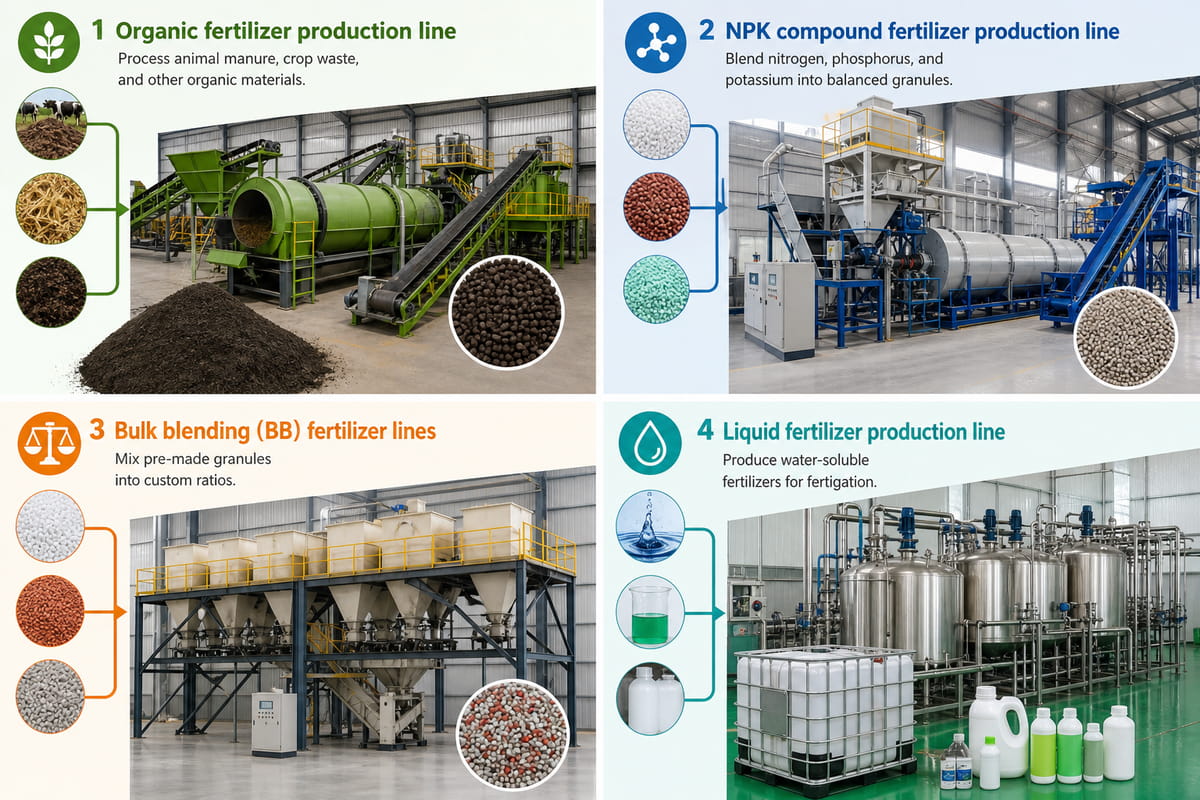
The 4 Main Types of Fertilizer Production Lines
Fertilizer production lines generally fall into four categories. Each one serves a different purpose, requires different equipment, and produces a different end product.
Here they are:
- 1. Organic fertilizer production lines – Process animal manure, crop waste, and other organic materials
- 2. NPK compound fertilizer production lines – Blend nitrogen, phosphorus, and potassium into balanced granules
- 3. Bulk blending (BB) fertilizer lines – Mix pre-made granules into custom ratios
- 4. Liquid fertilizer production lines – Produce water-soluble fertilizers for fertigation
Let’s dig into each one.
Organic Fertilizer Production Lines
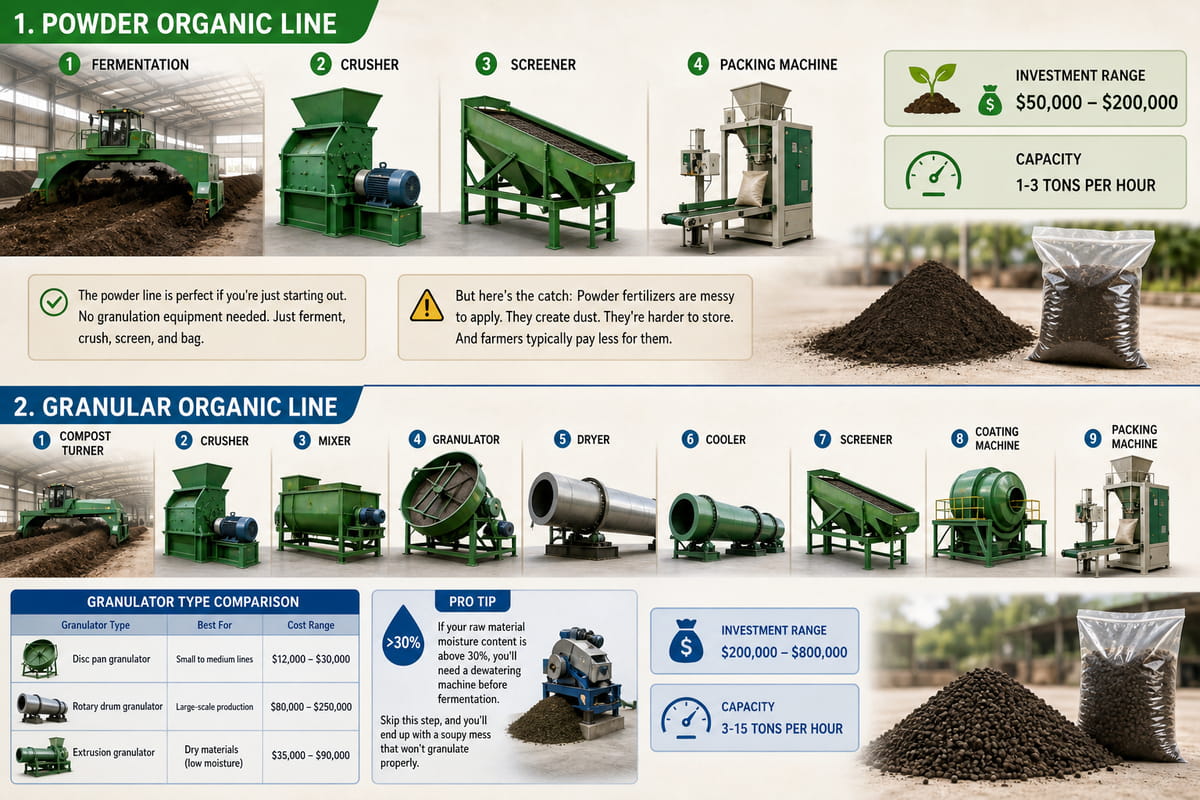
Organic fertilizer lines are my personal favorite. Why? Because they turn waste into gold. Literally.
A Midwest cooperative I worked with increased their manure value from $15/ton to $210/ton by upgrading from a simple powder line to a granulated organic production system. That’s a 14x multiplier.
Powder Organic Fertilizer Production Line
This is the simplest setup. Here’s what you need:
- Fermentation equipment (compost turner or fermentation tank)
- Crusher
- Screener
- Packing machine
Investment range: $50,000 – $200,000
Capacity: 1-3 tons per hour
The powder fertilizer production line is perfect if you’re just starting out. No granulation equipment needed. Just ferment, crush, screen, and bag.
But here’s the catch: Powder fertilizers are messy to apply. They create dust. They’re harder to store. And farmers typically pay less for them.
Granular Organic Fertilizer Production Line
This is where the real money is.
A granular organic fertilizer production line adds granulation equipment to the powder line. The most common granulators for organic materials:
| Granulator Type | Best For | Cost Range |
|---|---|---|
| Disc pan granulator | Small to medium lines | $12,000 – $30,000 |
| Rotary drum granulator | Large-scale production | $80,000 – $250,000 |
| Extrusion granulator | Dry materials (low moisture) | $35,000 – $90,000 |
Full equipment list for granular organic:
- Compost turner
- Crusher
- Mixer
- Granulator (disc, drum, or extrusion)
- Dryer
- Cooler
- Screener
- Coating machine
- Packing machine
Pro tip: If your raw material moisture content is above 30%, you’ll need a dewatering machine before fermentation. Skip this step, and you’ll end up with a soupy mess that won’t granulate properly.
Investment range: $200,000 – $800,000
Capacity: 3-15 tons per hour
NPK Compound Fertilizer Production Lines
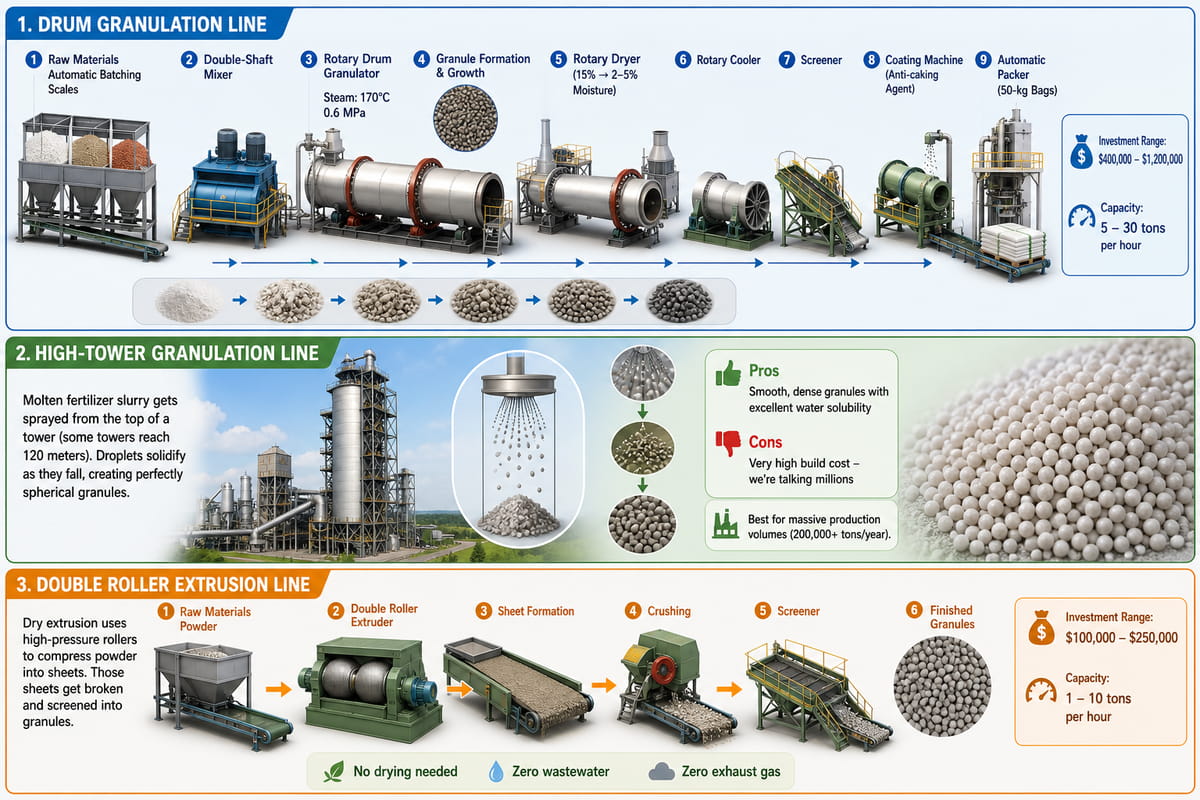
NPK lines are the workhorses of the fertilizer industry. They produce those uniform granules you see in bags labeled “15-15-15” or “20-10-10.”
Over 65% of compound fertilizer plants worldwide use drum granulation. It’s the industry standard for a reason.
Drum Granulation Line
This is the heavy-duty option. Here’s how it works:
- 1. Raw materials (urea, DAP, potassium chloride) go into automatic batching scales
- 2. Ingredients get mixed in a double-shaft mixer
- 3. Steam (at 170°C, 0.6 MPa) enters the rotating drum granulator
- 4. Particles form and grow as they tumble
- 5. Granules go through a rotary dryer (moisture drops from 15% to 2-5%)
- 6. Rotary cooler brings temperature down
- 7. Screener separates合格 from off-spec material
- 8. Coating machine applies anti-caking agent
- 9. Automatic packer fills 50-kg bags
Investment range: $400,000 – $1,200,000
Capacity: 5-30 tons per hour
High-Tower Granulation Line
This is the premium option. Molten fertilizer slurry gets sprayed from the top of a tower (some towers reach 120 meters). Droplets solidify as they fall, creating perfectly spherical granules.
Pros: Smooth, dense granules with excellent water solubility
Cons: Very high build cost – we’re talking millions
Best for massive production volumes (200,000+ tons/year).
Double Roller Extrusion Line
Here’s a secret weapon for smaller operators.
Dry extrusion uses high-pressure rollers to compress powder into sheets. Those sheets get broken and screened into granules.
The big advantage? No drying needed. Zero wastewater. Zero exhaust gas.
Investment range: $100,000 – $250,000
Capacity: 1-10 tons per hour
I helped a startup in Kenya launch a 3-t/h extrusion line for under $120,000. They were operational within 60 days of equipment arrival.
Bulk Blending (BB) Fertilizer Lines
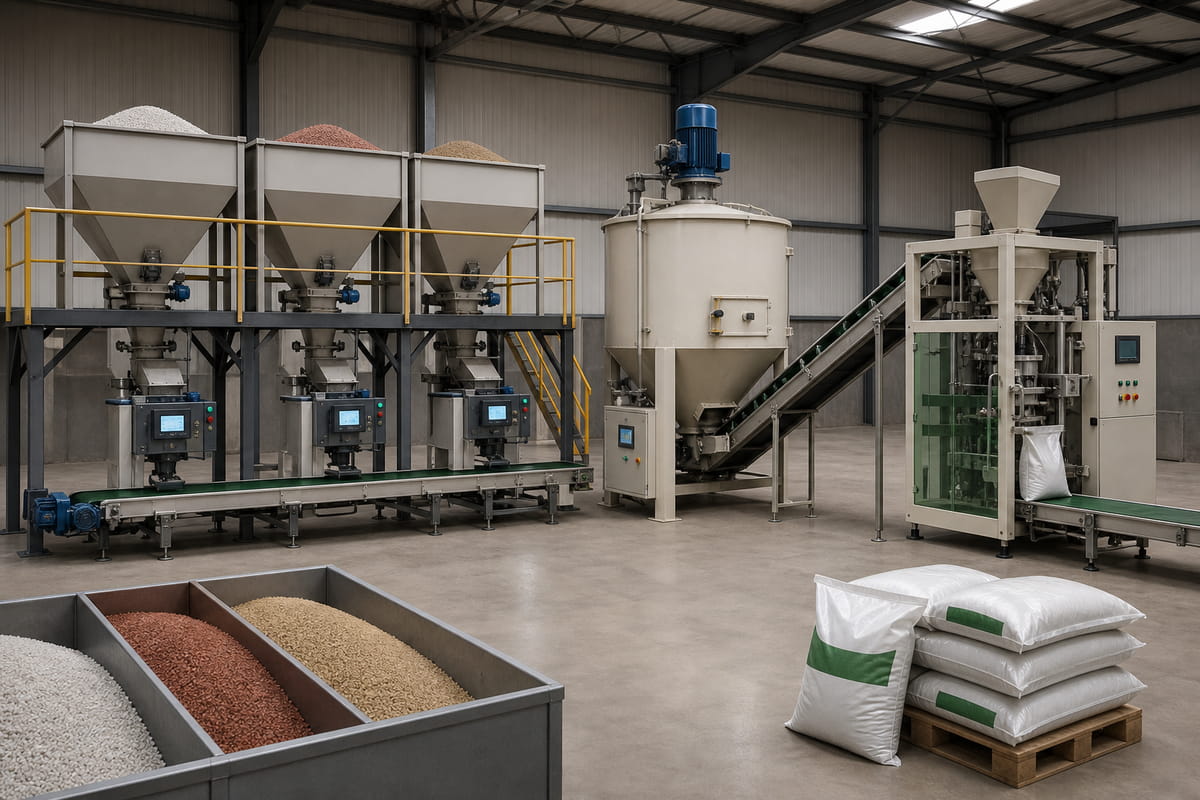
BB lines are the simplest of the bunch. You’re just mixing pre-made granules together.
Here’s the setup:
- High-precision electronic batching scales
- Automated mixer
- Packaging machine
That’s it. Three machines. Maybe a conveyor or two.
Investment range: $30,000 – $80,000
Capacity: 1-20 tons per hour
When should you use a BB line?
When you need custom blends for specific soil conditions. A regional ag retail center might blend a 10-20-10 today and a 15-30-10 tomorrow. With a BB line, you can switch formulas in minutes.
But here’s the downside: Nutrients can segregate during transport. Shaking a truck full of BB fertilizer can cause the heavier granules to settle at the bottom. That means your 15-15-15 might end up being 12-18-15 by the time it reaches the field.
Liquid Fertilizer Production Lines
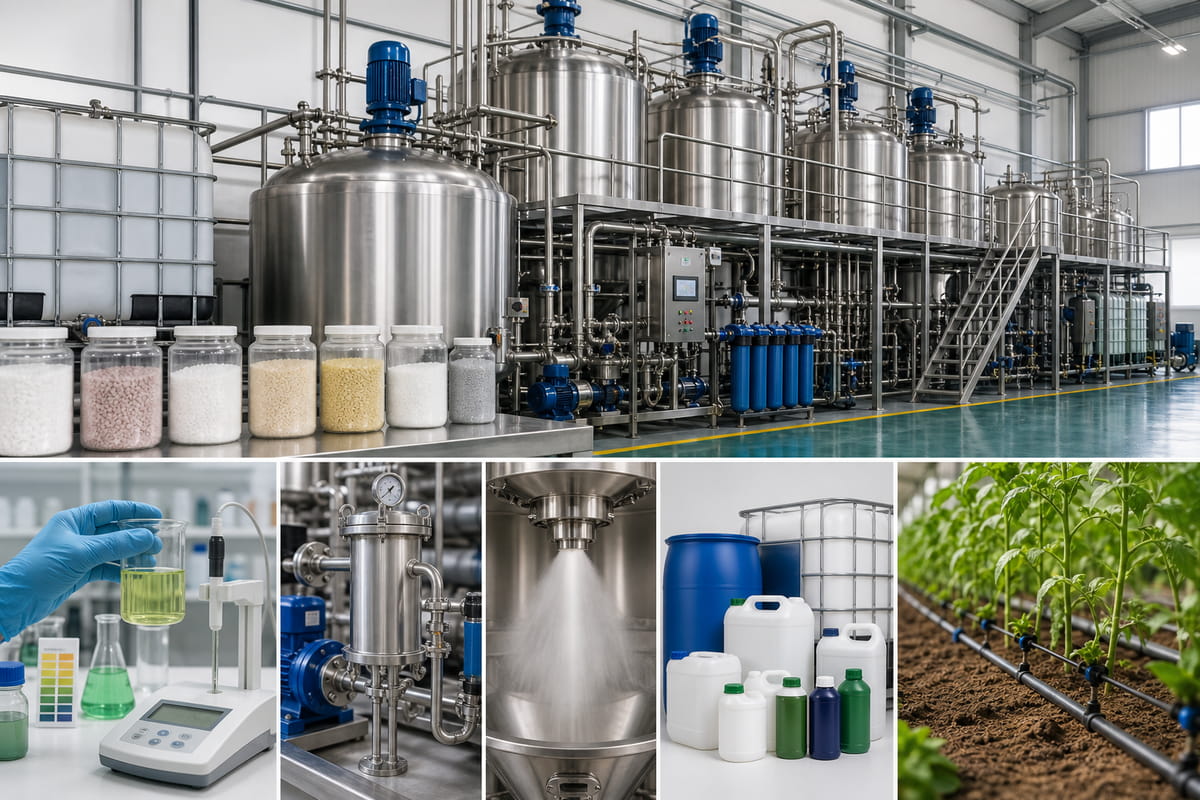
Now let’s talk about an often-overlooked option: liquid fertilizers.
These aren’t your granddad’s liquid manures. We’re talking about precision-formulated nutrient solutions that dissolve completely in water.
Here’s the thing: liquid fertilizers are exploding in popularity. Why? Because they work perfectly with drip irrigation systems. And precision agriculture is taking over the world.
How liquid fertilizer lines work:
- 1. Raw materials (MAP, MKP, urea, calcium nitrate, trace elements) go into controlled dissolution tanks
- 2. The solution gets filtered to remove any insoluble particles
- 3. pH is adjusted for stability
- 4. If you’re making a powder water-soluble fertilizer, you’ll spray-dry the solution into fine powder
- 5. If it’s straight liquid, you’re done — just package it in drums, IBC tanks, or bottles
Investment range: $80,000 – $300,000
Capacity: 1-10 tons per hour (or liters per hour for liquid)
Who should use a liquid line?
High-value crop growers. Think tomatoes, berries, greenhouse vegetables — crops where every drop of nutrient counts.
Pro tip: Liquid fertilizers give you the fastest nutrient uptake. Plants can absorb them within hours instead of days. But they’re also more expensive to produce per unit of nutrient.
Key Differences Between Organic and Chemical Fertilizer Plants
Let me give you a quick comparison table:
| Factor | Organic Plant | Chemical NPK Plant |
|---|---|---|
| Raw materials | Composted manure, plant waste | Urea, DAP, KCl |
| Moisture content | 25-35% post-fermentation | <1% crystalline |
| Core process | Biological decomposition | Chemical synthesis |
| Corrosion risk | Organic acids | Chlorides/ammonia |
| Energy use | Moderate | High (drying) |
| Typical investment | $100k – $800k | $500k – $5M |
Pro tip: A Philippine plant I consulted saved $1.2M annually by separating their organic and chemical production lines. Cross-contamination was ruining both products. Don’t make the same mistake.
How to Choose the Right Capacity for Your Fertilizer Production Line
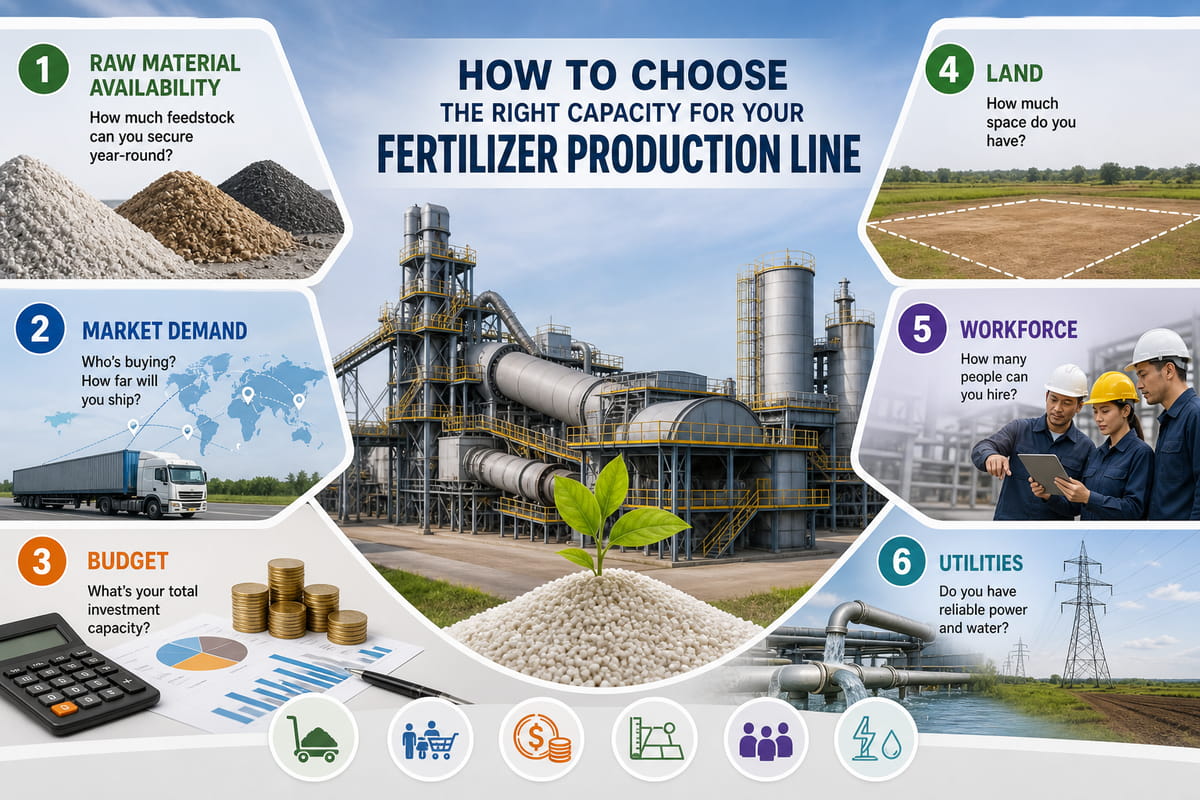
This decision depends on six factors:
- 1. Raw material availability – How much feedstock can you secure year-round?
- 2. Market demand – Who’s buying? How far will you ship?
- 3. Budget – What’s your total investment capacity?
- 4. Land – How much space do you have?
- 5. Workforce – How many people can you hire?
- 6. Utilities – Do you have reliable power and water?
Here’s a capacity selection matrix:
| Parameter | Small (1-3 t/h) | Medium (3-8 t/h) | Large (8-20 t/h) |
|---|---|---|---|
| Investment | $50k – $200k | $200k – $800k | $800k – $3M |
| Land needed | 800-1500 m² | 2000-5000 m² | 6000-15000 m² |
| Workers | 4-6 | 8-12 | 15-30 |
| Power | 50-100 kW | 200-500 kW | 600-1500 kW |
An Indian entrepreneur I know increased his profits 62% by choosing a 5 t/h plant instead of starting small. The medium capacity better matched his guaranteed offtake agreements.
Advanced Fertilizer Production Technologies (2026 Trends)
The industry is moving fast. Here’s what’s changing in 2026:
AI-based formulation systems – These optimize your NPK ratios in real-time based on raw material analysis.
Automated quality control – Cameras and sensors check every granule for size, hardness, and nutrient content.
Continuous composting reactors – Cut fermentation time from 30 days to 7 days.
Low-energy drying – Heat recovery systems can reduce energy costs by 40%.
Smart packaging integration – Bags with QR codes that track batch information from production to field.
Core Equipment Lifespan Guide
Here’s what you can expect from your equipment:
| Machine | Expected Lifespan | Key Wear Parts |
|---|---|---|
| Granulator | 5-8 years | Dies, rollers |
| Dryer | 7-10 years | Lifters, bearings |
| Mixer | 8-12 years | Paddles, shaft |
| Crusher | 4-7 years | Hammers, screens |
| Conveyor | 6-9 years | Belts, rollers |
A Nigerian startup cut maintenance costs 38% by choosing equipment with standardized, locally available spare parts. The cheaper models with proprietary components were a nightmare to maintain.
Troubleshooting Common Problems
| Problem | Likely Cause | Solution |
|---|---|---|
| Low granule strength | Improper moisture | Adjust binder/drying |
| High dust levels | Insufficient coating | Increase oil/wax |
| Uneven size | Screen damage | Replace/clean screens |
| Material buildup | Static electricity | Install ionizers |
| High energy use | Inefficient drying | Optimize temperatures |
The Bottom Line
Choosing the right fertilizer production line comes down to three things: your raw materials, your budget, and your market.
Here’s my recommendation:
- Starting small with organic waste? Go with a powder organic line (under $200k)
- Want premium organic granules? Upgrade to a granular line with disc granulation ($200k – $800k)
- Need NPK compound fertilizer? Start with drum granulation if you have the budget ($400k+)
- On a tight budget for NPK? Double roller extrusion ($100k – $250k)
- Need custom blends fast? BB fertilizer line ($30k – $80k)
- Targeting high-value greenhouse crops? Liquid fertilizer line ($80k – $300k)
The global compound fertilizer market was valued at over $190 billion in 2025. It’s projected to exceed $220 billion by 2029. That’s a lot of demand.
Remember this: The best production line is the one that matches your specific situation. Don’t buy a 20-t/h drum granulation system if you can only source 2 tons of raw material per day.
Start with what you have. Grow from there.
And that’s the full picture of what are the different types of fertilizer production lines. Now it’s your move.