Quick Summary
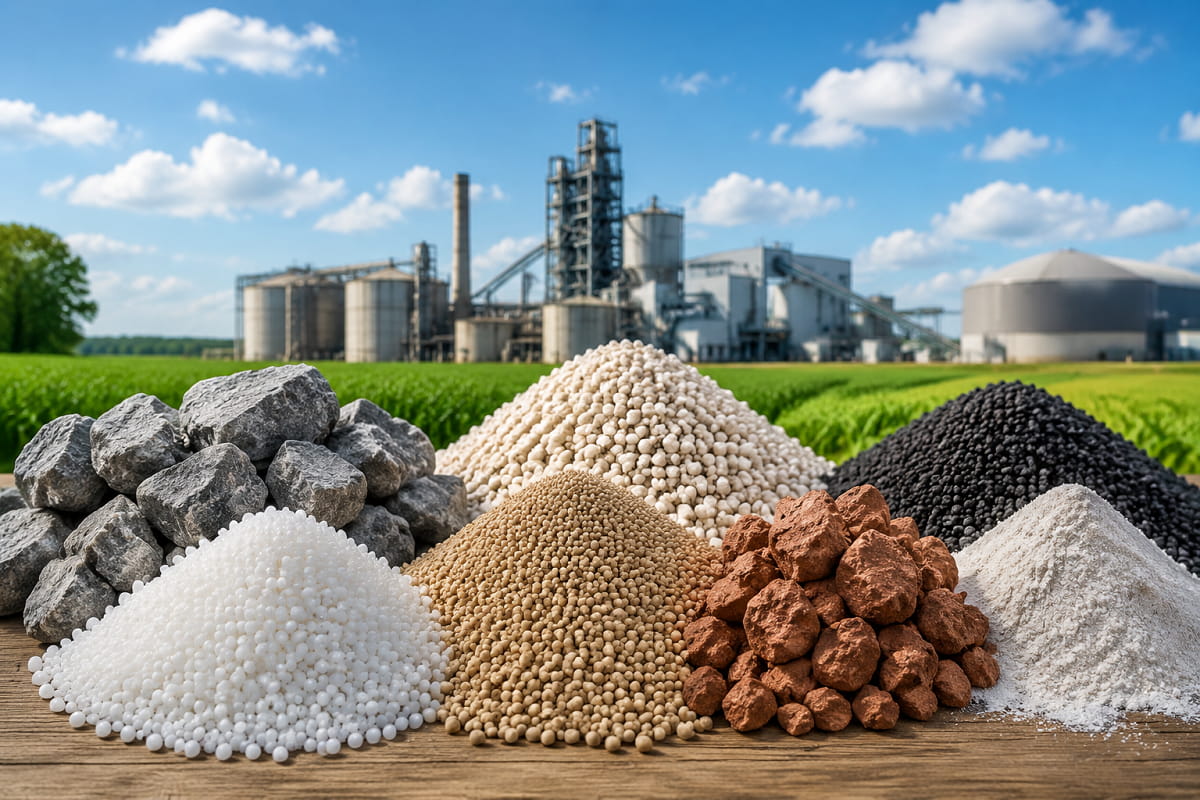
Fertilizer production relies on three main raw material sources: atmospheric nitrogen combined with natural gas to make ammonia, phosphate rock treated with sulfuric acid for phosphorus, and mined potash deposits for potassium. Secondary nutrients come from limestone, dolomite, and metal ores, while micronutrients are sourced from industrial byproducts and mineral deposits.
Have you ever looked at a bag of 10-10-10 and thought, “What the heck is actually in here?”
Fertilizer isn’t just “plant food” from a factory. It’s the result of grabbing raw materials from the air, ancient sea beds, fossil fuels, and huge underground ore deposits. Then mixing them with some serious chemistry.
And today, as a professional fertilizer production line manufacturer, I’m going to break the whole thing down for you.
Let’s get started.
What Raw Materials Are Used in Fertilizer Production?
The Big Three: NPK And Where They Come From
Most complete fertilizers hinge on three primary nutrients:
- Nitrogen (N) – pushes green leafy growth
- Phosphorus (P) – builds strong roots and blooms
- Potassium (K) – overall plant health and resilience
Together they’re NPK – the backbone of modern farming. And each one has its own raw material origin story.
Nitrogen (N): Pulling Growth Out of Thin Air
This might blow your mind:
78% of the air you’re breathing right now is nitrogen gas (N₂).
But plants can’t use it in that form. They need it converted into something reactive – and that’s where fertilizer production steps in.
The primary raw materials for nitrogen fertilizers are:
- Atmospheric nitrogen – literally pumped out of the air
- Natural gas (or sometimes coal) – provides hydrogen and energy
- Water – additional hydrogen source
- Air – oxygen for certain process steps
Step 1: Take nitrogen from the air and combine it with hydrogen stripped from natural gas, under insane heat and pressure, with an iron-based catalyst. This is the Haber-Bosch process – arguably the most important chemical reaction of the 20th century.
The output? Anhydrous ammonia (NH₃) – which is 82% nitrogen. That’s the foundation for practically everything else.
Step 2: From ammonia, you go in different directions:
- Mix ammonia with carbon dioxide → you get urea (46% nitrogen)
- React ammonia with nitric acid → ammonium nitrate (34% N)
- React ammonia with sulfuric acid → ammonium sulfate (21% N, plus sulfur)
Here’s something most people don’t realize:
About 60% of the natural gas used in this process is the raw material – it provides the hydrogen atoms. The rest is burned for energy to reach the crazy temperatures and pressures needed.
So when natural gas prices spike, nitrogen fertilizer prices follow. No exceptions.
Pro Tip: Next time you’re comparing fertilizer prices, peek at natural gas market trends. They’re tied at the hip.
Phosphorus (P): Mining Ancient Marine Life
Phosphorus doesn’t come from the air. It comes from phosphate rock – mined all over the world in places like Florida, Morocco, and China.
That rock? It’s largely fossilized remains of ancient marine creatures and their waste deposited on sea floors millions of years ago. (I know, a little gross. But also incredibly cool.)
The raw materials feeding phosphorus fertilizer production:
- Phosphate rock ore (containing 12-17% phosphorus in raw form)
- Sulfur – transformed into sulfuric acid
- Water
- Ammonia (for ammonium phosphate products)
First, phosphate rock is strip-mined from open pits. It’s gritty, gray stuff. Then it goes through beneficiation – basically a washing and separation process that removes clay and sand, bumping the phosphorus content.
The upgraded rock gets ground fine and treated with concentrated sulfuric acid (90-93%). The reaction produces:
- Phosphoric acid (the key intermediate)
- Gypsum (a byproduct filtered out)
This is the “wet process.” The resulting green phosphoric acid contains about 22% phosphorus and can be:
- Concentrated further for use as a liquid fertilizer
- Reacted with ammonia to make Monoammonium phosphate (MAP) or Diammonium phosphate (DAP) – both water-soluble, high-analysis products
MAP typically runs 11% N and 48-55% P₂O₅. DAP comes in at 18% N and 46% P₂O₅. Farmers love these because they’re easy to handle and dissolve perfectly in soil moisture.
Here’s the part that trips people up: sulfuric acid is absolutely essential. And the sulfur to make it is either mined directly or recovered as a byproduct from oil refining and metal smelting.
So a disruption in sulfur supply (say, a refinery slowdown) ripples right through the phosphate fertilizer chain.
Bottom line? Phosphate fertilizer production sits at the intersection of mining, chemical manufacturing, and global energy markets.
Potassium (K): Salts of Vanished Oceans
Potassium rounds out the NPK trio. And its raw materials come from a dramatically different source: evaporite deposits.
Picture huge inland seas from way back. They dried up over millions of years. What’s left? Beds of potassium salts that dissolve in water. Buried deep too – hundreds, sometimes thousands of feet down. You’ll find regular table salt mixed in with them. That’s how it works underground.
The main raw materials:
- Potash ores – a mix of potassium chloride (KCl), potassium sulfate minerals, and clay
- Brine solutions – from salt lakes like the Dead Sea or Great Salt Lake
Potash ore is either:
- Mined conventionally underground (like massive rooms and pillars) or
- Extracted through solution mining (pumping hot brine down to dissolve the potash and bring it to the surface)
The raw material then undergoes flotation or crystallization to separate the potassium salts. The big product? Potassium chloride, often called muriate of potash (MOP) – 60-63% K₂O. It’s the most widely used K source on the planet.
For chloride-sensitive crops (avocados, some tobacco, potatoes), there’s potassium sulfate (SOP) – 50-53% K₂O, plus sulfur. And potassium nitrate delivers K plus nitrogen without chloride.
Fun fact: Canada makes more potash than anyone else on the planet. Most of it comes from Saskatchewan – those deposits actually run into North Dakota and Montana too. Russia and Belarus? Major producers as well. When politics get messy over there, potassium fertilizer prices jump. Happens fast.
The Hidden Ingredients: Secondary Nutrients and Micronutrients
Sure, NPK grabs the headlines. But balanced fertilizers also contain a supporting cast of secondary elements and trace elements – and they have their own raw material story.
Here’s a quick-fire rundown:
- Calcium – Limestone (calcium carbonate) quarried from sedimentary rock. Also gypsum if you need calcium without raising pH.
- Magnesium – Dolomite (calcium magnesium carbonate) from dolomite quarries; or Epsom salt (magnesium sulfate) from mineral springs or synthetic processes.
- Sulfur – Elemental sulfur mined from volcanic regions or salt domes, or captured as a byproduct from natural gas processing (desulfurization).
- Iron – Ferrous sulfate (byproduct of steel pickling) or iron oxide sourced from mineral deposits.
- Zinc, Manganese, Copper – Usually sulfate salts produced from mined metal sulfide ores; chelated forms also use synthetic organic compounds for better plant uptake.
- Boron – Borax (sodium tetraborate) from evaporated lake beds in places like California’s Mojave Desert or Turkey.
- Molybdenum – Molybdenite ore processed into molybdates.
These are blended in small quantities (micronutrient doses are often measured in ounces per acre). But without them, plants hit deficiency walls.
Pro Tip: If you’re buying a complete fertilizer blend, check the “derived from” statement on the label. It literally lists raw materials – and you can spot quality differences between soluble sulfates and cheap oxide forms.
Putting It All Together: From Raw Materials to Bag of Fertilizer
So to repeat the question: what raw materials are used in fertilizer production? Let’s crystalize everything into a single reference table.
| Nutrient | Raw Materials | Key Intermediate / Product |
|---|---|---|
| Nitrogen | Air, natural gas/coal, water | Ammonia → urea, ammonium nitrate, UAN solutions |
| Phosphorus | Phosphate rock, sulfur | Phosphoric acid → MAP, DAP, triple superphosphate |
| Potassium | Potash ore, brine | Potassium chloride (MOP), potassium sulfate (SOP) |
| Calcium | Limestone, gypsum | Calcium carbonate, calcium nitrate |
| Magnesium | Dolomite, magnesite | Magnesium sulfate, magnesium oxide |
| Sulfur | Elemental sulfur, smelter gases | Sulfuric acid, ammonium sulfate |
| Micronutrients | Metal sulfates, oxides, borates | Zinc sulfate, iron chelate, borax, etc. |
The blender takes these base materials, grinds them, mixes them, sometimes granulates them, and boom – a uniform homogenous NPK fertilizer that spreads evenly in the field.
Why This Matters For You (And Not Just A Farmer)
You might be thinking, “Okay, I’m not running a fertilizer factory. Why do I care?”
Three reasons.
1. Price Swings Hit Your Wallet
Back in 2007-2008, fertilizer prices went absolutely nuts. Total chaos. Natural gas costs shot through the roof, sulfur prices exploded, and countries started blocking phosphate rock exports. Plus the dollar was weak. Everything hit at once. Once you know what goes into making fertilizer, those crazy headlines actually start making sense. Perfect storm, really.
2. Sourcing Impacts Quality
That cheap 10-10-10 bag? Probably has muriate of potash loaded with chloride. Corn doesn’t mind, but your tomatoes will hate it. Maybe it’s got oxide micronutrients too – those barely work in alkaline soil. Really sluggish. Know what’s in there and you can grab the right stuff for your plants. Makes a difference.
3. It’s The Foundation Of Our Food System
Without the air, natural gas, phosphate rock, and potash we turn into fertilizer, global crop yields drop by an estimated 40-50%. Literally half the world’s food is tied to these raw materials. That’s wild.
The Raw Material – Energy Connection
There’s one more thread I want to pull.
Every stage of fertilizer raw material extraction and conversion eats energy:
- Natural gas as feedstock and fuel for ammonia synthesis
- Electricity to grind phosphate rock and run flotation cells
- Diesel to operate massive potash mining machines
- Heat to evaporate brines and crystalize salts
This is why fertilizer prices track energy markets so closely. It’s also why innovation is pouring into “green ammonia” (using renewable hydrogen instead of natural gas) and microbial fertilizers that fix nitrogen from the air using bacteria instead of the Haber-Bosch process.
We’re not there yet at scale, but the raw material landscape of 2040 might look very different from 2026.
Common Questions About Fertilizer Raw Materials
What’s the main raw material for nitrogen fertilizer? Pull nitrogen straight from the air. Mix it with hydrogen from natural gas. Bang – you get ammonia, and that’s basically the starting point for every commercial nitrogen product out there. Simple as that.
Where does phosphate rock come from? Sedimentary deposits of ancient marine fossils, primarily mined in Florida, North Carolina, Morocco, China, and the Middle East. Igneous deposits exist too but are less common.
Is potash the same as potassium? In fertilizer talk, “potash” means a potassium-bearing material. The term comes from the old practice of leaching wood ashes and evaporating the “pot ash.” Today it almost always refers to mined potassium chloride.
Why can’t we recycle nitrogen from the air without natural gas? We can – using electrolysis of water to get hydrogen. It’s just much more expensive. Research into “green ammonia” is trying to close that cost gap using renewable energy.
How are micronutrient raw materials sourced? Some come from metal ores – zinc, manganese, copper. Others? Boron from evaporated brine. Industrial leftovers work too. Plants need these nutrients to work better across different soil pH levels, so they make chelated versions. Basically wrapping the nutrients so plants can grab them easier.
Wrapping This Up
So there you have it.
The next time you rip open a bag of lawn food or a jug of water-soluble bloom booster, you’ll know exactly what’s inside and where it came from.
We covered:
- How nitrogen fertilizers start with air and natural gas to make ammonia
- Why phosphate rock needs sulfuric acid to unlock phosphorus
- That potassium comes from ancient evaporated seas
- The secondary and micronutrient raw materials that round out the blend
And now when someone asks you what raw materials are used in fertilizer production, you can give them the full picture – from air to ammonia, from rock to root zone, from brine to bloom.
That’s the kind of deep, useful knowledge that helps you make smarter choices in the garden, on the farm, or even just in conversation at the garden center.
Now if you’ll excuse me, I need to go top-dress my tomatoes with a little potassium sulfate. They’re looking a bit chlorotic, and now I know exactly what raw material will fix that.