Quick Summary
Small scale urea production costs $150,000-$300,000 for granulation plants (1-5 TPH), not millions like synthesis plants. Start with basic blending ($50,000-$80,000) to minimize risk, then upgrade to granulation once established.
Success requires stable raw material contracts, quality control discipline, and 2-3 months working capital buffer. Expect 8-18 month payback if you maintain 70% capacity utilization and avoid common mistakes like underestimating seasonality.
Planning to set up a small scale urea production plant? You’re looking at an investment between $150,000 and $300,000 for a basic 1-5 tons per hour operation.
The actual cost depends on whether you’re doing full synthesis (making urea from scratch) or just granulation (processing bulk urea into retail products).
In this guide, as a professional fertilizer production line manufacturer, let me break down exactly what you’ll need to budget for in 2026.
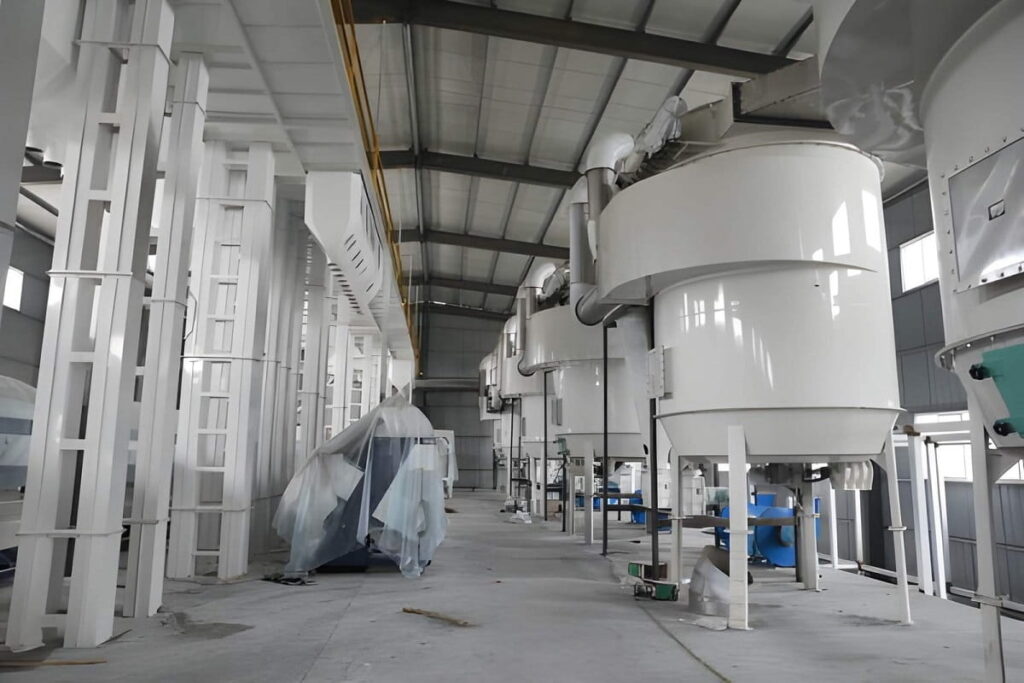
The Real Cost of Small Scale Urea Production
Most people think “small scale urea production” means building a mini version of those massive fertilizer plants you see near natural gas fields.
Not quite.
A true synthesis plant (converting ammonia and CO2 into urea) rarely makes sense below 100,000 tons per year. Those facilities cost hundreds of millions.
What most entrepreneurs actually mean is a granulation or blending facility that takes bulk urea and turns it into:
- Granular fertilizer
- NPK blends
- Coated slow-release products
- Custom formulations
This approach costs 90% less and can be profitable at just 1-5 tons per hour.
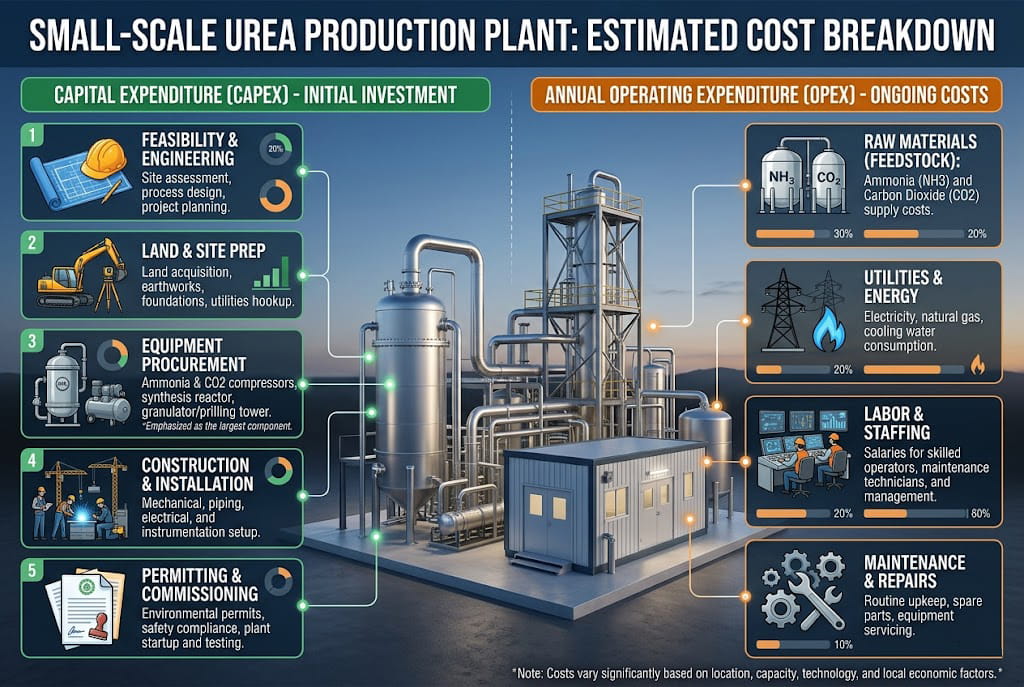
Equipment Costs: The Biggest Chunk
Your machinery will eat up 60-70% of your initial investment.
Here’s what you’ll need:
For a basic powder blending line ($30,000-$60,000):
- Mixer
- Conveyor system
- Simple bagging equipment
- Basic quality control tools
For a granulation plant ($100,000-$200,000):
- Rotary drum granulator
- Dryer
- Cooler
- Screening equipment
- Coating system (optional)
- Automated bagging line
I’ve seen operators start with used equipment to cut costs by 40%. But watch out – older dryers and granulators often guzzle energy like crazy.
Hidden Costs That Can Break Your Budget
Remember when I said the equipment costs $100,000-$200,000?
That’s just the machines.
You also need to factor in:
Installation and commissioning: Add 15-20% to equipment costs. A $150,000 granulation line needs another $22,500-$30,000 for proper setup.
Civil works: Even a small 5 TPH plant needs 300-800 square meters of covered space. Construction runs $50-$100 per square meter in most markets.
Utilities hookup:
- Three-phase power (200-500 kW)
- Water treatment system
- Compressed air
- Natural gas or LPG for drying
Permits and licensing: Environmental permits, fertilizer manufacturing license, safety clearances. Budget $10,000-$30,000 depending on your location.
(Pro tip: Start the permit process 6 months before you plan to break ground. Trust me on this one.)
Operating Costs: Where Profits Live or Die
Your biggest ongoing expense? Raw materials.
Bulk urea prices swing wildly – from $300 to $800 per ton over the past few years. When prices spike, your margins evaporate faster than water on a hot granulator.
Here’s a typical monthly operating budget for a 3 TPH plant running one shift:
Raw materials (70% of costs):
- Bulk urea: 500 tons × $400 = $200,000
- Additives and coating: $20,000
Utilities (15% of costs):
- Electricity: $15,000
- Gas/fuel: $10,000
- Water: $2,000
Labor (10% of costs):
- 2 operators: $6,000
- 1 supervisor: $4,000
- 4 packers/helpers: $8,000
Other (5% of costs):
- Maintenance: $5,000
- Quality testing: $3,000
- Packaging materials: $7,000
Total monthly operating cost: ~$280,000
With granular urea selling at $550-$650 per ton, you’re looking at gross margins of 20-30%.
Not bad. But those margins disappear fast if you can’t secure stable raw material prices.
The Smart Way to Start Small
Want to minimize risk? Start with a basic blending operation.
Here’s why:
- Lower capital cost: $30,000 gets you running vs. $200,000+ for granulation
- Faster setup: 2-3 months vs. 6-12 months
- Flexible products: Easy to switch between NPK ratios
- Lower operating costs: No drying = 50% less energy use
Once you’ve built a customer base and understood your market, upgrade to granulation.
I’ve seen three entrepreneurs follow this path in the past two years. All three expanded to full granulation within 18 months.
Location Matters More Than You Think
Your plant location can swing costs by 40% or more.
Best locations share three features:
- Near agricultural areas: Cuts transport costs to farmers
- Good transport links: Rail or highway access for bulk deliveries
- Reliable power: Frequent outages will destroy product quality
Avoid the temptation to set up in a cheap industrial zone 200km from your customers.
Transport will kill your competitiveness.
Technology Choices That Impact Your Bottom Line
Not all granulation technologies are equal.
Pan granulation:
- Lower equipment cost ($50,000-$80,000)
- Better for small batches
- Harder to maintain consistent quality
- Uses more binder
Drum granulation:
- Higher equipment cost ($100,000-$150,000)
- More consistent product
- Lower operating costs
- Easier to scale up
For operations under 5 TPH, I lean toward drum granulation despite the higher upfront cost. The consistency pays off in customer retention.
ROI Reality Check
Let’s talk returns.
A well-run 3 TPH granulation plant can generate:
- Revenue: $3.5-4.2 million annually
- Gross profit: $700,000-$1.2 million
- Net profit: $350,000-$600,000
Payback period: 8-18 months
But (and this is a big but)…
These numbers assume:
- 70% capacity utilization
- Stable raw material prices
- No major equipment breakdowns
- Consistent product quality
Miss any of these and your payback stretches to 3+ years.
Common Mistakes That Cost Big Money
I’ve watched dozens of small fertilizer plants launch. The ones that fail usually make these mistakes:
1. Underestimating working capital
You need 2-3 months of operating costs in the bank. Raw material suppliers want cash upfront. Farmers expect 30-60 day credit terms.
2. Skipping quality control
One batch of substandard fertilizer can destroy your reputation. Budget for proper lab equipment and testing from day one.
3. Ignoring seasonality
Fertilizer demand spikes during planting season. You need storage for 2-3 months of production or you’ll be turning away orders when demand peaks.
4. Choosing the wrong technology
That bargain Chinese granulator might save $50,000 upfront but cost $100,000 in downtime and repairs over two years.
Financing Your Plant: Options and Reality
Banks love fertilizer plants (steady demand, tangible assets). But they want to see:
- 30-40% equity investment
- Proven management team
- Offtake agreements
- Detailed feasibility study
Alternative financing routes:
Equipment financing: Many suppliers offer 2-3 year payment terms. Rates are higher but approval is easier.
Partner with farmers cooperatives: They provide customer base and sometimes capital in exchange for better prices.
Government schemes: Many countries subsidize fertilizer production. Check your agriculture ministry’s programs.
The Regulatory Maze
Every country regulates fertilizer differently. But expect to deal with:
Environmental permits:
- Air emissions (especially for dryers)
- Wastewater discharge
- Noise levels
Product registration:
- Nutrient guarantees
- Heavy metal limits
- Labeling requirements
Safety compliance:
- Worker safety equipment
- Fire suppression systems
- Emergency response plans
Start the permit process early. I mean EARLY. Like 6-12 months before you plan to start construction.
Future-Proofing Your Investment
The fertilizer industry is changing fast. Smart operators are preparing for:
Precision agriculture: Farmers want custom blends for specific fields. Flexible blending systems will win.
Sustainability demands: Coated and slow-release products command premium prices and will grow 15-20% annually.
Direct-to-farmer sales: Cutting out distributors improves margins by 10-15%. Plan for this from the start.
Organic additions: Equipment that can handle both mineral and organic inputs gives you flexibility as markets shift.
Your Next Steps
Ready to move forward? Here’s your action plan:
- Conduct a feasibility study: Include local demand analysis, competitor mapping, and raw material sourcing options.
- Visit operating plants: Nothing beats seeing equipment in action. Most manufacturers arrange plant visits.
- Secure raw material contracts: Lock in supply agreements before you buy equipment.
- Start permitting process: While you’re finalizing equipment choices.
- Build your team: You need at least one person with fertilizer production experience.
The Bottom Line on Small Scale Urea Production Plant Cost
A basic powder blending operation starts around $50,000-$80,000 all-in.
A proper granulation plant runs $200,000-$350,000 including installation and working capital.
Full urea synthesis? Forget it unless you have $50+ million and access to cheap natural gas.
The sweet spot for new entrants: Start with a 2-3 TPH granulation line focused on premium products (coated, slow-release, custom blends). Total investment of $250,000-$300,000 can generate $400,000+ in annual profits within 18 months.
But success requires more than just buying equipment. You need reliable raw material sources, quality control discipline, and deep understanding of your local agricultural market.
The opportunity is real. Global fertilizer demand grows 2-3% annually. Small, nimble producers who focus on service and quality can compete effectively with giant corporations.
Just make sure you budget realistically. That $150,000 equipment quote is just the beginning of your actual small scale urea production plant cost.