
Quick Summary
Setting up a fertilizer plant in 2026 costs anywhere from $10,000 to $550,000+ depending on type and scale. Powder organic is cheapest; granular organic requires 3x more investment.
Hidden costs like raw material proximity, automation, and working capital can make or break your budget. Plan for at least $477k in operating cash to survive the first six months.
You’re probably here because you’ve been crunching numbers for weeks.
Maybe you’ve got a line on some cheap land. Or perhaps you’ve noticed that fertilizer prices in your region have gone through the roof, and you’re thinking: “Why not me?”
How much to set up a fertilizer plant isn’t a simple number. It’s a range. A wide one.
As a professional fertilizer production line manufacturer, I’ve analyzed dozens of fertilizer plant projects over the years. And I’ve pulled together data from actual 2026 market rates to give you a realistic picture of what you’re looking at.
Let’s dive in.
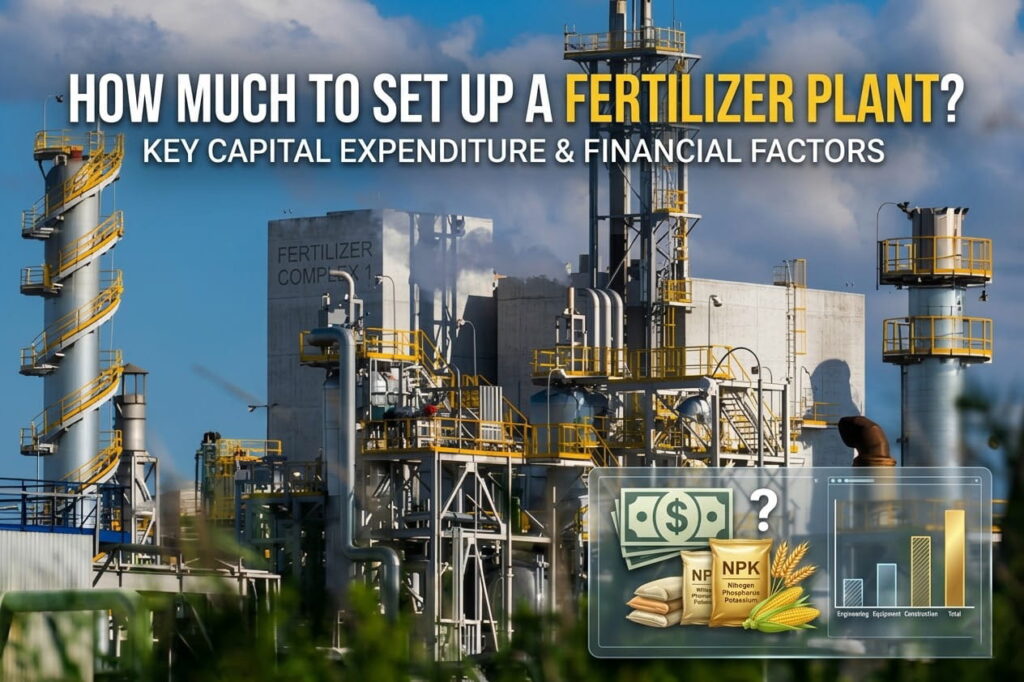
How Much to Set Up a Fertilizer Plant?
Depending on what you want to produce, how much to set up a fertilizer plant breaks down like this:
- Powder Organic Line: $30,000 – $100,000
- Granular Organic Plant: $100,000 – $550,000
- NPK Blending Setup: $10,000 – $150,000
- NPK Granulation Plant: $50,000 – $500,000+
- Liquid Fertilizer Facility: $20,000 – $300,000+
But here’s the thing:
These numbers only tell part of the story.
Plant Type by the Numbers
Let me break this down in a way that actually makes sense.
Powder Organic Lines (The Budget-Friendly Option)
If you’re just getting your feet wet, powder organic fertilizer is your lowest-risk entry point.
A 1–5 ton per hour powder line will run you $30,000 to $45,000. At the top end, a 15–20 TPH operation bumps up to $80,000–$100,000.
Why the big spread?
Simple: you’re skipping the drying and cooling stages. That means fewer machines, less energy consumption, and a much simpler layout.
Pro Tip: If your local farmers are already used to applying powder, start here. You’ll be profitable faster.
Granular Organic (The Premium Play)
Granules sell for more. Everyone knows that.
But here’s what most people don’t realize:
You’ll need roughly 3x the equipment investment compared to powder.
A small-scale granular line (1–5 TPH) runs $100,000 to $150,000. Jump to 10–20 TPH, and you’re looking at $350,000 to $550,000.
The extra equipment? Rotary dryers, coolers, coating drums. These aren’t optional if you want stable, baggable granules that don’t turn into mush after a month in storage.
NPK Options (Chemical Fertilizer)
This is where things get interesting.
Bulk Blending is your cheapest route into NPK production. A simple setup with batching equipment, a mixer, and a packing line runs $10,000 to $50,000 for small scale. Medium/large operations hit $60,000–$150,000.
But if you want granular NPK (the stuff that commands premium prices), you’re looking at $50,000 to $150,000 for small scale and $300,000–$500,000+ for larger operations.
Liquid Fertilizer (The Wildcard)
Liquid lines are interesting because they require stainless steel equipment (corrosion resistance adds cost).
Small liquid plants start around $20,000–$50,000. Large-scale automated lines? $200,000+ easily.
Breaking Down the CAPEX
Let’s get specific.
For a standard granular organic fertilizer plant (the most common entry point I see entrepreneurs choose), here’s how a $500,000 budget typically shakes out:
| Category | Percentage | Estimated Cost |
|---|---|---|
| Production Machinery | 30–40% | $150,000–$200,000 |
| Drying & Cooling Systems | 20% | $100,000 |
| Facility & Utilities | 20% | $100,000 |
| Quality Control Lab | 10–15% | $50,000–$75,000 |
| Permits & Licensing | 5% | $25,000 |
Sound good? Here’s where people mess this up:
They forget that the machinery cost is just the beginning. Installation alone can add 10–15% to your equipment budget.
The Hidden Costs Nobody Talks About
I’ve seen too many entrepreneurs blow their budget because they forgot these line items.
Raw Material Proximity (This Is Huge)
Transporting heavy raw materials (wet manure, rock phosphate, potash) is brutally expensive.
If you locate your plant near your raw material source, you can cut logistics costs by up to 30%. That’s not a small number.
In my experience, this single decision determines whether you’re profitable in year one or scrambling for cash by month six.
The Automation Trade-Off
Here’s the deal:
Semi-automatic bagging and PLC-controlled batching increase your upfront costs. Significantly.
But they also slash your long-term labor overhead.
A fully automated line might need 6–10 workers. A manual operation? Try 20–40.
With labor rates ranging from $5 to $150 per day depending on your location, this adds up fast.
Energy Consumption
Your dryers will eat energy like crazy.
For a 100 kW production line, you need a backup generator rated at 150–200 kW if you’re in an area with unstable power. That’s another $20,000–$50,000 people forget to budget.
Real-World Example: Medium-Scale Organic Fertilizer
Let me walk you through a real scenario.
A client of mine recently launched an organic fertilizer production facility. Here’s what their numbers looked like:
Initial CAPEX: $425,000
- Production Equipment: $150,000 (plus $50,000 upgrade for blending)
- R&D Lab Setup: $75,000
- Facility Improvements: $25,000
- Pre-Launch Payroll (3 months): $157,500
- Logistics Assets: $80,000 (delivery vehicle + forklift)
- Software & Licensing: $15,000
Monthly OPEX: $70,000–$110,000
- Raw Materials: Manure, crop residues, microbial cultures
- Labor: 20–40 workers
- Energy: Electricity + fuel for dryers
- Packaging: 50kg bags + stitching
Here’s the kicker:
They hit breakeven in 2 months.
But they needed a cash buffer of $1.039 million to get there.
The bottom line? Strong unit economics mean nothing if you run out of cash before revenue starts flowing.
Land Costs by Plant Type
You might be wondering about land.
Here’s what I’m seeing in 2026:
| Plant Type | Capacity | Area Required | Annual Rent (Est.) | Purchase Cost (Est.) |
|---|---|---|---|---|
| Powder Organic | 1-3 TPH | 800 m² | $5,000–$24,000 | $100,000–$400,000 |
| Powder Organic | 20 TPH | 5,000 m² | $25,000–$150,000 | $500,000–$2.5M |
| Granular Organic | 1-3 TPH | 2,000 m² | $10,000–$60,000 | $200,000–$1M |
| Granular Organic | 20 TPH | 10,000 m² | $50,000–$300,000 | $1M–$5M |
| NPK Plant | 1-40 TPH | 1,000–8,000 m² | $5,000–$240,000 | $100,000–$4M |
| Liquid Plant | 1,000–20,000 L/h | 1,000–5,000 m² | $5,000–$150,000 | $100,000–$2.5M |
Pro Tip: If land costs are killing your budget, consider powder lines or dry granulation. They require 30–50% less space than wet granulation plants.
3 Ways to Reduce Your Fertilizer Plant Cost
1. Start Small, Scale Smart
I see this mistake constantly:
Entrepreneurs buy equipment sized for year 5 when they’re still figuring out year 1.
A 1–5 TPH line can produce 30,000 tons annually. That’s enough to generate $150,000–$200,000 in revenue and pay back your investment in 2–3 years.
Start there. Then add capacity as demand grows.
2. Buy Key Equipment First
For NPK granular production, you can start with just:
- Feeder
- Double roller granulator
- Packing machine
Add the dryer, cooler, and coating line later when you have cash flow.
In my experience, this phased approach works beautifully for bootstrapped entrepreneurs.
3. Consider Used Equipment
Refurbished mixers, conveyors, and even granulators can save you 10–15% upfront.
Just be careful with anything that touches corrosive materials. Stainless steel equipment is worth paying for new.
The $100,000 Fertilizer Plant (Yes, It’s Possible)
Can you set up a fertilizer plant for $100,000?
Absolutely.
Here’s how:
Option A: 5 TPH Dry Granulation (NPK)
- Dynamic batching machine: $12,000–$15,000
- Double shaft mixer: $6,000–$8,000
- Double roller granulator (2 units): $16,000–$24,000
- Rotary screener: $5,000–$7,000
- Packaging equipment: $10,000–$12,000
- PLC container: $4,000–$6,000
- Belt conveyors: $4,500–$12,000
Total: ~$57,500–$84,000
Option B: 10 TPH Organic (Simplified)
- Wheel type compost turner: $30,000–$35,000
- Vertical crusher: $6,000–$8,000
- Rotary drum granulator: $35,000–$40,000
- Semi-automatic bagging: $10,000–$15,000
- Belt conveyors: $4,500–$12,000
- PLC container: $4,000–$6,000
Total: ~$90,000–$116,000
See what happened there?
You’re not getting a fully automated, turnkey operation. But you ARE getting a functional plant that produces salable product.
Labor Savings Through Automation
Here’s a number that stops people cold:
A traditional 1–20 TPH fertilizer plant needs 20–40 workers.
With automation? 6–10.
Let’s do the math:
If your average worker costs $30/day (conservative estimate), that’s:
- Traditional: $600–$1,200 per day
- Automated: $180–$300 per day
Annual savings: $150,000+ easily.
The bottom line? That automated packing line and palletizing robot pays for itself in 12–18 months.
Energy Cost Strategies
Your biggest operational expense after raw materials? Energy.
Here’s how to control it:
Go Diesel for Composting
Diesel-powered compost turners are actually more economical than electric in many regions. They offer better maneuverability and eliminate the need for expensive electrical infrastructure in composting areas.
Dry Granulation = Lower Energy
If your product can handle it, dry granulation eliminates drying and cooling entirely. That’s a 20–30% reduction in your energy bill.
Heat Recovery Systems
For wet granulation lines, drum dryers with heat recovery systems can improve efficiency by up to 20%. Worth every penny.
The Raw Material Equation
Here’s a truth bomb:
Your raw material cost isn’t just about price per ton. It’s about distance.
If you own a livestock farm, manure is essentially free. If you’re buying from suppliers, you’re at the mercy of market prices.
For organic fertilizer, you’ve got options:
- Livestock manure
- Agricultural residues
- Industrial waste
- Urban sludge
- Municipal waste
For NPK, you’re looking at:
- Urea
- MAP, DPP, SSP
- Potassium chloride/sulfate
- Calcium carbonate
Pro Tip: Sometimes you can replace expensive microbial agents with rice bran, yeast, or sugar. Not always, but worth testing.
Permits and Licensing (Don’t Skip This)
I’ve watched projects stall for 6 months because someone forgot about environmental clearances.
Budget at least $25,000–$50,000 and 3–6 months for:
- Environmental permits
- Local business licenses
- Agricultural certifications
- Safety inspections
Sound annoying? It is. But operating without them can get your plant shut down overnight.
The Bottom Line
So how much to set up a fertilizer plant?
Here’s your cheat sheet:
| Plant Type | Capacity | Investment Range |
|---|---|---|
| Powder Organic | 1-20 TPH | $30,000–$100,000 |
| Granular Organic | 1-20 TPH | $100,000–$550,000 |
| NPK Blending | 5-100 TPH | $30,000–$500,000 |
| NPK Granulation | 1-40 TPH | $80,000–$500,000 |
| Liquid Fertilizer | 1,000–20,000 L/h | $20,000–$300,000 |
Plus $477,000+ in working capital to cover your first six months.
In my experience, the entrepreneurs who succeed aren’t the ones with the biggest budgets. They’re the ones who:
- Start with a clear understanding of their local market
- Match their equipment to actual demand (not wishful thinking)
- Locate near raw materials 4. Phase their expansion
The fertilizer market isn’t going anywhere. Global food demand keeps climbing, and soil needs replenishment.
If you’ve got the patience and the capital, how much to set up a fertilizer plant is an investment that can pay off for decades.
Now get out there and crunch those numbers. Your fertilizer plant won’t build itself.
This is super good information, I hope it doesn’t change for the next 5 years too much.. You need to recommend a list of builders, who could stay close to your guidelines as they build, keeping cost some what in line with your figures +.-