Quick Summary:
Fertilizer mixer machines are modern fertilizer production equipments that combine raw ingredients into a single uniform nutrient blend, but no single type fits every operation. Horizontal, vertical, rotary drum, pan, and BB blenders have different strengths—and the right choice depends on your material, capacity, and production setup.
Watch out for compatibility risks: some fertilizers react when mixed, causing nitrogen loss or lumps. For best results, pair your mixer with a batching system and avoid common mistakes like overfilling, skipping maintenance, or using the wrong mixer type.
Feeding your crops with a fertilizer mix that isn’t uniform can sabotage your harvest before it even starts. Manual mixing leaves you with clumps, separated particles, and nutrient imbalances—so some plants thrive while others lag behind. That patchiness doesn’t just hurt yields; it wastes your raw materials and budget. The fix? A fertilizer mixer machine. But with so many types available, choosing the wrong one creates even more headaches.
In this guide, as a professional fertilizer mixer machine manufacturer, I will explain what fertilizer mixer machines are, the most common types (horizontal, vertical, rotary drum, pan, and BB blenders), how the mixing process works, and the key factors to weigh before you buy. You’ll also learn which materials to avoid mixing and the mistakes that can hurt your production line.

Why Should You Care About Uniform Fertilizer Mixing?
Fertilizer mixing isn’t the flashiest part of farming or manufacturing. But it’s one of the most important.
Here’s the deal: if you’re putting down a fertilizer blend with an inconsistent NPK ratio, you can’t blame the fertilizer for poor results. You’d be blaming the mixing process.
The most valuable functions of a fertilizer mixer machine are:
- Blending ingredients completely so each batch has the same nutrient profile.
- Improving accuracy so plants get the exact ratio you planned.
- Preventing separation so different particle sizes and weights don’t sort themselves apart during storage or transport.
In other words, a fertilizer mixer turns a pile of individual raw materials into a single, reliable product. You can actually trust it.
The Main Types of Fertilizer Mixer Machines
Not all fertilizer mixer machines are created equal. In fact, choosing the wrong type is one of the most common mistakes I see. Let’s break down the main options so you know what you’re looking at.
Horizontal Mixers
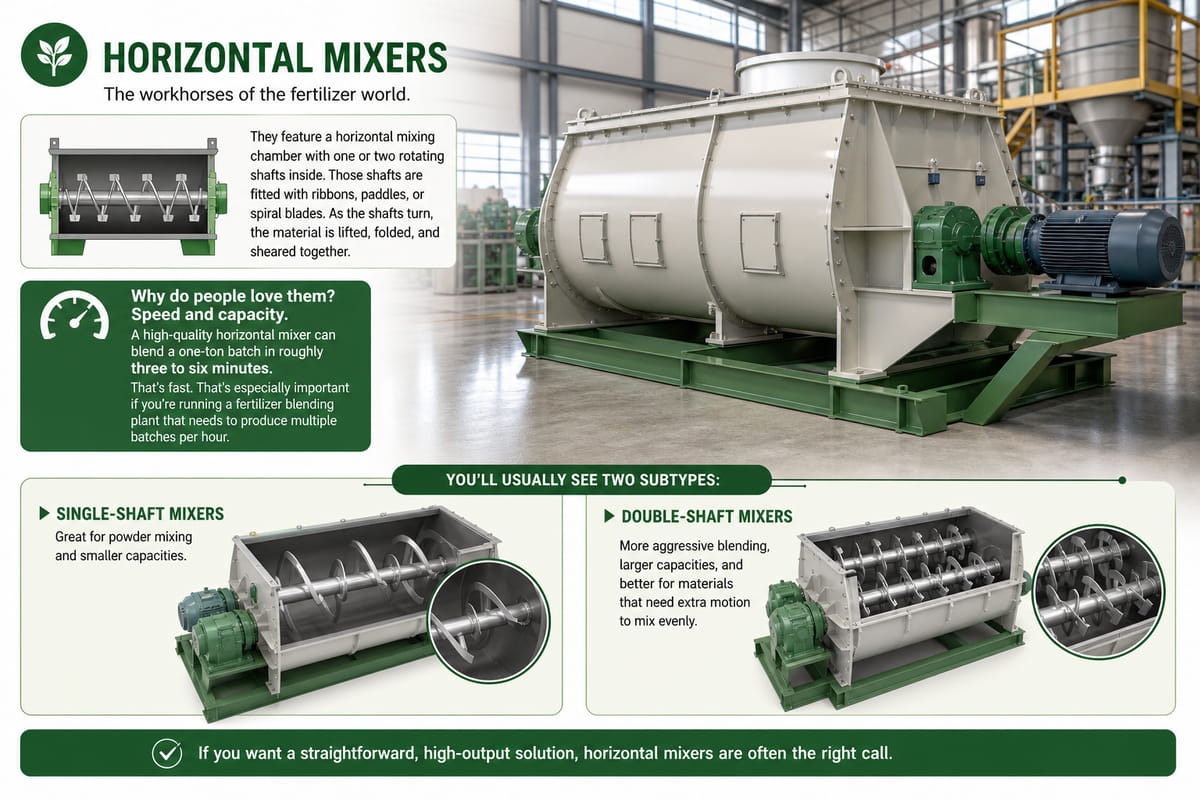
Horizontal mixers are the workhorses of the fertilizer world.
They feature a horizontal mixing chamber with one or two rotating shafts inside. Those shafts are fitted with ribbons, paddles, or spiral blades. As the shafts turn, the material is lifted, folded, and sheared together.
Why do people love them? Speed and capacity.
A high-quality horizontal mixer can blend a one-ton batch in roughly three to six minutes. That’s fast. That’s especially important if you’re running a fertilizer blending plant that needs to produce multiple batches per hour.
You’ll usually see two subtypes:
- Single-shaft mixers — great for powder mixing and smaller capacities.
- Double-shaft mixers — more aggressive blending, larger capacities, and better for materials that need extra motion to mix evenly.
If you want a straightforward, high-output solution, horizontal mixers are often the right call.
Vertical Mixers
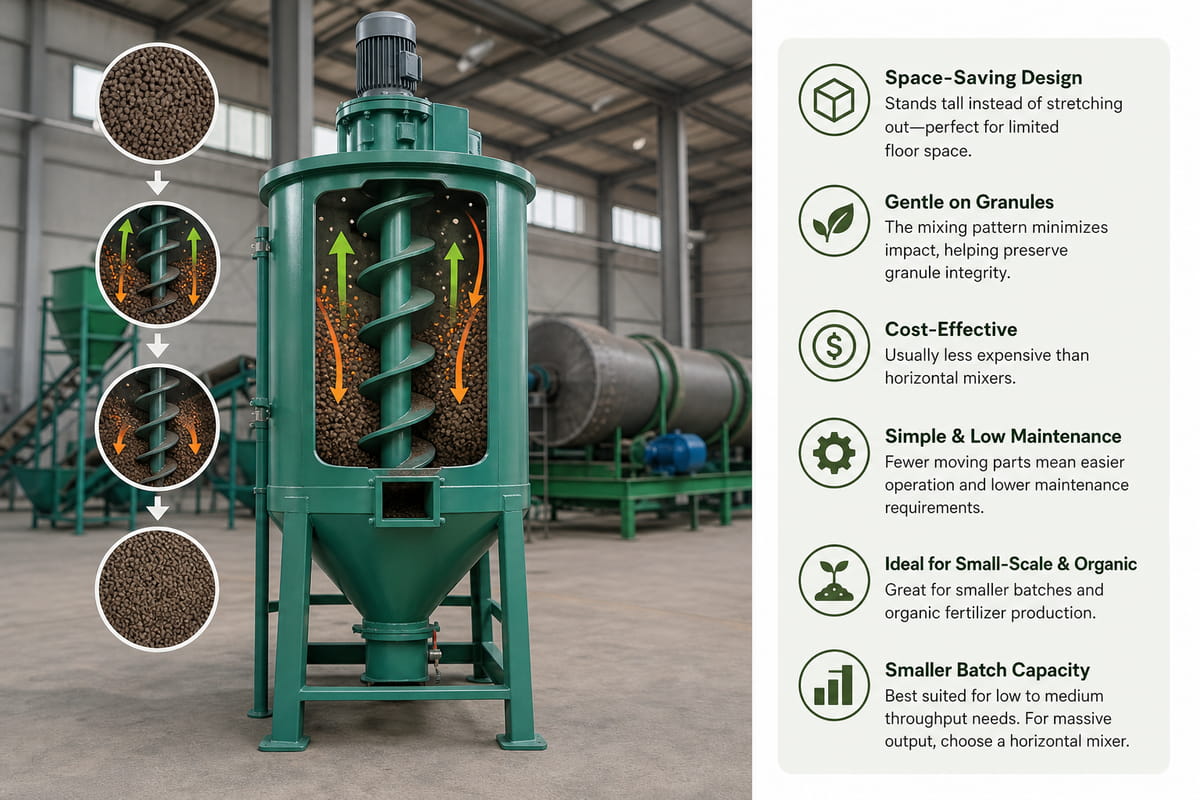
Vertical mixers are the space-saving option.
Instead of a long horizontal chamber, they use an internal auger screw to lift materials from the bottom to the top. Gravity then pulls the material back down through the mixing pattern.
This design is gentler on granules. It’s also ideal for operations with limited floor space. The footprint is smaller because the machine stands tall rather than stretched out.
Vertical mixers are usually less expensive than horizontal units. They also work well for small-scale organic fertilizer production or when you need a simple, lower-maintenance setup.
Just remember: vertical mixers generally have smaller batch capacities. If you need massive throughput, you’ll probably want a horizontal system.
Rotary Drum Mixers

Rotary drum mixers take a different approach.
A big rotating drum slowly turns the material over and over. Think of it like a giant food dehydrator or a rock tumbler. The tumbling action blends powders and granules without crushing fragile particles.
This makes drum mixers a great choice for materials that break easily. They also work well when you need to add liquid coatings or moisture in a gentle way.
You won’t get the same speed as a horizontal mixer. But if product integrity matters more than speed, a rotary drum mixer is worth considering.
Pan Mixers
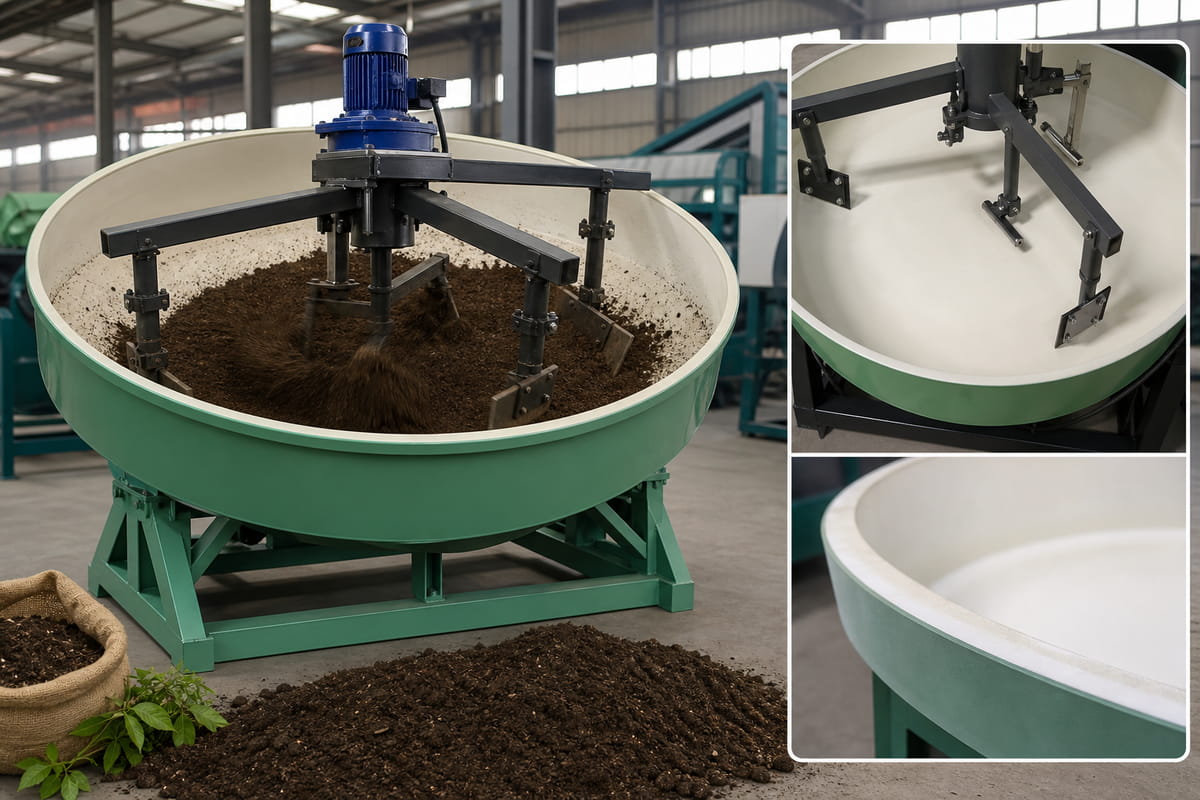
Let me tell you about pan mixers, because they’re a hidden gem in organic fertilizer production.
A pan mixer uses a flat, round pan with mixing arms above or inside the pan. The arms rotate and stir the material thoroughly. The mixing action is fast, efficient, and easy to control.
One of the reasons I personally recommend pan mixers for certain organic applications is their resistance to sticking. Many pan mixers use special polypropylene liners inside the disc. That means less material caking on the walls. It also makes cleanup easier and extends the machine’s life.
If you’re producing organic fertilizer and dealing with stickier raw materials, put pan mixers on your shortlist.
BB Fertilizer Blenders
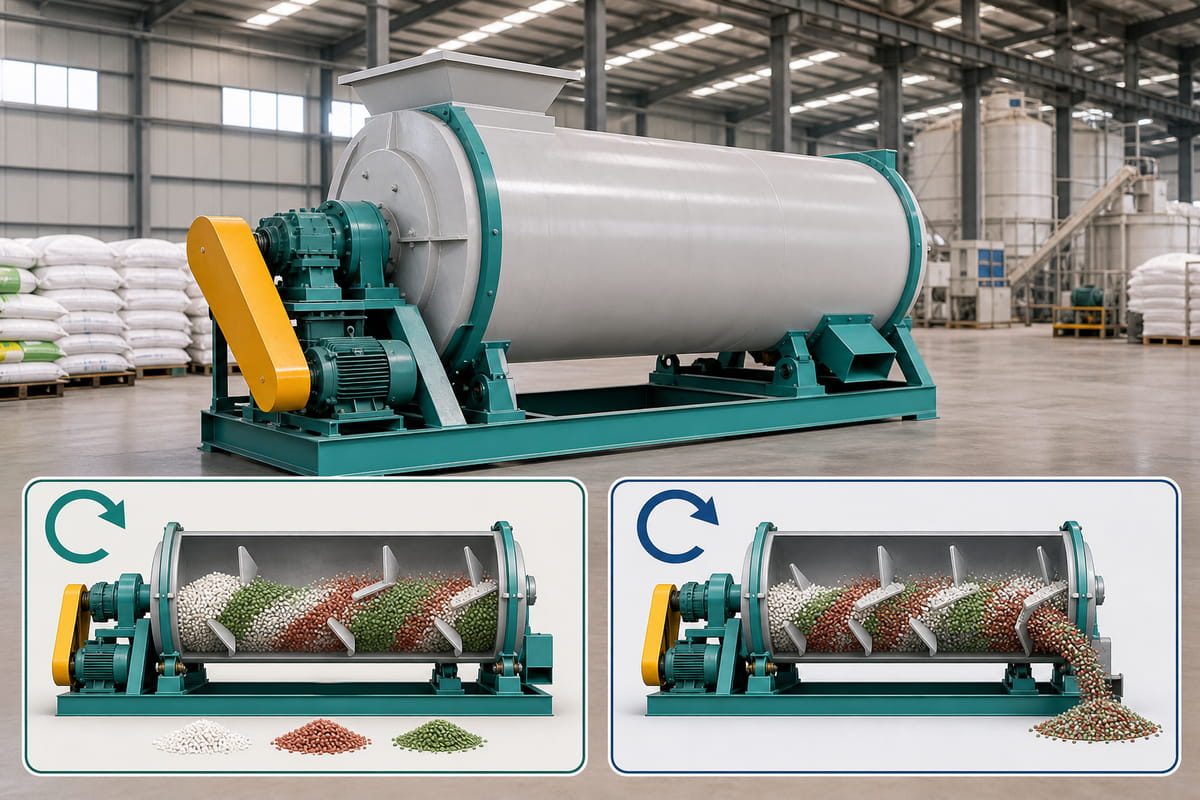
Bulk blending fertilizers are a different beast.
BB fertilizer blenders are designed specifically to mix granular or pelleted fertilizers without destroying them. Many of these machines use positive and negative rotation.
Here’s how that works: rotate the drum one direction, and you mix your fertilizer granules evenly. Reverse the direction, and it discharges the blended material. Simple and effective.
If you’re making bulk blended fertilizer, this type of machine is your best friend.
How Fertilizer Mixer Machines Work Step by Step
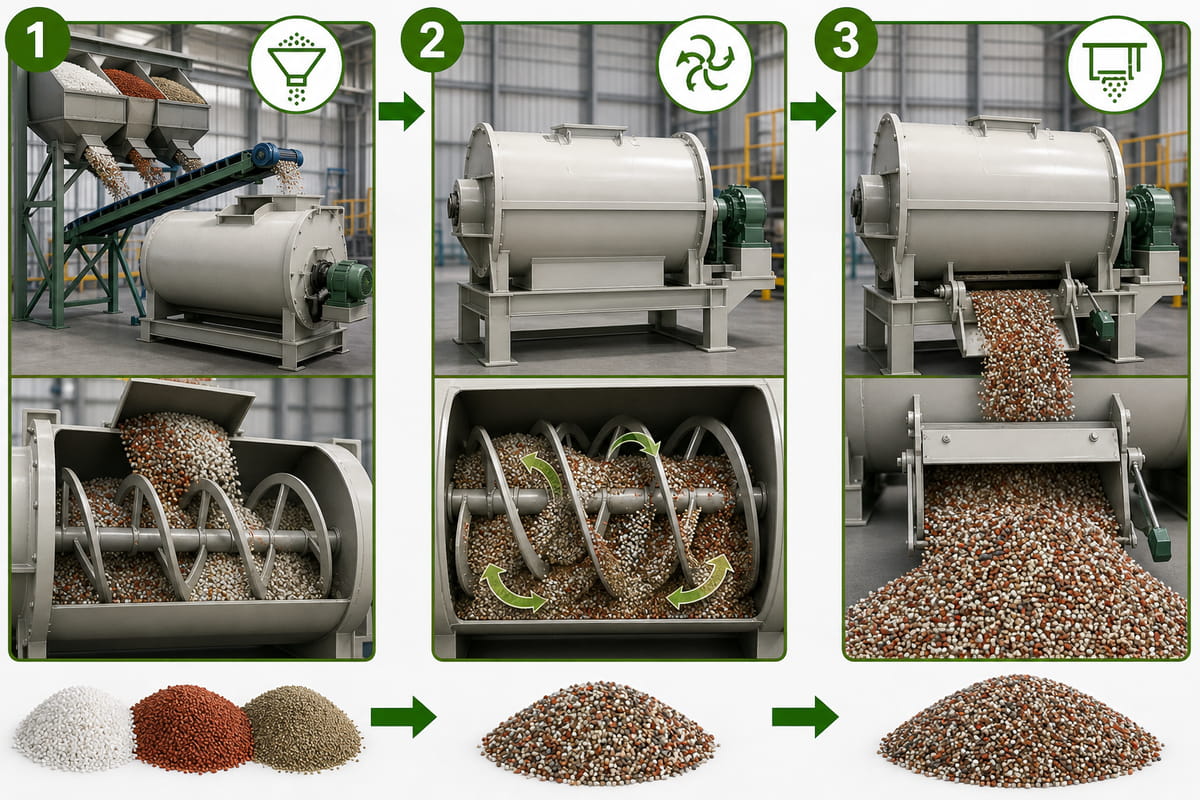
You might be surprised to learn that most fertilizer mixer machines follow the same basic workflow. It doesn’t matter if you’re using a horizontal ribbon blender or a rotary drum.
Step 1: Feeding
Raw materials enter the machine through an inlet. Depending on your setup, this can happen manually or automatically with conveyors and hoppers.
Ideally, you want to feed ingredients in the correct proportions before mixing starts. I’m a big believer in pairing mixers with batching equipment. That way, you can precisely control how much nitrogen, phosphorus, and potassium goes into each batch.
Step 2: Mixing
Once the materials are inside the mixing chamber, the real work begins.
Internal ribbons, paddles, screws, or drum rotation creates motion. The material gets folded over again and again. Particles that started on the top end up on the bottom. Particles on the bottom end up on top.
The goal is simple: make every handful of material identical.
Step 3: Discharging
When the mixing cycle is complete, the uniform blend exits through a discharge door or valve.
Some machines use automated discharge gates. Others reverse the direction of their mixing shaft or drum to push material out.
Either way, what comes out should look and test like a completely consistent fertilizer blend.
My Buying Checklist for Fertilizer Mixer Machines

If you’ve never purchased a fertilizer mixer before, the options can feel overwhelming. But I’ve found that most buying decisions come down to six things.
1. Batch Size and Production Capacity
How much fertilizer do you need per hour? Per day?
Don’t guess. Take your target production number and work backward. A small vertical mixer might be perfect for 500 pounds per batch. A large double-shaft horizontal mixer could handle 15 tons per hour.
Buying too small slows down your entire operation. Buying too large wastes energy and money.
2. Material Type
Are you mixing dry powders? Granules? Organic compost? Chemical fertilizers with added moisture?
Powders mix differently than granules. Sticky organic materials need a machine that won’t clog. Fragile granules need gentle mixing.
Always match the machine to the material. That’s the easiest way to avoid headaches.
3. Construction Quality
Fertilizer is corrosive. That’s just a fact.
Pay attention to the materials used inside the mixing chamber. Stainless steel spiral blades can handle harsh fertilizer ingredients. Hardened steel tool bits last longer. Polypropylene liners prevent sticking.
I always tell buyers to inspect the parts that touch the material. If those parts use cheap materials, you’ll be replacing them soon.
4. Mixing Speed and Efficiency
Time is money.
A mixer that takes twenty minutes per batch can wreck your production schedule. A mixer that finishes in six minutes keeps things moving. Look for horsepower, mixing speed, and the manufacturer’s expected cycle time.
5. Maintenance Requirements
The best fertilizer mixer machine is one you don’t have to fight with every week.
Ask about access to the mixing chamber. Can you easily inspect the blades and shafts? Are spare parts available? What about cleaning between different fertilizer recipes?
Routine maintenance is not the glamorous part of fertilizer production. But skipping it will cost you.
6. Integration With Your Production Line
A mixer isn’t an island.
If you’re building a compound fertilizer production line, the mixer needs to fit between your crusher, screener, batching system, and packaging equipment.
That means considering inlet heights, discharge positions, and conveyor connections. A machine that’s technically capable but impossible to integrate will still slow you down.
Pro Tip: always discuss your full line layout with the manufacturer before buying. They can help you customize the machine to fit your actual facility.
The Hidden Problem: Particle Segregation
Let me explain something that most people don’t think about until it’s too late.
Different fertilizer particles have different sizes and weights. When you mix them together perfectly and then pour them into a pile, they can separate again.
This is called particle segregation. It’s frustrating.
The heavy particles fall to the bottom. The fine powders stay on top. The entire blend becomes inconsistent before it reaches your field.
That’s why the design of your fertilizer mixer matters. A good mixer uses mechanical agitation to hold materials together long enough for a stable blend. The right machine won’t just mix your fertilizer; it will reduce segregation.
What Materials Are Fertilizer Mixer Machines Made From?

One thing that separates good fertilizer mixers from bad ones is the material quality. You’d be surprised how much difference this makes.
Fertilizer ingredients can be abrasive and corrosive. If the machine’s internal parts aren’t protected, they’ll wear down fast.
Here are the materials I look for:
- Stainless steel nozzles for water or liquid addition, because they resist corrosion.
- Hard steel tool bits on the mixing blades, because they stand up to abrasive powders.
- Polypropylene liners in pan mixers, because they stop material from sticking.
- Carbon steel frames with proper coatings, because the structure needs to handle heavy loads.
When you see these features, you’re looking at a machine that’s built for the long haul.
How Batching Equipment Fits Into Fertilizer Mixing
Here’s something I see a lot: people buy a great fertilizer mixer machine but forget how the materials get into it.
You don’t just dump in all your ingredients by eye. At least, you shouldn’t.
A batching machine or weighing system measures each raw material before it enters the mixer. This gives you precise control over your fertilizer formula.
For static batching, you can weigh materials before adding them to the mixer. For continuous batching, an automatic system feeds materials in the correct ratio while the mixer is running.
If you’re serious about producing commercial fertilizer, batching and mixing go hand-in-hand. Good mixing can’t fix bad ratios.
Can You Mix All Fertilizers Together?
This is a question I get all the time. And the answer is no.
Some fertilizers don’t react well together.
For example, quicklime, slaked lime, or wood ash shouldn’t be mixed with ammonium-based fertilizers. Mixing them can release ammonia gas. That means you lose nitrogen into the air instead of feeding your plants.
Another example is superphosphate. If you mix it with certain nitrates and store the blend for too long, it can become sticky, lumpy, and difficult to spread.
So, yes, fertilizer mixer machines are powerful tools. But they’re not magic. You still need to understand basic fertilizer compatibility.
If you’re unsure, talk to an agronomist or fertilizer specialist before mixing ingredients in bulk.
The Bottom Line
Fertilizer mixer machines are a critical part of modern fertilizer production. They turn separate ingredients into a consistent, reliable nutrient blend. That consistency protects your crops, saves money, and makes your operation far more efficient.
From horizontal mixers to pan mixers to BB fertilizer blenders, the best choice depends on your materials, your space, and your production targets.
But no matter which machine you choose, the principle stays the same: good mixing changes everything.
And that’s the real answer to what are fertilizer mixer machines — they’re the bridge between raw ingredients and a truly dependable fertilizer product.