Quick Summary:
An NPK fertilizer production line is an integrated system that converts nitrogen, phosphorus, and potassium raw materials into uniform compound fertilizer granules. The line depends on accurate batching, proper granulation, drying, cooling, screening, coating, and packaging to maintain product quality and storage stability.
The article also shows that capacity choice should follow distribution radius and raw material supply, not a random tonnage target. It highlights key cost ranges, the effect of granulation method on equipment and operating cost, and practical warnings such as moisture control, dust collection, and planning for year-three formulas.
Your NPK fertilizer production line should be your most profitable asset. Instead, you’re dealing with off-spec granules, high recycle ratios, and raw materials that cake in storage. Buy the wrong system and you’ll spend months fighting moisture issues, segregation problems, and packaging delays that eat your margins.
The good news? A properly designed line changes everything. In this guide, as a professional NPK fertilizer production line manufacturer, I will walk through the 7-step NPK manufacturing process, breaks down all 4 granulation methods, lays out real equipment costs from $90K to $2M+, and shows you exactly what an NPK fertilizer production line needs to produce consistent, uniform granules that farmers trust.

Why NPK Fertilizer Production Lines Matter
Three numbers explain why NPK owns the compound fertilizer market: 190 million tons of global demand, a 3.2% compound annual growth rate that’s held steady since 2018, and a per-hectare application rate that keeps climbing as soil depletion accelerates.
But the raw demand numbers only tell half the story.
The structural reason NPK keeps winning is simple: farmers don’t want to think about blending. A 15-15-15 NPK granule gives them predictable nutrient release in one pass across the field. No separate urea top-dressing. No triple superphosphate side-banding. One product, one application, predictable yield response.
That operational simplicity is what drives procurement managers to default to NPK over straight fertilizers.
And here’s the part most people miss: an NPK production line that can formulate 12-24-12 in the morning and switch to 20-10-10 by afternoon gives you pricing flexibility. When potash prices spike, adjust the potassium ratio. When urea floods the market, push nitrogen-heavy blends. The line itself doesn’t care—it’s all in the batching system’s recipe management.
In 2026, specialty NPK grades are growing twice as fast as commodity blends. 12-32-16 with zinc. 15-15-15+5S with sulfur coating. These aren’t niche products anymore. They’re the fastest-growing SKUs across distributors in Brazil, Nigeria, and India.
And producing them requires precise batching tolerance and a granulation process that handles micronutrient powders without segregation.
The Core Equipment in an NPK Fertilizer Production Line

Every NPK fertilizer production line shares a common backbone of nine equipment stations. The specific sizing changes by capacity, but the functional blocks don’t.
Here’s what you need to know:
- Automatic batching system – Weighs and doses raw materials. Look for ±0.2–0.5% dynamic accuracy.
- Crusher – Breaks down oversized particles. Chain or cage type works best.
- Mixer – Homogenizes raw materials before granulation. Dual-shaft is my pick.
- Granulator – Forms powder into granules. This is the heart of the whole line.
- Dryer – Removes moisture. Usually a rotary drum.
- Cooler – Brings hot granules back to near-ambient temperature.
- Screener – Separates on-size product from oversize and undersize.
- Coating machine – Applies anti-caking agent. Protects your product in storage.
- Packaging machine – Weighs and bags the finished fertilizer.
What often gets overlooked? The batching system’s recipe storage capacity. A system that holds only eight recipes will frustrate you within the first year. Most commercial plants run 20–40 active NPK formulas across different crop programs. Specify at least 50-recipe storage and make sure the PLC supports USB recipe import.
That one detail saves more downtime than any equipment upgrade you’ll make later.
The 7-Step NPK Fertilizer Manufacturing Process
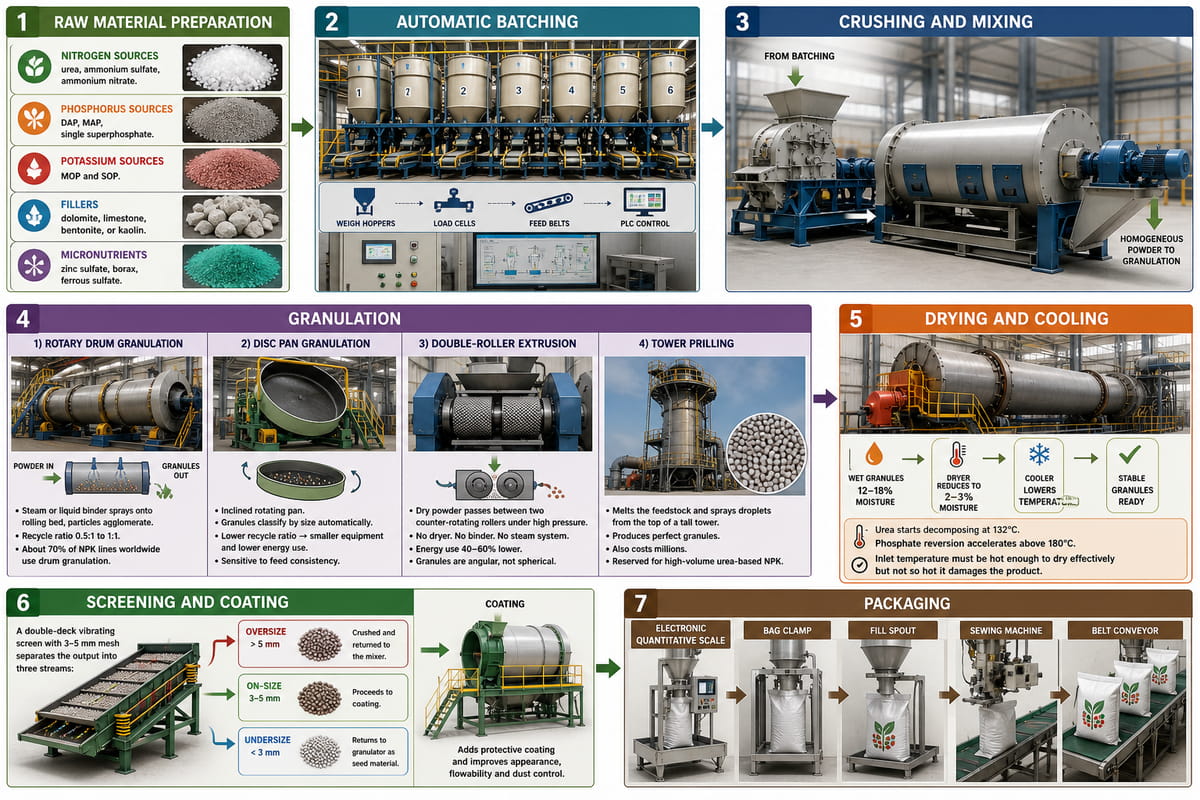
Let me walk you through the actual process. No fluff.
Step 1: Raw Material Preparation
NPK production draws from five raw material categories.
- Nitrogen sources: urea, ammonium sulfate, ammonium nitrate.
- Phosphorus sources: DAP, MAP, single superphosphate.
- Potassium sources: MOP and SOP.
- Fillers: dolomite, limestone, bentonite, or kaolin.
- Micronutrients: zinc sulfate, borax, ferrous sulfate.
The prep area needs three things right: storage segregation, moisture control, and pre-screening.
Raw materials stored in the same bay without physical dividers will cross-contaminate. Urea fines drifting into the MOP pile create hot spots in the granulator that cause uneven nutrient distribution.
Moisture is the second problem. Urea and ammonium sulfate are hygroscopic. If storage humidity stays above 60% for more than 48 hours, those materials start clumping. Budget for a dehumidifier in the storage area. It’s cheaper than the yield loss from bad batches.
Step 2: Automatic Batching
Batching is where the NPK ratio becomes real.
The difference between a 15-15-15 that tests at 15.2-14.8-15.1 and one that tests at 14.1-15.7-14.3 is the batching system’s dynamic accuracy under load.
A properly spec’d batching station uses individual weigh hoppers. Each raw material gets its own load cell and feed belt. The PLC cycles through the recipe and doses each material to setpoint.
Pro Tip: Some manufacturers quote static accuracy of ±0.1%. That looks great on a datasheet. It means nothing when material is moving at two tons per hour. Demand dynamic accuracy numbers.
Hopper count matters too. Six hoppers handles a basic NPK formula. But for specialty grades with sulfur, zinc, boron, and a separate coating binder, you’ll need eight to ten hoppers minimum. Plan for the formulas you’ll run in year three, not year one.
Step 3: Crushing and Mixing
The crusher and mixer form a single functional unit. Material enters the crusher, discharges into the mixer, and exits as a homogeneous powder ready for granulation.
Here’s the thing: the crusher size is dictated by your recycle ratio, not your raw material intake rate. In drum granulation, 30–50% of the material exiting the screener is off-spec and gets returned. So a 5 TPH line running at a 1:1 recycle ratio actually pushes 10 TPH through the crusher.
Undersize the crusher and you create a death spiral. The recycle loop backs up. The granulator starves for fines. Granulation efficiency drops. The recycle ratio climbs further. It takes about four hours to cascade from “slightly undersized crusher” to “line is down.”
The mixer has one job: homogeneity. If the mixed powder isn’t chemically uniform, every granule exiting the granulator carries a different NPK ratio. No amount of screening fixes that.
Binder addition happens in the mixer, not the granulator. Adding liquid binder at 3–8% by weight here gives more even distribution than spraying it onto the granulation bed.
Step 4: Granulation
This is the heart of the line.
Four granulation methods dominate:
Rotary drum granulation is the workhorse. Powder enters a rotating drum, steam or liquid binder sprays onto the rolling bed, and particles agglomerate into granules. Recycle ratio runs 0.5:1 to 1:1. About 70% of NPK lines worldwide use drum granulation.
Disc pan granulation uses an inclined rotating pan. Granules classify themselves by size automatically. Recycle ratio is lower, which means smaller downstream equipment and lower energy use. The catch? It’s sensitive to feed consistency.
Double-roller extrusion skips the wet granulation step entirely. Dry powder passes between two counter-rotating rollers under high pressure. No dryer. No binder. No steam system. Energy use is 40–60% lower. The trade-off? Granules are angular, not spherical.
Tower prilling melts the feedstock and sprays droplets from the top of a tall tower. Produces perfect granules. Also costs millions. Reserved for high-volume urea-based NPK.
Your granulation method choice locks in your equipment list, your operating costs, and your product quality ceiling.
Step 5: Drying and Cooling
Wet granules leaving the granulator carry 12–18% moisture. At that level, they’ll cake into a solid block inside the storage silo within 72 hours.
The dryer pulls that down to 2–3% without thermally degrading the nutrients. Urea starts decomposing at 132°C. Phosphate reversion accelerates above 180°C. So inlet temperature needs to be hot enough to dry effectively but not so hot it damages the product.
The standard spec is a rotary drum dryer with co-current airflow. The co-current design is non-negotiable. Counter-current would expose the driest, hottest granules to the hottest gas at the discharge end.
Cooling follows immediately after drying. Skip cooling and two things happen: hot granules soften the screen mesh, reducing service life by 60–70%. And hot granules bagged directly will sweat inside the bag and turn into a single solid lump.
Step 6: Screening and Coating
The screener defines your product. A double-deck vibrating screen with 3–5 mm mesh separates the output into three streams:
- Oversize gets crushed and returned to the mixer.
- Undersize returns directly to the granulator as seed material.
- On-size proceeds to coating.
If the purchase order says “90% between 2–4 mm” and screener efficiency drops to 85%, you’re shipping 5% off-spec material. Distributors notice within the first hectare.
Coating is deceptively simple. Granules enter a rotary drum where a metering pump atomizes anti-caking agent onto the rolling granule bed. This is also where colorants go in for product differentiation.
Step 7: Packaging
The packaging station turns bulk granules into a shippable product. Standard configuration: electronic quantitative scale, bag clamp, fill spout, sewing machine, belt conveyor.
A ±0.1% weighing accuracy on a 50 kg bag means ±50 grams. Tight enough for commercial sale and tight enough to avoid overfilling. Electronic scales with auto-tare give you audit trails. Mechanical scales don’t.
Woven polypropylene bags with an inner PE liner are the standard for 25–50 kg bags. For export shipments, spec a thicker liner and add a desiccant packet. Replacing a container-load shipment that arrived as a solid block of fused NPK will quickly make you glad you did.
What Does an NPK Fertilizer Production Line Cost?
Let’s talk money.
A complete NPK fertilizer production line costs:
- $90,000–$150,000 for 1 TPH capacity.
- $320,000–$520,000 for 5 TPH capacity.
- $1.2M–$2.0M for 20 TPH capacity.
The granulation method significantly affects the price. Double-roller extrusion lines cost 30–40% less than equivalent drum granulation lines because they eliminate the dryer, cooler, and steam system.
Equipment accounts for only 55–65% of total project cost. Civil construction, installation, and commissioning eat the rest.
The one line item most buyers under-budget by 30–50%? Interconnecting conveyors and bucket elevators. Equipment suppliers sometimes quote the major machines only and treat conveyors as “site scope.” Ask for a single quote that includes every conveyor, elevator, chute, and transfer point between the crusher inlet and the packing machine outlet.
How to Choose the Right Production Capacity
I get asked this constantly.
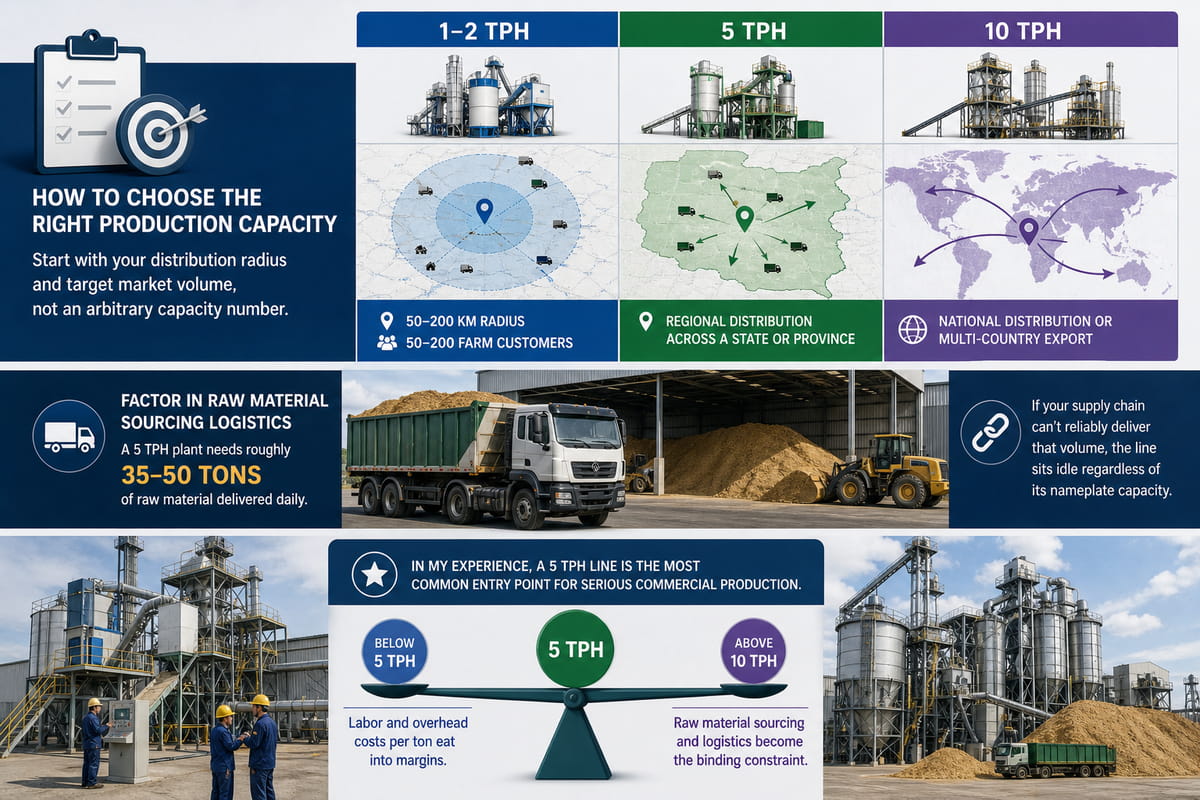
Here’s my advice: start with your distribution radius and target market volume, not an arbitrary capacity number.
A 1–2 TPH line serves a 50–200 km radius with 50–200 farm customers. A 5 TPH line handles regional distribution across a state or province. A 10 TPH line supports national distribution or multi-country export.
Also factor in raw material sourcing logistics. A 5 TPH plant needs roughly 35–50 tons of raw material delivered daily. If your supply chain can’t reliably deliver that volume, the line sits idle regardless of its nameplate capacity.
In my experience, a 5 TPH line is the most common entry point for serious commercial production. Below that, labor and overhead costs per ton eat into margins. Above 10 TPH, raw material sourcing and logistics become the binding constraint.
Common Mistakes I See in NPK Fertilizer Projects
Let me save you some pain.
Mistake #1: Underinvesting in the batching system. An 8-hopper system costs $25,000–$35,000 more than a 6-hopper. If your product roadmap includes specialty NPK with micronutrients, those two extra hoppers become essential. Adding them later costs twice as much.
Mistake #2: Buying a 1 TPH line thinking “we’ll scale up later.” A 1 TPH drum granulation line can’t be meaningfully upgraded to 5 TPH. The drum diameter is wrong. The dryer is undersized. The batching hoppers are too few. If 5 TPH is the three-year plan, buy modular equipment that can run at 1–2 TPH initially with space pre-planned for expansion.
Mistake #3: Skipping dust collection. At 5+ TPH, the visible dust plume from an unscrubbed system will attract regulatory attention. Budget for cyclone separation and wet scrubbing. Skimp here and you’ll be cleaning NPK dust off neighboring properties within a month.
Mistake #4: Ignoring moisture control. In humid coastal environments, spec a dryer with a higher length-to-diameter ratio. It costs a little more upfront. It prevents the moisture-caking problems that plague competitors.
The Bottom Line
Here’s the deal: an NPK fertilizer production line isn’t just a collection of machines. It’s a system. Every stage affects the next. Batching accuracy affects granule uniformity. Drying affects storage stability. Screening affects product reputation. Coating affects shelf life.
The plants that succeed don’t just buy equipment. They understand the process. They plan for their year-three product mix. They budget for the boring stuff like conveyors and dust collection. And they choose a granulation method that matches their raw materials and target market.
In 2026, the opportunity is real. Specialty NPK grades are growing. Farmers want uniform granules. The market rewards plants that can switch formulas quickly and produce consistent quality.
So, what is an npk fertilizer production line? It’s the system that turns raw potential into rows of healthy crops. And if you build one the right way, it’s also the system that turns a solid investment into a steady profit.