Key Takeaways
- Most plans fail because they try to build a full granulation plant on Day 1; the recommended path is Phase 1: Commercial Compost Production followed by Phase 2 (>2 years) for high-margin pellets.
- Realistic Capital Expenditure (CAPEX) for a semi-automated line sits between $150,000 and $510,000, with a minimum cash reserve need of $1,063,000 to cover working capital before first sales.
- Unit economics are brutal due to 40-60% mass loss during composting and high energy costs for drying; profitability hinges on charging tipping fees or granulating material to sell at $350 per ton instead of $40 per ton for bulk compost.
- The biggest bottleneck isn’t capital—it’s expertise in managing C/N ratios and troubleshooting a pan granulator.
You’re looking at a spreadsheet and it’s giving you a headache.
There’s a line item for a $150,000 granulator. Another for $80,000 in lab equipment. And you haven’t even factored in the cost of leasing land far enough away from neighbors so the smell doesn’t start a local revolt.
Starting an organic fertilizer production business plan isn’t like starting a dropshipping store or a freelance writing gig. This is heavy industry. It’s capital intensive. You’re dealing with manure logistics, volatile commodity prices, and machinery that can break down and cost you thousands in downtime.
But here’s the other side of that coin.
The demand for organic inputs is exploding. Farmers are watching their soil turn to lifeless dust because of synthetic salt-based fertilizers. They are desperate for soil amendments that actually build microbial biomass.
So, how do you write a business plan that doesn’t just collect dust on a bank manager’s desk but actually gets funded and, more importantly, makes money in 2026?
In this guide, as a professional organic fertilizer production line manufacturer, let me break down the 7 concrete steps you need to map out a 5-year forecast and understand exactly where every dollar of your $510,000 CAPEX is going.
Why You Need a Different Kind of Plan
Most business plan templates are garbage. They’re designed for SaaS companies or coffee shops. They don’t account for the specific nightmare of organic waste management logistics.
I’ve analyzed the business models of successful composting operations from Zimbabwe to Kochi, India. There’s a pattern. The ones that fail try to do everything at once. The ones that succeed phase their approach.
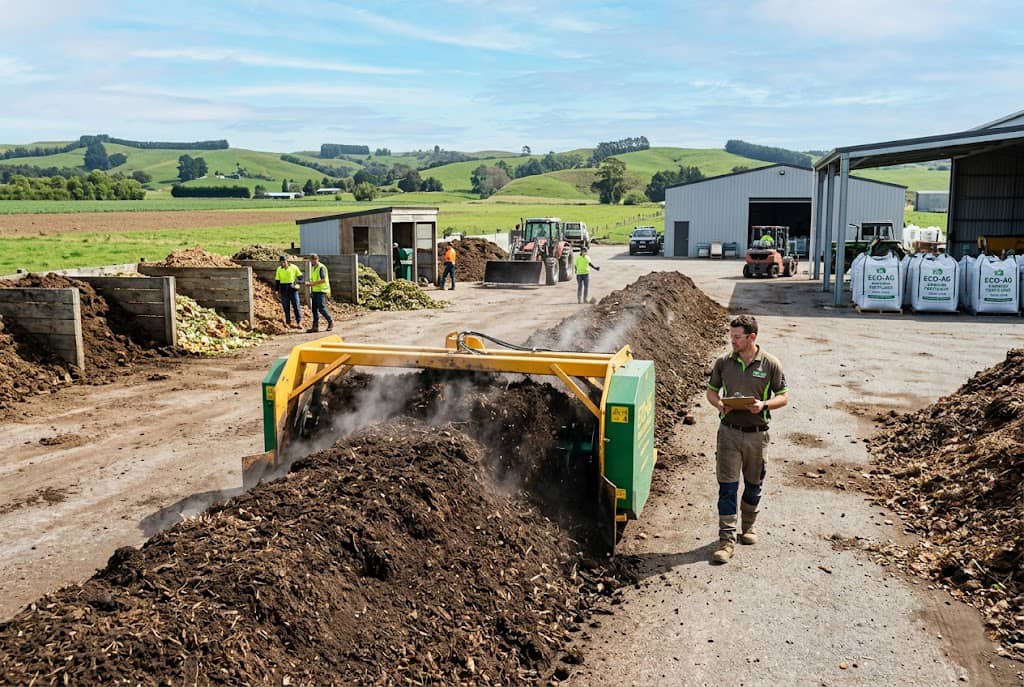
Pro Tip: Don’t try to build a full-scale granulation plant on Day 1. Start with Phase 1: Commercial Compost Production. Get the fermentation process dialed in. Master the supply chain of raw feedstock. Then, in Phase 2 ( >2 years), you add the drying, cooling, and granulation equipment to make high-margin pellets.
That’s exactly the structure we’re going to follow in this organic fertilizer production business plan.
7 Steps to Finish an Organic Fertilizer Production Business Plan
Step 1: Define Product and Market
You can’t just say “I sell fertilizer.” That’s like saying “I sell food.” Are you a Michelin-star chef or a hot dog vendor?
You need to segment your product mix. Based on market data, you need distinct lines:
1. Vitality Blend (Retail): Premium granulated product for home gardeners. High margin, small bag sizes.
2. Farm Bulk (Wholesale): Screened compost sold by the cubic yard or ton. Low margin, high volume.
3. Specialty Amendment: Think biochar blends or vermicompost for organic vegetable farms.
The Data: Why does this matter? Because the unit economics are wildly different. A bag of retail blend might sell for $2,800 per ton equivalent (when broken down), while bulk compost might fetch $40 per ton.
You need to map out your target customer segmentation right now. Are you selling to landscapers who need bulk organic matter? Or nurseries who need precise NPK ratios? This decision dictates the machinery you buy in Step 2.
Step 2: Detail Operations and CAPEX
This is the section where your organic fertilizer production business plan gets real. You’re not buying a laptop and a Wi-Fi connection. You’re buying steel.
According to industry data from established manufacturers, here’s the minimum viable asset list for a small-to-medium commercial setup targeting 1 ton per hour:
| Equipment | Estimated Cost (USD) | Why You Need It |
|---|---|---|
| Compost Turner | $8,200 – $20,000 | Oxygen equals speed. Turning windrows manually is a labor nightmare. |
| Crusher/Grinder | $8,000 – $24,000 | Uniform particle size = uniform composting. |
| Granulator Machine | $37,000 – $70,000 | This is the big one. Turns powder into sellable pellets. |
| Rotary Dryer & Cooler | $7,500 – $15,000 | If moisture is above 20%, your bags will burst or mold. |
| Packaging Machine | $1,500 – $4,000 | Manual bagging at scale is a great way to destroy employee morale. |
| Lab Equipment | $5,000 – $10,000 | You can’t guess NPK. You need quality control. |
Bottom Line? Your Capital Expenditure (CAPEX) will realistically sit between $150,000 (for a very lean, semi-manual compost operation) and $510,000+ for a fully automated granulation line. You need to secure this financing before you move a single shovel of chicken manure.
Step 3: Determine Pricing and Volume
I see a lot of spreadsheets projecting a breakeven in 2 months.
(Record scratch)
Hold up. Is that realistic? Only if you have a captive supply of free raw material and a guaranteed off-take agreement with a major farm cooperative.
For the rest of us mortals, you need to calculate COGS ruthlessly.
Here’s the math on COGS for one ton of finished product:
- Raw Material (Manure/Waste): $0 – $20 (If you charge tipping fees, this is negative cost. That’s the holy grail.)
- Transportation & Aggregation: $15 – $30 (Fuel isn’t cheap in 2026.)
- Direct Labor: $10 – $25 (Running the compost turner and screener.)
- Packaging (Bags/Pallets): $5 – $15.
Total Direct COGS per Ton: Roughly $30 – $90 for bulk compost.
If you sell that ton for $40, you have razor-thin margins. But if you granulate that same material and sell it for $350 per ton as an organic fertilizer, suddenly you have breathing room for sales commissions and fixed costs (like that $10,000/month lease payment for land).
Step 4: Calculate Unit Economics
This is where most organic fertilizer production business plans fall apart. They account for the machine payment but forget shrinkage.
- Moisture Loss: 1,000 kg of raw cow dung does not equal 1,000 kg of finished compost. The conversion rate is brutal. You lose about 40-60% of mass to volatile solids breakdown and water evaporation. That’s not waste; that’s science. But it kills your volume projections if you don’t account for it.
- Screening Rejects: About 10-15% of material coming out of the rotary drum screen is too big. You have to run it back through the crusher. That costs electricity and time.
- Quality Control Testing: You can’t just sell this stuff without an NPK analysis. Labs charge $50-$200 per sample. If you’re making custom blends, this operational expense adds up fast.
Step 5: Project Fixed and Variable Costs
Let’s talk about the monthly burn rate while you’re waiting for the thermophilic phase of your compost to finish (which takes 4-7 weeks, by the way—you’re not making anything sellable on Day 1).
Fixed Costs (You Pay No Matter What):
- Facility Lease: $10,000 – $15,200 (For 2,600 sqm in a rural/industrial zone).
- Admin Staff: $4,900 – $5,500.
- Equipment Financing/Depreciation: $5,000 – $12,000.
Variable Costs (Scale with Production):
- Sales Commissions: 10-30% (If you use distributors).
- Energy (Drying): This is the silent killer. Drying granules from 35% moisture to 15% moisture requires a lot of BTUs. Whether it’s diesel, natural gas, or biomass, budget $15-$25 per ton for fuel.
Minimum Cash Need: Before you sell a single bag, you’re looking at a cash reserve of $1,063,000 (including CAPEX and 6-12 months of working capital). That’s the number the bank wants to see.
Step 6: Build the Team and Wage Schedule
You cannot run a commercial compost facility with just a CEO and a laptop. You need boots on the ground.
Year 1 Headcount (Example for 5,000 TPY):
- Head of Production: 1 FTE ($70,000/yr). This person needs to understand C/N ratios and pile temperature like a chef knows a sauce.
- Machine Operators: 2 FTEs ($30,000/yr each). Someone has to drive the loader and watch the conveyor belt.
- General Labor/Casuals: 4-6 FTEs ($15,000/yr equivalent). For picking contaminants (plastic bags are the enemy of organic certification).
Pro Tip: The biggest bottleneck in this industry isn’t capital. It’s expertise. Finding someone who knows how to troubleshoot a pan granulator is hard. Budget for technical training or partner with an equipment supplier who offers turnkey installation support.
Step 7: Finalize Financial Metrics
Let’s bring this organic fertilizer production business plan home.
If you follow the phased approach—starting with bulk compost sales to cover OPEX while you save for the pelletizing line—here is a realistic financial trajectory for 2026:
- Year 1 Revenue (Bulk Compost): $49,000 – $150,000.
- Year 1 OPEX: $52,900 – $76,700.
- Net Year 1: Slight loss or breakeven. This is normal. You are building inventory and customer lists.
- Year 3 Revenue (Granulated Fertilizer + Compost): $450,000 – $800,000.
- Projected Payback Period: 15-24 months after Phase 2 expansion.
What About the “Secret Sauce”?
Since you’re reading this deep into the article, I know you’re serious about building a real business, not just a hobby vermicomposting bin.
The things you need to be thinking about for your marketing and your production include:
- Soil Amendment: This is how you sell it. You aren’t just selling nutrients; you’re selling soil structure and water retention.
- Microbial Biomass: This is the buzzword that justifies your premium price over synthetic NPK.
- C/N Ratio: If you don’t know the ideal Carbon-to-Nitrogen ratio is 30:1 for hot composting, you will end up with a smelly, anaerobic mess.
- Feedstock: This is the industry term for “stuff we put in the pile.” Diversify it. Chicken manure for nitrogen, sawdust or bamboo chips for carbon, and oyster shell flour for calcium.
- Granulation: The process of turning powder into hard, round pellets using a drum or pan granulator. This is where the money is made.
Conclusion: Your First Move
Writing this organic fertilizer production business plan is the easy part. Executing it—dealing with environmental permits, sourcing reliable organic waste, and calibrating a rotary dryer—is where the real work begins.
But the opportunity in 2026 is massive. Governments are cracking down on landfill disposal of organics. Farmers are facing fertilizer shortages. You have a chance to solve a massive environmental problem and build a high-ROI asset.
Don’t let the $500,000 CAPEX number scare you off. That’s the barrier to entry that keeps the competition away. Start with the compost turner. Master the pile. Sell the bulk. Then, and only then, buy the granulator.
Your Next Step: Open up a spreadsheet. Map out the raw material sources within a 20-mile radius. That’s the only number that matters right now. Everything else in this organic fertilizer production business plan flows from the quality and cost of your feedstock.
Now get out there and get your hands dirty.