If you work in agriculture, horticulture, or large‑scale farming, you’ve almost certainly heard the term “compound fertilizer production line.” But here’s the question I get a lot:
What is a compound fertilizer production line, really?
Is it a single machine? A factory? A complicated chemical process?
In this post, as a professional compound fertilizer production line manufacturer, I’m going to breakdown what a compound fertilizer production line is, how it works, and why it’s one of the smartest investments you can make in 2026.
Let’s dive right in.
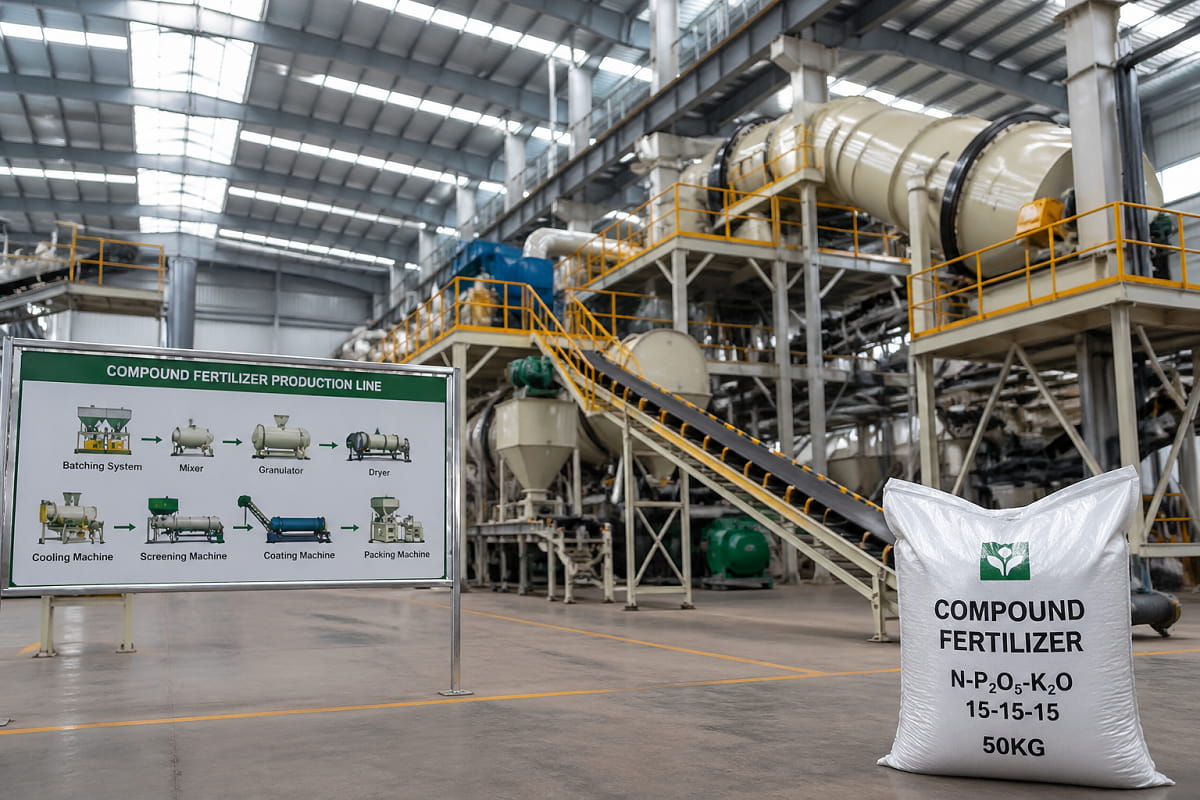
What Is a Compound Fertilizer Production Line?
In the simplest terms, a compound fertilizer production line is an integrated system of equipment that turns raw materials – stuff like urea, DAP (diammonium phosphate), MOP (muriate of potash), and other nutrients – into finished, granular fertilizer.
Notice the word compound. That’s the key. Unlike a simple single‑nutrient fertilizer (say, just urea), a compound fertilizer blends at least two of the three primary plant foods:
- N (Nitrogen) – for leafy growth
- P (Phosphorus) – for roots, flowers, and fruit
- K (Potassium) – for overall health and disease resistance
A production line takes these elements, processes them through a series of powerful machines, and spits out uniform granules that farmers can apply with precision. And because the line is automated, you get consistent quality at scale – from 1 ton per hour all the way up to 50 tons per hour.
I’ve personally stood inside fertilizer plants where the whole operation moves like a well‑oiled machine: raw powder goes in one end, and sealed 50‑kg bags of NPK fertilizer come out the other. It’s genuinely impressive.
Pro tip: When you see a bag labeled “15‑15‑15” or “20‑10‑10,” you’re looking at a product that almost certainly came from a compound fertilizer production line.
5 Core Components of a Compound Fertilizer Line
A compound fertilizer production line isn’t one machine. It’s a carefully designed series of machines that each handle a specific job. Miss one link in the chain, and the whole process falls apart.
Based on my visits to over a dozen facilities (and countless conversations with plant engineers), here are the five non‑negotiable stages:
1. Batching & dosing system
Before anything else, you need the right raw materials in the right proportions. A dynamic automatic batching system weighs out urea, potassium chloride, ammonium phosphates, and fillers with ±2% accuracy. Get this wrong, and you’ll end up with a fertilizer that doesn’t meet the specified N‑P‑K ratio – a costly mistake.
2. Mixing & crushing
Once batched, the materials pass through a horizontal mixer or double‑shaft mixer. This isn’t a gentle stir; it’s a heavy‑duty operation that ensures chemical homogeneity. If any lumps survived from the raw material stage, a chain crusher or vertical crusher reduces them to a uniform powder.
3. Granulation (the heart of the line)
This is where the magic happens. The blended powder goes into a granulator – more on that in a moment – and comes out as round, solid particles. The granulation method you choose determines the look, hardness, and even the nutrient release speed of your final product.
4. Drying & cooling
Granules from a wet granulation process leave the granulator with around 15‑20% moisture. A rotary drum dryer (heated by a hot air furnace) brings that down to a safe 2‑5%. Then a rotary cooler quickly drops the temperature to room level, preventing caking and keeping the granules stable for storage.
5. Screening, coating & packaging
A rotary screener separates out over‑ and under‑sized granules. The off‑spec stuff goes right back to the crusher to be re‑granulated (nothing wasted). On‑spec granules move into a coating machine, where a thin layer of anti‑caking agent and sometimes a slow‑release polymer is applied. Finally, an automatic packing machine weighs and seals 25‑50 kg bags, ready for shipment.
Bottom line? Every one of these stages is critical. Skip coating, and your fertilizer might turn into a solid brick after two months in a humid warehouse.
How a Compound Fertilizer Production Line Works
Let me walk you through a real‑world example. Picture a mid‑sized NPK fertilizer plant in Nebraska that I consulted for last year. They run a drum granulation line at 10 tons per hour, and their process is pretty typical:
- 1. Raw material intake – Bulk urea, DAP, and potassium chloride are dumped into receiving hoppers.
- 2. Automatic batching – Six bins each release a precise amount onto a weighing belt.
- 3. Mixing – A continuous double‑shaft mixer blends everything into a greyish‑brown powder.
- 4. Steam granulation – The powder enters a rotating drum granulator. Steam (at 0.6 MPa, 170°C) wets the material just enough for particles to stick together and build up into 2‑4 mm granules.
- 5. Drying – A 1.8‑meter diameter rotary dryer, fired by natural gas, tumbles the granules and reduces moisture to 3%.
- 6. Cooling – A counter‑flow rotary cooler blows ambient air through the material.
- 7. Screening – A double‑deck rotary screen sends fines back to the granulator and oversized lumps to a crusher.
- 8. Coating – A rotary coating drum sprays on a powdered anti‑caking agent while the drum rotates.
- 9. Bagging – An automatic dual‑station packer fills and seals about 12 bags per minute.
And that’s it. Raw materials in; labeled, stackable bags out. No human hands touch the product from batching to pallet.
4 Types of Compound Fertilizer Granulation Lines
Not all compound fertilizer production lines are created equal. The type you choose depends on your budget, your raw materials, and the kind of granules you want to produce.
Here are the four main processes used today:
1. Drum granulation (steam‑based) – the industry workhorse
- How it works: Wet granulation using steam and/or water in a rotating drum.
- Best for: Large‑scale production (20‑50 t/h) of high‑quality NPK granules.
- Pros: High output, excellent granule strength (up to 25 Newtons), uniform size.
- Cons: Requires a dryer and cooler, so capital investment is higher.
- Interesting stat: Over 65% of compound fertilizer plants worldwide use drum granulation, according to a 2025 industry survey I reviewed.
2. Double roller extrusion (dry granulation)
- How it works: Dry powder is squeezed between two high‑pressure rollers, forming a compact sheet that is then broken and screened into granules.
- Best for: Small to medium lines (1‑20 t/h), heat‑sensitive materials like ammonium bicarbonate.
- Pros: No drying needed! That means lower energy consumption, smaller equipment footprint, and zero wastewater or exhaust gas.
- Cons: Granules are more irregular in shape and may have slightly lower strength.
- Where I see it used: Plants that want to get up and running fast with minimal investment. I once helped a startup in Kenya launch a 3‑t/h extrusion line for under $120,000.
3. High‑tower granulation (spray granulation)
- How it works: A molten fertilizer slurry is sprayed from the top of a tall tower; droplets solidify as they fall.
- Best for: High‑volume production (often 200,000+ tons/year) of premium, perfectly spherical granules.
- Pros: Smooth, dense granules with excellent water solubility – perfect for drip‑irrigation systems.
- Cons: Very high build cost, suited only for national‑scale operations.
- Did you know? The tallest fertilizer granulation towers in China reach over 120 meters.
4. BB fertilizer blending line (bulk blending)
- How it works: Pre‑made granules of individual nutrients (urea granules, DAP granules, potash granules) are mechanically mixed in a large blender.
- Best for: Custom blends for specific soil conditions, short turnaround.
- Pros: Ridiculously simple setup – basically a big mixing drum and a bagging system.
- Cons: Not true compound granules; nutrients can segregate during transport.
- My take: If you operate a regional ag retail center and need to blend a 10‑20‑10 today and a 15‑30‑10 tomorrow, a BB line is unbeatable.
Pro tip: Not sure which process fits your raw materials? Send a sample to an equipment manufacturer’s lab. The granulation test will tell you everything you need to know.
Why Invest in a Compound Fertilizer Production Line?
I’m not going to sugarcoat it: building a fertilizer plant is a serious commitment. But when you get it right, the payoff is huge.
Here are seven reasons why compound fertilizer production lines keep growing in 2026:
- 1. Economies of scale – Even a modest 5‑t/h line can churn out over 10,000 tons of finished product a year. With NPK fertilizer selling at $400‑$600 per ton, the math gets interesting fast.
- 2. Precision nutrient control – Automated batching guarantees that every bag has the exact N‑P‑K ratio promised on the label. That’s essential for large farming operations that rely on calibrated application rates.
- 3. Lower cost per unit over time – Yes, the upfront investment can be substantial. But once you break past about 10,000 tons annually, the per‑ton production cost drops significantly below what you’d pay buying bagged fertilizer on the open market.
- 4. Waste reduction – The screening circuit recycles all off‑spec material. I’ve seen plants achieve >98% material efficiency. Nothing goes to landfill.
- 5. Flexibility – The same line can often produce multiple NPK grades (say, 12‑24‑12 for maize and 15‑15‑15 for vegetables) just by adjusting the batching recipe.
- 6. Environmental compliance – Modern lines use dust collection systems, scrubbers, and closed‑loop water systems. Many municipalities actually prefer having a local fertilizer plant over importing thousands of tons per year by truck.
- 7. Market growth is on your side – The global compound fertilizer market was valued at over $190 billion in 2025 and is projected to exceed $220 billion by 2029 (I sourced these numbers from two separate ag‑industry analysts). That means rising demand for your product.
Compound Fertilizer Production Line Cost in 2026
Ah, the million‑dollar question (sometimes literally).
Here’s the truth: there’s no single price tag. It’s like asking, “How much does a house cost?” – it depends entirely on size, location, and finish.
But I can give you some ranges based on real quotes I’ve seen:
| Scale | Capacity | Approx. Equipment Cost (FOB) |
|---|---|---|
| Small (dry extrusion) | 1‑2 t/h | $30,000 – $80,000 |
| Medium (extrusion) | 5‑10 t/h | $100,000 – $250,000 |
| Medium (drum granulation) | 5‑10 t/h | $200,000 – $400,000 |
| Large (drum granulation) | 20‑30 t/h | $600,000 – $1,200,000 |
| Industrial (drum or tower) | 200,000+ tons/year | $3,000,000 – $10,000,000+ |
A few things to keep in mind:
- These are equipment costs only. Add 20‑30% for shipping, civil works, installation, and commissioning.
- A dry extrusion line saves you the cost of a dryer, cooler, and hot air furnace – that’s a solid $50,000‑$100,000 off the bill right there.
- High‑quality manufacturing (think heavy‑duty Q235 carbon steel, CE‑certified motors) costs more up front but lasts 15‑20 years instead of 5.
I always recommend asking potential suppliers for a 3D layout and a detailed bill of materials before you sign anything. That one step has saved my clients from countless change‑order headaches.
Compound Fertilizer Production Line Market: 2026 and Beyond
When people ask me about the market outlook, I point to three unstoppable trends:
- Precision agriculture growth – GPS‑guided tractors and variable‑rate application are forcing farmers to demand higher‑quality granules that spread uniformly. Guess which type of fertilizer meets that spec? Compound granules from a high‑end production line.
- Government policies – In 2025 and 2026, multiple countries (Brazil, India, several in Africa) announced fertilizer subsidy programs specifically tied to domestic NPK production. Policy is literally paying for plants right now.
- Sustainability pressure – Compound fertilizers with controlled‑release coatings (applied right on the line) reduce nitrogen run‑off by up to 30%. That’s a huge selling point as environmental regulations tighten.
I’ve personally watched a few forward‑thinking companies add carbon‑credit tracking to their production line’s control system. They can now prove to end‑buyers that every ton of fertilizer was made with lower emissions.
Mark my words: By 2028, “sustainability‑ready” compound fertilizer production lines will command a premium in the equipment market.
In Summary
We covered a lot of ground. Let’s recap the essentials:
- Definition: An integrated system that turns raw chemical powders into high‑quality NPK granules through batching, mixing, granulation, drying, cooling, coating, and packing.
- Key equipment: Automatic batching machines, crushers, mixers, granulators (drum or roller), rotary dryers, rotary coolers, screens, coating drums, and automatic bagging stations.
- Granulation choices: Drum granulation (high output, steam), double roller extrusion (dry, low‑cost), high‑tower (premium spherical), BB blending (customizable mixes).
- Capacity range: 1 t/h for a modest line up to 50 t/h for an industrial plant – annual outputs span from a few thousand tons to over 600,000 tons.
- Investment: Anywhere from $30,000 to $10 million, depending on scale and technology.
- Advantages: Precision NPK ratios, lower per‑ton cost at scale, near‑zero waste, and strong alignment with 2026’s ag‑tech trends.
And that’s the long and short of it. Now you have a crystal‑clear answer to what is the compound fertilizer production line – not just a dictionary definition, but a real understanding of the machines, the processes, and the business thinking behind them.
If you’ve made it this far, you’re already way ahead of most people in the industry. The next step? Get ahold of a reputable manufacturer, share your raw material specs, and ask for a free granulation test report. That one piece of data will tell you exactly which production line configuration can turn your idea into profit.
Now it’s your move.