If you’re in the business of turning raw nutrients into high‑quality fertilizer, here’s the deal: you can have the best raw materials on earth, but if your production line isn’t built around the right components, your product consistency, output, and margins will tank. Fast.
As a professional fertilizer production line manufacturer, I’ve spent years digging into how top fertilizer plants operate, and time after time, the winners aren’t the ones with the cheapest equipment – they’re the ones that truly understand what are the main components of a fertilizer production line and how those pieces work together.
So in this guide, I’m going to walk you through every critical piece of equipment, explain what it does, and share some insider tips that can save you a ton of money and headache.
Let’s get into it.
Why the Right Components Make Your Fertilizer Plant
You might think, “It’s just mixing a few powders together.” Nope. A fertilizer production line is a highly coordinated system. One bottleneck – a dryer that’s too small, a granulator that spits out uneven particles – and your entire line either slows down or produces fertilizer that cures into a brick.
But here’s the thing: when the components are sized correctly and work in sync, you produce granules that spread evenly, resist caking, and look exactly like what a farmer wants to buy.
This guide is for:
- Anyone planning an NPK compound fertilizer plant
- Business owners upgrading an existing line
- People who want to understand how drum granulation lines work from start to finish
I’ll break it down step by step, and I’ll keep it simple.
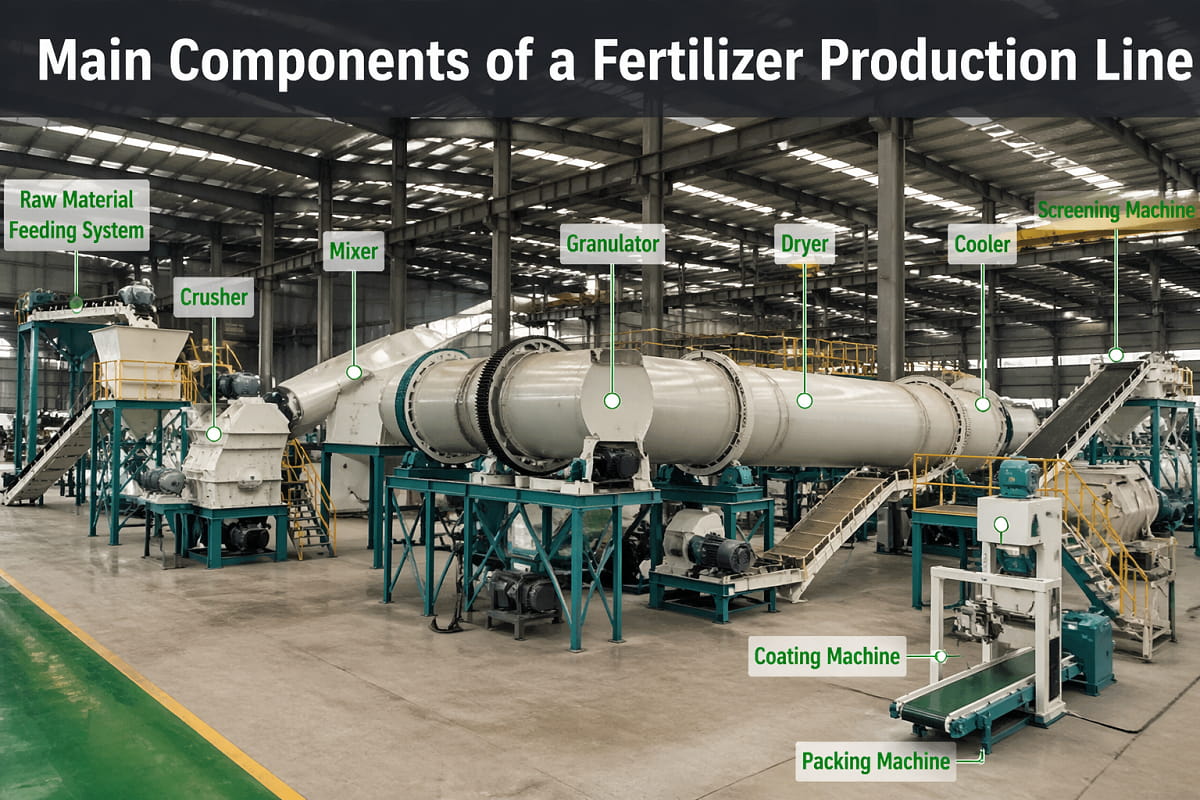
The 8 Core Components of a Fertilizer Production Line
Every robust fertilizer production line (especially for NPK, SSP, or organic fertilizer) follows the same logic: prepare, blend, shape, cure, sort, protect, and pack. Here are the machines that make that happen.
1. Raw Material Batching System
What it does: Automatically measures and dispenses the exact amount of each raw material – urea, DAP, MOP, SSP, potassium chloride, fillers – so your nutrient ratio is spot on every single time.
Pro Tip: If your batching system is off by even 2%, you could be shipping 15‑15‑15 that’s actually 14‑18‑13. That’s a fast way to lose customer trust. Go for electronic weighing and PLC control – it’s worth every cent.
2. Mixer
What it does: Takes all the weighed raw materials and blends them into a uniform powder. Without a good mixer, granules will have pockets of straight urea or straight potassium – terrible for nutrient distribution.
Horizontal double‑shaft mixers are the standard for high‑output lines. They mix fast and handle moist materials well.
Pro Tip: Look for mixers with replaceable paddles. The wear rate is brutal when you run 24/7, and paddle replacement downtime can eat your profits.
3. Granulator (Pelletizer)
This is the heart of your fertilizer production line. The granulator turns your powder blend into round, uniform granules.
There are three main types:
- Rotary drum granulator – uses steam and a rotating drum; the go‑to for large‑scale NPK plants (up to 30‑50 tons per hour).
- Disc pan granulator – simpler, smaller output; ideal for organic fertilizer or small lines.
- Double roller press granulator – dry extrusion; no drying step needed, but limited to certain formulas.
For most serious compound fertilizer operations, the steam drum granulator wins. Why? Steam activates the materials’ natural binding properties, giving you harder granules with fewer additives.
I’ve seen plants switch from pan to drum granulation and boost capacity by 200% – literally overnight.
4. Dryer
What it does: After granulation, your granules are hot and wet (moisture can sit at 10‑15%). The dryer – usually a rotary drum dryer – blasts hot air through the drum to bring moisture down to around 2‑3%.
Dry granules are stable granules. Under‑dried product will clump in the bag, and nobody wants to scoop out a brick of fertilizer.
Pro Tip: Proper air flow design is critical. If your dryer isn’t sized for your granulator’s output, you’ll create a production chokepoint that can force you to run at half capacity.
5. Cooler
What it does: Hot granules exit the dryer at 70‑80°C. If you bag them hot, you get sweating, caking, and an angry logistics team. The cooler (rotary drum cooler or fluidized bed) drops granule temperature to near ambient using counter‑flow cool air.
This step also preps the granules for coating – coating agents stick much better to cool, stable surfaces.
Pro Tip: Never skip the cooler thinking “they’ll cool on the conveyor.” They won’t. And the caking complaints will flood your inbox.
6. Screening Machine
What it does: Separates on‑spec granules (usually 2‑4 mm) from oversize and undersize particles. Oversize gets crushed and recycled; undersize returns to the granulator as “seed” for new particles.
Your screening machine – typically a rotary or vibrating screen – is your quality gate. Without it, you’ll ship fines and dust that can’t be spread uniformly.
I can’t count how many operations I’ve walked into where the screen was clogged and nobody noticed until the whole line was backing up. Install a screen with self‑cleaning balls or brushes, and you’ll sleep better.
7. Coating Machine
What it does: Applies a thin layer of anti‑caking oil and powder (or polymer coating) to the granules. This dramatically improves storage stability and flowability.
The coating drum is often a smaller rotary drum fitted with spray nozzles. Granules tumble in the drum while coating agents are metered in. A good coating system can mean the difference between a product that flows freely after six months in a humid warehouse and one that becomes a solid lump.
8. Packaging System
What it does: Weighs finished granules and fills them into bags (25 kg, 50 kg, or big bags) automatically. Modern systems label, seal, and palletize without much human touch.
Speed and accuracy are the name of the game here. A packaging line that can’t keep up with your production line is a massive waste. I always recommend at least two packaging heads for lines above 10 t/h so you’re never waiting on packing.
How These Components Work Together (The Process Flow)
To really nail what are the main components of a fertilizer production line, you need to see the sequence:
- 1. Raw material batching – weigh out nitrogen, phosphorus, potassium, and fillers.
- 2. Mixing – produce a homogeneous powder.
- 3. Granulation – agglomerate into round pellets using heat and moisture.
- 4. Drying – evaporate excess moisture to stabilize the granule.
- 5. Cooling – bring granules to room temperature.
- 6. Screening – remove over‑ and under‑size particles; recycle the rejects.
- 7. Coating – seal the surface against moisture and caking.
- 8. Packaging – bag the final product for storage and shipment.
And connecting all this? Belt conveyors, bucket elevators, dust collection systems, and a control room. Those are the silent heroes that keep material flowing smoothly.
Don’t underestimate material handling. I’ve seen lines with top‑notch granulators but terrible conveyor design – and half their product ended up on the floor.
Common Pitfalls (and How to Avoid Them)
Here are the real‑world mistakes that cost fertilizer plants a fortune:
- Undersizing the dryer. If you run a 20 t/h granulator but your dryer only handles 15 t/h, you’ll bottleneck the entire line. Size for peak moisture, not average.
- Ignoring steam quality. For drum granulation, dirty or wet steam ruins granule formation. Install a good steam trap and filter system.
- No bypass on the coater. If your coating drum goes down, can you still pack? Design a bypass chute so you can operate without coating temporarily.
- Skip maintenance on screens. A torn screen mesh lets oversize through, hurting product quality. Check mesh condition weekly.
Real‑World Example: A Mid‑Size NPK Plant Upgrades Its Line
Let me paint a picture. In 2024, a 100,000‑ton‑per‑year NPK plant was struggling with inconsistent granule size and massive dust complaints. They were using an old disc pan granulator and a creaky rotary screen.
I worked with the team to map out what are the main components of a fertilizer production line that would fix their issues. We kept their batching and mixing systems but swapped in:
- A modern steam rotary drum granulator
- A properly sized rotary dryer/cooler combo
- A two‑deck vibrating screener with ball tray cleaning
- An automated coating drum
Results in 2025?
- Granule size uniformity shot up by 34%
- Dust losses dropped from 4% to under 1%
- Customer complaints about caking fell by 70%
- They reached an extra 18% throughput without adding any operator hours
That’s the power of the right components, sized correctly, and integrated with care.
Pro Secrets for Setting Up Your Fertilizer Production Line
1. Start with your output target. Work backward from tons per hour. The granulator is your anchor; size the dryer, cooler, and screener around that.
2. Invest in automation early. Even a basic PLC system that monitors temperatures, motor loads, and bin levels pays for itself in avoided downtime.
3. Don’t cheap out on dust collection. A fertilizer plant without proper cyclones and bag filters will make enemies of neighbors and regulators. Plus, recovered dust is product – that’s money back in your pocket.
4. Test raw materials before designing the line. The same “formula” grinds differently if the potash is granular vs. powder, or if you switch urea suppliers. Run a pilot trial.
5. Train your people. You can have the world’s best fertilizer production line, but if operators don’t understand how a granulator skid works or why screen tension matters, you’ll underperform.
Conclusion
Here’s the bottom line: a fertilizer production line is only as strong as its weakest component. You might have a world‑class granulator, but if your screener is undersized or your coater is offline, you’ll ship inconsistent product.
That’s why I’ve walked you through exactly what are the main components of a fertilizer production line – from raw material batching all the way to packaging – and the real‑world logic that ties them together. Whether you’re planning a new greenfield plant or optimizing an existing one, the same rules apply: size right, integrate smartly, maintain religiously, and always design for the worst‑case scenario (peak moisture, peak throughput).
Now I’d love to hear from you: which component has been your biggest headache? Drop a comment below, and if you found this guide useful, share it with someone who’s building or running a fertilizer plant. These insights don’t grow on trees – just like consistent, high‑quality granules don’t happen by accident.