Ever wondered what happens to all that animal manure and agricultural waste? You know, the stuff that piles up behind farms and causes that… distinct odor?
That “waste” is actually liquid gold for farmers. But only if you process it correctly. And that’s exactly where an organic fertilizer production line comes into play.
In this complete guide, as a professional organic fertilizer production line manufacturer, I’m going to break down exactly what this equipment does, how it works, and—most importantly—whether investing in one makes sense for your operation in 2026.
Let’s dive in.
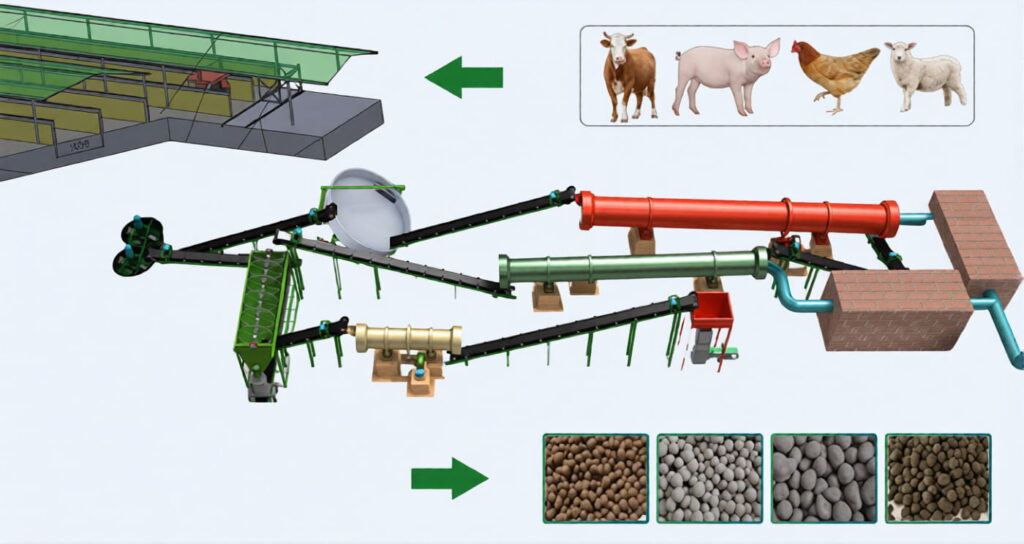
What Is an Organic Fertilizer Production Line?
An organic fertilizer production line is a group of machines that takes organic waste—chicken manure, crop straw, food processing scraps—and turns it into clean, safe fertilizer
Think of it as a recycling plant for your farm’s waste.
Only here, you’re not making recycled plastic or paper. You’re making something that actually helps your soil and bumps up crop yields.
Pretty cool, right?
Why Should You Care About Organic Fertilizer Production?
Let me hit you with some numbers:
Recent ag data points to the global organic fertilizer market hitting about $15.2 billion by 2026. Here’s the reason. Farmers are starting to see that chemical fertilizers work fast, sure, but over time they wreck soil health.
I’ve seen it up close. Worked with a farmer in Iowa who ran synthetic fertilizers for 15 years. Yields stalled. Soil turned to dust. Every season he paid more money just to get the same results. Right.
Then he started adding organic fertilizer to his operation.
Within two seasons, his soil structure improved. His water retention increased. And his yields? They jumped 22%.
The bottom line? Organic fertilizer works. And an organic fertilizer production line lets you make it yourself.
How Does an Organic Fertilizer Production Line Actually Work?
Alright, let’s get into the nitty-gritty. I’m going to walk you through each stage of the process.
Stage 1: Raw Material Collection and Preparation
First things first: you need stuff to turn into fertilizer.
The beauty of an organic fertilizer production line is that it can handle TONS of different materials:
- Animal manure (chicken, cow, pig, sheep—you name it)
- Agricultural waste (straw, crop residues, soybean meal)
- Food processing byproducts (sugar dregs, vinegar lees, cassava residue)
- Urban sludge (yes, even sewage sludge can be processed)
Here’s a pro tip: If your materials are heavy on moisture, like fresh manure, run them through a solid-liquid separator first. Extra water gets pulled out, and the whole process runs smoother.
Stage 2: Fermentation (The Magic Happens Here)
This is where the real transformation occurs.
You see, raw manure straight from the barn is actually terrible for plants. It contains pathogens, weed seeds, and ammonia that can burn your crops.
But when you compost it properly? All those problems disappear.
An organic fertilizer production line uses compost turners built for speed. Instead of waiting three to six months for things to break down naturally, fermentation wraps up in about 15 to 20 days.
The machine mixes air into the pile, keeps temps in the sweet spot around 60–70°C, and breaks everything down evenly.
Personally, I like groove-type compost turners for mid to large setups. They work fast, don’t quit, and need very little hands-on work.
Stage 3: Crushing and Mixing
Once the material is fully fermented, you break it down into even pieces. Short step. Important one.
A fertilizer crusher smashes those composted clumps into fine powder, which matters because even particle size makes granulation work better later on.
Then comes the mixer.
Here’s the thing. Plain compost works fine. But if you’re aiming for premium organic fertilizer, adding targeted nutrients or amendments usually makes sense.
Maybe the soil needs more potassium. Or you toss in helpful microorganisms for a bio-organic mix.
The mixer ensures everything gets blended evenly. No hot spots. No uneven nutrient distribution.
Stage 4: Granulation (Optional But Recommended)
Now we’re getting to the good stuff.
You can certainly sell powdered organic fertilizer. But let me tell you—granular fertilizer is where the real money is.
Why?
- Easier to store (no caking or clumping)
- Easier to apply (works with standard spreaders)
- Slow-release nutrients (better for plants)
- Higher perceived value (customers pay more)
An organic fertilizer granulator transforms your powder into uniform pellets. There are several types, but my personal favorite for organic materials is the new patent organic fertilizer granulator. It’s specifically designed for organic matter and achieves a granulation rate of 95%+.
Stage 5: Drying and Cooling
Fresh granules are warm and moist. Not ideal for storage.
A rotary drum dryer reduces moisture content to around 10-15%. Then a cooling machine brings the temperature down to ambient levels.
Skipping this step? Big mistake. Without proper drying, your fertilizer will turn into a moldy, clumpy mess within weeks.
Stage 6: Screening and Grading
Nobody wants fertilizer that’s half dust and half boulders.
A screening machine separates your granules by size. The perfect ones get packaged. The oversize gets crushed again. The undersize gets recycled back into the granulator.
Zero waste. Maximum efficiency.
Stage 7: Packaging
The final step: getting your product into bags.
Modern packaging machines can handle 5kg, 15kg, 25kg, or 50kg bags—whatever your market demands. And with automatic bagging scales, one person can package tons of fertilizer per hour.
Types of Organic Fertilizer Production Lines
Not all systems are created equal. Based on my experience working with fertilizer manufacturers around the world, here’s how they break down:
Small-Scale Systems (1-3 tons/hour)
Perfect for:
- Farm cooperatives
- Small agricultural businesses
- Beginners testing the waters
Investment range: $100,000-$300,000
These setups are compact and pretty easy to run. You can fit one into about 2,000 square feet and start turning out good fertilizer in just a few weeks.
Medium-Scale Systems (5-15 tons/hour)
Suited for:
- Regional fertilizer producers
- Large farming operations
- Growing businesses
Investment range: $500,000-$1.2 million
At this scale, you’re talking full automation and much higher output. A 10‑ton‑per‑hour setup can turn out roughly 50,000 tons a year, enough to serve a large customer base.
Large-Scale Systems (20+ tons/hour)
Designed for:
- Commercial manufacturers
- Large waste management facilities
- Major agricultural cooperatives
Investment range: $2 million+
These large-scale setups run fully automated and can handle just about any organic material. Think nonstop, 24/7 operation, very little labor, and output pushed to the max.
Real Results: What Can You Expect?
Let me share some actual data from operations using an organic fertilizer production line.
Case Study: Poultry Farm Cooperative (Midwest USA)
Setup: 5 ton/hour granular organic fertilizer line processing chicken manure
Investment: $850,000
Results after 18 months:
- Processing 25,000 tons of manure annually
- Eliminated $180,000/year in waste disposal costs
- New revenue: $1.2 million from fertilizer sales
- Local farmers reporting 15-20% yield increases
The cooperative’s president told me: “We used to PAY to get rid of this stuff. Now it’s our most profitable product line.”
Case Study: Agricultural Waste Processor (Netherlands)
Setup: 15 ton/hour complete organic fertilizer production line
Investment: €2.1 million
Results after 2 years:
- Processing 80,000 tons of crop residues and food waste
- Producing premium organic fertilizer pellets
- Exporting to 12 countries
- ROI achieved in 26 months
Key Considerations Before Buying
Look, I’m not going to sugarcoat this: investing in an organic fertilizer production line is a BIG decision. Here’s what you need to think about:
1. Raw Material Supply
Do you have consistent access to organic waste? And I mean CONSISTENT. If your material supply dries up for three months, your equipment sits idle. And idle equipment doesn’t make money.
2. Market Demand
Who’s going to buy your fertilizer? Local farmers? Garden centers? Export markets?
I recommend securing at least a few committed buyers BEFORE you pull the trigger on equipment. Nothing validates a business model like actual purchase orders.
3. Space Requirements
A complete organic fertilizer production line needs room. We’re talking:
- Covered space for equipment (2,000-10,000 sq ft depending on capacity)
- Raw material storage area
- Finished product warehouse
- Vehicle access for loading/unloading
4. Regulatory Compliance
Organic fertilizer production is regulated in most countries. You’ll need to understand:
- Permitting requirements
- Environmental regulations
- Product certification standards (if you want to sell “certified organic”)
5. Technical Support
Who’s going to fix your equipment when it breaks down?
Make sure your supplier offers:
- Installation supervision
- Operator training
- Spare parts availability
- Ongoing technical support
Common Questions About Organic Fertilizer Production Lines
How long does setup take?
Typically 2-4 months from order to production, depending on equipment availability and site preparation.
What’s the profit margin?
I’ve seen gross margins range from 30-50% for commodity organic fertilizer to 60-70%+ for specialty blends.
Can I produce different formulations?
Absolutely. By adjusting the mixing stage, you can create custom blends for different crops or soil conditions.
What about odor?
A well-designed system with proper fermentation controls actually ELIMINATES odor. The composting process breaks down the compounds that cause smells.
Is an Organic Fertilizer Production Line Right for You?
Here’s my honest take:
If you have access to organic waste materials AND a market for fertilizer, investing in an organic fertilizer production line is one of the smartest moves you can make in 2026.
You’re solving a waste problem. You’re creating a valuable product. And you’re contributing to sustainable agriculture.
That’s a triple win.
But if you don’t have reliable material supply or clear market demand? Pump the brakes. Start smaller. Maybe just a composting operation. Build your customer base. Then scale up.
The Bottom Line
An organic fertilizer production line turns waste into value. It’s proven gear farmers and business owners worldwide use to flip environmental headaches into real income.
Whether you’re running a small 1‑ton‑per‑hour setup or a big 20‑ton‑per‑hour plant, the basics don’t change: solid fermentation, full processing, and quality checks at every step.
Organic fertilizer demand keeps climbing. People want food grown the right way. Farmers are finally seeing that healthy soil equals healthy profits.
Got piles of manure or farm waste sitting around? Maybe stop calling it a problem and start calling it a chance.
What’s an organic fertilizer production line? It’s how you turn organic waste into black gold.
Have questions about setting up your own organic fertilizer production line? Drop them in the comments below. I read every single one.